
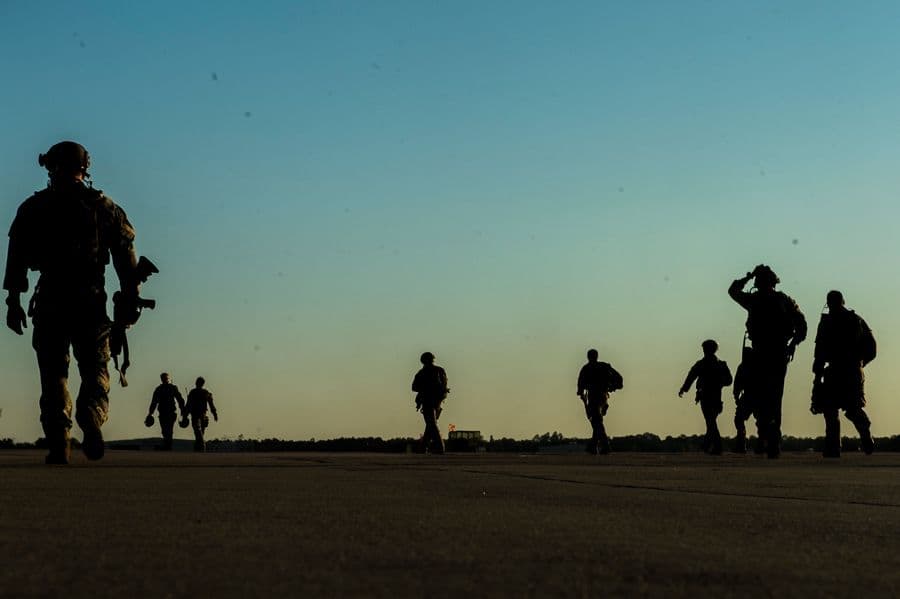
Special Operations Forces for the Decisive Decade
Last updated 07:47 PM EDT • Read time: 5m
In his recent remarks hailing the congressional bipartisan agreement on the national security supplemental appropriations, President Biden noted, "our nation stands at an inflection point — an inflection point in history — where the decisions we make now are going to determine the course of our future for decades to come. This is one of those moments.” Our principal adversaries and competitors, China, Russia, North Korea, and Iran, continue to contest the rules-based international order through direct and indirect confrontation, disruption, and malign influence. The employment of emergent and disruptive technologies, such as artificial intelligence and uncrewed systems, has fundamentally altered the modern battlefield and provides highly cost-effective means of challenging traditional military power. At the same time, terrorist groups continue to threaten U.S. citizens at home and abroad.
Within this new and rapidly evolving security environment, our Nation’s special operations forces (SOF) provide extraordinary value in strengthening international partnerships, responding to crises, deterring conflict, and setting conditions for the United States to prevail in a potential conflict. Last month, U.S. Special Operations Command and the Global SOF Foundation hosted our annual SOF Week for 2024 that brought together military, interagency, industry and international partners and highlighted the critical role of U.S. and international SOF in addressing these complex security challenges. The event brought together over 21,000 participants from across 80 countries to discuss key operational and technological challenges for SOF in this changing strategic environment, as we are increasingly called upon to operate in remote, austere, and contested environments.
One of U.S. SOF’s core strengths is our ability to build and cultivate a global network of generational relationships through low-cost, small-footprint deployments. Since the Second World War, our specially selected and trained forces have worked shoulder-to-shoulder alongside allies and partners to understand strategic challenges, develop stronger partnerships, maintain stability, counter disinformation and other malign influence, and deter aggression. On a given day, U.S. SOF are deployed to more than 85 countries, conducting operations, training, and joint exercises, and when combined with our partners, U.S. SOF’s reach extends to nearly every corner of the globe.
U.S. SOF’s ability to operate globally and in small teams provides a cost-effective means to build partner capacity, enhance interoperability, and gain valuable insights in advance of crisis or conflict. For example, since 1994, U.S. SOF have supported multinational training efforts with Ukraine that have proved critical to Ukraine’s remarkable resilience in resisting Russia’s illegal and unprovoked invasion. SOF training of Ukrainian Forces in air defense, robotics, unmanned systems integration, information operations, and the integration of artificial intelligence into operations, have been critical in Ukraine’s current operations. U.S. SOF continue to engage with regional European SOF partners in support of integrated deterrence. We continue to learn and adapt from Ukraine’s experience on the battlefield, while deepening relationships with partners who face threats from hostile powers.
U.S. SOF have long been the DoD pathfinder in developing and fielding technological advancements with immediate operational impacts through rapid prototyping, testing, and experimentation in real-world environments. Many of these advancements have been adopted by the Joint Force. In recent years, we have reviewed modernization priorities to operate in increasingly contested and denied environments in support of the U.S. Joint Force. Focused on providing U.S. SOF’s unique perspectives and capabilities in all domains, we are modernizing our surface and subsurface maritime capabilities; counter-unmanned systems; next-generation intelligence, surveillance, and reconnaissance; command and control; and collaborative and autonomous systems.
U.S. SOF also continue to lead through care for our most valuable resource — our people. Humans truly are more important than hardware and will continue to be even in an age where artificial intelligence, as well as all technology is rapidly advancing. Anchoring in this First SOF Truth, we continue to invest in the assessment, selection, and training that generates the most advanced fighting force in the world. U.S. SOF’s unique Preservation of the Force and Family program has set the standard in providing a holistic approach to optimizing readiness and resiliency across the force and families. In partnership with industry and academia, we continue to develop innovative approaches across the range of physical, behavioral, cognitive, familial/social, and spiritual domains necessary to ensure our forces and their families are optimally prepared to take on the challenges of an increasingly complex global environment. We are particularly focused on our pathfinding efforts to strengthening brain health, including preventing and treating traumatic brain injury as well as the effects of blast over pressure and exposure.
Representing only slightly more than 1.5 percent of the DoD budget, U.S. SOF provide the Nation an extraordinary value in addressing complex, global challenges. SOF’s unique capabilities create dilemmas for our competitors, empower our allies and partners to resist coercion, disrupt terrorist networks, respond at the first sign of global crises, and enable the Joint Force to prevail in conflict. As on display throughout SOF Week 2024, the teamwork among our military, interagency, international, academic, and industry partners — all working together — remains essential to securing shared interests and collective objectives in an increasingly complex world.
Christopher P. Maier is the Assistant Secretary of Defense for Special Operations and Low-Intensity Conflict. Among his responsibilities are all special operations, irregular warfare, counterterrorism, and information operations policy issues and the oversight of special operations peculiar administrative matters, on behalf of the Secretary.
General Bryan P. Fenton is a career Special Forces (Green Beret) Officer. He currently serves as the 13th Commander of the U.S. Special Operations Command (USSOCOM), located at MacDill Air Force Base, FL.
The views expressed in this article are the authors own and not the Department of Defense.

Reflecting on an Epic Horse Campaign in the Mountains of Afghanistan
By Brian Glyn Williams • RealClearDefense
The Godfather of American Foreign Policy Realism Speaks to Today’s World
By Francis P. Sempa • RealClearDefense
In Pursuit of Nuclear Abolition
By Peter Huessy • RealClearDefense
Innovation Alone Won’t Prepare the U.S. for the Future Battlefield
By Joshua Segal • RealClearDefense
The sUAS Tactical Trifecta
By Bryan T. Woody • RealClearDefense
Navy Civilianizes Six Former Flag Billets, Reduces Six to Captains
By Mongilio, USNI N.
Raytheon's $8B Contract for Strategic Comms Terminal Modernization
By M+A El
America’s Maritime Moment Will Not Wait
By CDR Salamander
Armor Up?
By Marine Corps Compass Points
Who Shoots Down the Drone Over the Shipyard?
By John Ferrari & Dillon Prochnicki • RealClearDefense