
Seapower: An American Imperative
Last updated 06:07 AM EDT • Read time: 4m
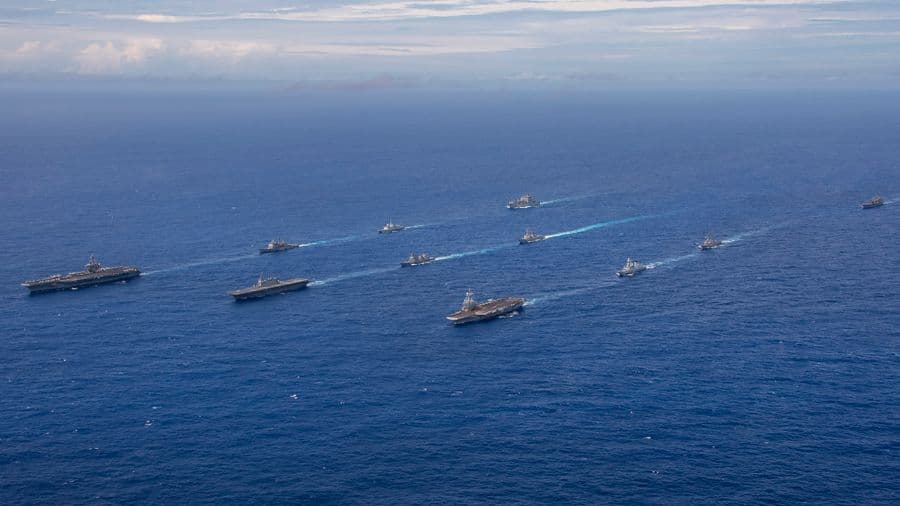
American seapower is in dire straits, especially compared to the U.S.'s primary peer rival, the People's Republic of China. In December of last year, the U.S. Navy was able to field just 296 battle force ships, while its current shipbuilding plan would shrink the size of the fleet even lower over the next two years, reaching 283 ships in 2027. Meanwhile, the Merchant Marine is made up of an aging fleet of just 185 flagged merchant vessels, which the U.S. relies on to facilitate its global trade during peacetime and which the military would depend on to transport fuel, weapons, and other supplies in the event of conflict. By contrast, the PRC possesses the largest navy in the world with over 370 ships, along more than 5,500 merchant vessels, and a shipbuilding capacity estimated to be 230 times that of the United States. Attention by both Congress and the executive branch is needed to reverse the decline of American seapower.
The top priority should be ensuring adequate funding for the military Sea Services, Merchant Marine, and civilian offices focused on maritime security. This will require more than just greater funding for these agencies, but careful investment in essential areas. In pursuit of this, Congress should create a "Maritime Security Initiative," designed as a cross-departmental budget display measure, providing a clear picture of maritime security spending across the government.
The concept of a "budget display" is not new, but the Maritime Security Initiative would make such a display more effective. The Pacific Deterrence Initiative was also designed as a budget display for Congress. It allows the Department of Defense to highlight how various investments by the military services are being oriented towards deterrence efforts in the Indo-Pacific. However, PDI's budget display status was born out of a compromise. Its architects originally intended it to provide its own separate set of funding for the Defense Department, like its European predecessor. Various analysts today have rightfully argued that PDI has not produced substantial new investments in Indo-Pacific deterrence, in large part because it does not provide any new funding for the Department of Defense.
Still, the idea of a "budget display" as a means of helping Congress to track spending and identify where additional investments are needed has merit. However, rather than merely highlighting funding by a single department, a budget display should highlight funding across multiple departments and agencies. A Maritime Security Initiative would therefore allow Congress to understand how cross-governmental efforts are being directed towards enhancing the U.S.'s maritime security. This in turn would enable them to better spend money in priority areas and consolidate resources towards a unified maritime security strategy.
The second step to revitalizing the U.S.'s maritime strength is to elevate the status of maritime security efforts within the executive branch of government. To that end, Congress should create a Maritime Security Council, housed within the Executive Office of the President of the United States, focused on advising the president on the full range of maritime security issues impacting America. Just as the Homeland Security Act of 2002 codified the Homeland Security Council (initially authorized by Executive Order 13228), Congress could codify a Maritime Security Council into law, with a status equal to that of both the National and Homeland Security Councils.
It was recently announced that a new office will be stood up under the National Security Council focused on shipbuilding. This office could serve as a foundation for the eventual creation of an MSC. The MSC would be chaired by the president and made up of the vice president, and secretaries of state, defense commerce, transportation, homeland security, and other officials as deemed necessary. The secretary of the Navy would also regularly be invited to MSC meetings, while the chief of naval operations, commandant of the Marine Corps, and commandant of the Coast Guard would serve as the MSC's military advisors.
Maritime security is an American imperative. Revitalizing the U.S.'s maritime strength will depend on Congress's ability to allocate money towards needed areas across the U.S. government, along with a higher level of executive attention on maritime security issues.
Luke Widenhouse is a research assistant at the Yorktown Institute and senior at St. John's College in Annapolis, MD.
Washington Cannot Ignore Afghanistan’s Weapons Legacy
By Saima Afzal • RealClearDefense
Moral Injury at One O'Clock
By Jeff Hood • RealClearDefense
The Mirror-Life Trap: When Deterrence Must Prevent Invention
By Lawrence J. Kaiser • RealClearDefense
The Pentagon’s AI Agents Could Complete the Mission and Still Leak Secrets
By Burak Oktenli • RealClearDefense
A Passage to the Middle East: India as a Mediator and Security Partner
By Irina Tsukerman • RealClearDefense

U.S. Intel Confirms This Is China’s Secret Spaceplane
By Joseph Trevithick, The WarZone
Navy Sees 10-year High For Class A Aviation, Afloat Mishaps
By H. Mongilio, USNI News
U.S. Navy To Install AI Vessel Detection System on Five Destroyers
By The Defense Post
U.S. Navy’s CHAOS Program
By Dylan Malyasov, Defence Blog
Two U.S. Navy Carriers Ready to Operate New MQ-25A Tankers
By Global Defense News