
Why Europe Cannot Defend Itself
Last updated 02:45 AM EDT • Read time: 16m
A continent that no longer respects its own civilization cannot assimilate newcomers or defend its borders.
Europe’s deepest crisis is not simply found at its borders, but in the way Europe has learned to see itself. A civilization that distrusts its own history, symbols, and identity eventually loses the confidence necessary to assimilate newcomers, enforce its laws, and defend its frontiers.
Uncontrolled immigration and the fragmentation that follows are symptoms of a deeper loss of national self-respect. For decades, European ruling classes have treated inclusion as an ideological imperative and multiculturalism as a substitute for demographic and cultural continuity, assuming that rights alone could create a sense of belonging and that bureaucracy could hold together increasingly divided societies.
But assimilation requires a human element: a sense of belonging to the nation, and therefore a society confident enough in itself to transmit its own identity. When historical consciousness turns into permanent self-accusation, borders, symbols, continuity, and common culture themselves become objects of suspicion. A society that believes its culture, its past, and its identity are no longer worthy of being defended cannot expect newcomers to adopt or respect its way of life.
The question, therefore, is not simply how many people enter Europe, but whether states still possess the will to absorb them into an existing political community. Immigration becomes destabilizing when governments regulate flows and distribute rights without demanding assimilation.
Integration also has its limits. Beyond a certain threshold, schools, housing, welfare systems, security institutions, and cultural structures lose their capacity to absorb new populations. The result is fragmentation: parallel communities, competing loyalties, crime, and enclaves increasingly detached from the national whole.
Assimilation requires authority. Newcomers must enter a shared civic and national tradition and accept that some inherited customs and loyalties must give way to the laws, history, and character of the society they have entered. The same applies to religious communities.
A state unwilling to impose these conditions does not assimilate. It merely manages coexistence until the host society itself reaches a point of saturation and risks collapse.
Along this fault line, two currents begin to converge: concrete violence and institutional representation.
The first emerges in the cities. Where unassimilated groups do not recognize the norms, memory, or authority of the host nation, crime ceases to appear merely as individual deviance. It becomes the symptom of a deeper separation. Assaults, intimidation, informal control of neighborhoods, and the daily defiance of public order reveal distinct social bodies occupying the same national space.
The second current runs through the institutions. Associations, intermediaries, religious networks, and identity-based parties transform separation into representation. They do not necessarily act against the law. They inhabit it. They use its language, funding, advisory councils, and anti-discrimination mechanisms to influence decision-makers and give political form to a separate identity.
The critical point is reached when the two dynamics converge. Violence is reframed as psychological distress, responsibility is dispersed into the surrounding context, and the native population’s reaction is converted into moral guilt. The non-native is explained. The native is accused. The former remains an individual to be understood; the latter becomes a group to be monitored.
The nation is thus subjected to a double pressure. From below comes the violence of those who do not feel part of its destiny. From above comes a political and media discourse that prevents it from naming that violence. In between, the state retreats. It does not assimilate, it does not punish, but neither does it protect.
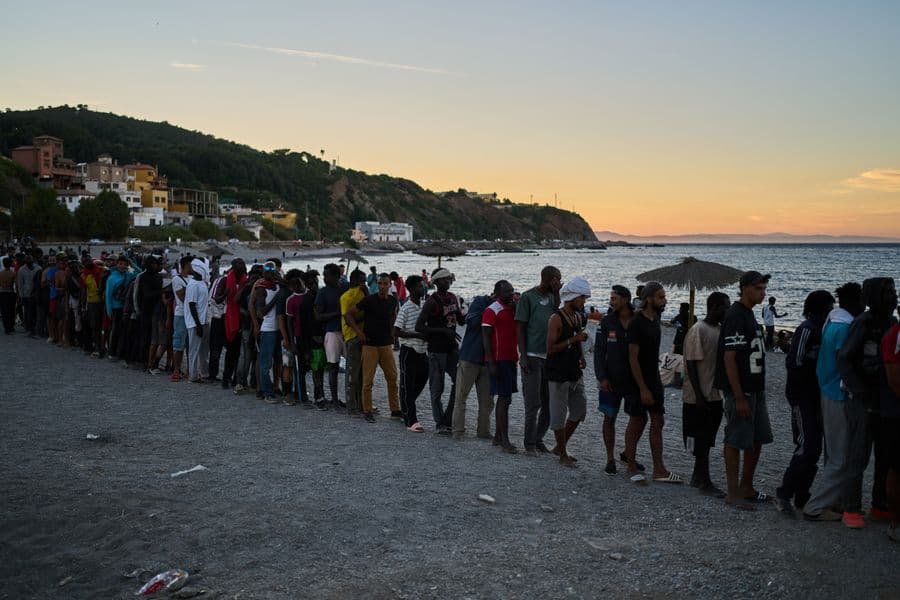
The events recently witnessed in Spain offer the clearest contemporary illustration of this retreat. On the eve of Throne Day, Morocco’s King Mohammed VI granted pardons or sentence reductions to 1,788 people. According to assessments by Spanish intelligence, however, Rabat tacitly enabled the influx by relaxing border controls and subsequently exploited it as a means of exerting pressure on Madrid. In the hours that followed, tens of thousands of people – largely young men of fighting age – crossed into Ceuta, causing unrest, setting vehicles on fire and, as documented footage appears to show, attempting to force their way into residents’ homes. Spanish authorities estimated that approximately 50,000 people crossed the border, compelling Madrid to deploy military and police reinforcements.
Ceuta is not a remote African outpost, but Spanish and European territory. Together with Melilla, it constitutes the European Union’s only land border with Africa and represents Europe’s first line of defense on the southern shore of the Strait. Losing control of it would therefore mean far more than facing a migration crisis: it would demonstrate that a European defensive position can be overrun through mass pressure.
Spain’s migration policy has also produced strategic consequences. The extraordinary regularization promoted by the Sánchez government for approximately half a million illegal immigrants has fueled the expectation that illegal entry and violations of the rules may subsequently be regularized. The Meloni government was among the few in Europe to recognize the broader implications of the crisis, temporarily reinstating controls on non-EU citizens arriving from Spain and tightening security along the Franco-Italian border. But this is still not enough. Deterrence exists only when declarations are backed by a concrete ability to impose costs. In Morocco’s case, that means adding real economic and diplomatic pressure, but above all making the use of military force in support of the Spanish border credible should Rabat once again use migration flows as an instrument of pressure.
Moreover, as long as migration policy remains subordinated to ideology, abstract moral principles, and the conformism of European elites more concerned with appearances than with defending their territory and citizens, Europe will struggle to respond with the necessary seriousness and resolve, including, when indispensable, through the deployment of military forces and other coercive measures.
What is now visible at Europe’s external frontier has long been unfolding within its major states. In Germany, approximately 890,000 people entered the country in 2015 alone, exceeding the state’s immediate capacity to control, distribute, and assimilate them. Cologne made visible what the policy of reception had concealed. Hundreds of women were assaulted by groups composed largely of North African and Middle Eastern men; the police were overwhelmed, and the authorities hesitated even to name the origin of the violence. This was not merely a failure of public order. It was political inhibition.
Since then, the numbers have deepened the wound. In 2024, more than 85,000 foreign nationals appeared in Germany’s violent-crime statistics. The most revealing figure concerns people from the Maghreb countries: although they represented only 0.5 percent of the foreign population in that category, they accounted for 9.1 percent of the suspects. A minimal demographic presence therefore corresponded to a criminal incidence far greater than its numerical weight.
The Bundesamt für Verfassungsschutz, Germany’s domestic intelligence service, has recently warned of the persistent Islamist threat, citing the attacks in Mannheim, Solingen, Munich, and Berlin. In its 2024 report, it estimated that more than 28,000 individuals belonged to the Islamist milieu, almost 10,000 of whom were oriented toward violence. In the background stand the Muslim Brotherhood and its networks. Not only terrorist attacks, but gradual penetration: political contacts, social relationships, and entry into the institutional nerve centers.
Germany’s inability to assimilate also stems from its shame toward itself. In Hamburg, supporters of the national team were attacked by masked assailants and called “Nazis.” In 2016, the Green Youth of Rhineland-Palatinate urged people to lower their flags, elevating national self-shame into a source of pride.
When a society teaches that loving its own form is suspect, it surrenders its symbols to its adversaries. The memory of Nazism, from a necessary form of historical consciousness, becomes a permanent prohibition against national identity.
In France as well, immigrant violence increasingly tends to merge with the use of institutions against the state that hosts them. Louis, seventeen years old, was beaten to death by a group of immigrants. Not an isolated case, but a fragment of a broader sequence. A sign of a public space over which the state exercises ever less control.
The French trajectory cannot be separated from uncontrolled mass immigration. For decades, Paris allowed the entry and concentration of communities that it subsequently proved unable to assimilate.
In the voids left by failed assimilation, family networks, religious codes, neighborhoods, and forms of belonging have taken root – often running parallel to national continuity rather than being integrated into it.
It is here that entrisme takes hold. Originally, it was a political tactic: entering a party, a trade union, or an association in order to alter its orientation from within. French Trotskyists made use of it as early as the 1930s and 1950s, openly or clandestinely. Not a frontal assault. A slow penetration.
Today, the term is extended to a different process. Groups bearing codes alien to the republican canon take root in the social fabric, organize, make demands, and exert influence.
The report Frères musulmans et islamisme politique en France, published by the Ministry of the Interior in 2025, provided evidence of this second dynamic. Islamist entrisme runs through associations, schools, religious and charitable networks, municipalities, and political parties. It operates through the gradual occupation of the interstices left unguarded by the state. Where the street produces disorder, legalistic action transforms a foreign presence into influence; violence is allowed to spread openly, while legal organization translates it into representation.
This is where the decisive effect is produced: a tacit convergence of interests, silences, and affiliations is enough. Different communities, informal networks, religious structures, militant groups, and local representatives end up moving in the same direction, or at the very least refrain from obstructing one another. The state thus loses its grip on its own territory, hesitates to name what it cannot contain, and ultimately justifies what it is no longer able – or willing – to govern.
In England, the non-scandal of the grooming gangs – plainly visible, yet kept out of sight by eyes occupied elsewhere – shows how long a system can choose not to see in order to avoid damaging the image it has constructed of itself.
The Casey Report documented that, in numerous cities, very young white British girls were, for years, effectively handed over to criminal networks composed of men of Pakistani origin, often belonging to Muslim communities. Police forces, local authorities, and social services retreated before the ethnic and cultural factor, as though naming it were more dangerous than the crime itself. The protection of the narrative thus came to prevail over the protection of the victims.
In Italy as well, the issue unfolds across several levels: the street, associations, political parties, and schools. There is no need to imagine a hidden command structure. Profound transformations rarely obey a single direction. Apparently unrelated elements converge, echo one another, and ultimately compose the same picture.
In Modena, a city in Emilia-Romagna, a region of north-central Italy, a man of Moroccan descent behind the wheel suddenly turns his car into a battering ram against a crowd. In his past emerge hostile messages, threats, and invective against Christians. Yet the episode is quickly reduced by the usual media to the reassuring language of individual pathology.
Farther north, the messages of a young foreign national contain the vocabulary of religious war, hatred of unbelievers, and the promise to strike Italians in the heart of their homes. Words that seem to belong to ideological abstraction, until elsewhere those threats become reality: a door forced open by a foreigner, a woman assaulted, violence entering the domestic sphere.
Then comes politics. On television talk shows, meanwhile, an aging figure of the Left – still faithful to the name of an idea that ceased decades ago to correspond to itself – defends the attempt to attract the vote of an organized immigrant community. When confronted with the failure of that effort, he replies that voters will eventually learn to digest it. Electoral calculation thus meets multiculturalist dogma. A part of the Left, having lost the social classes it once represented, is searching for new electoral blocs. Identity-based networks, for their part, seek access, recognition, and representation. They identify openings within the institutional nerve centers of the state and use its procedures, freedoms, and weaknesses to increase their influence.
Each believes it is using the other. It is a dangerous game for those handling forces they barely understand. Convinced that they are incorporating them, they will ultimately find themselves trapped by them.
On the same terrain, the associative dimension also emerges. In Operation “Domino”, nine people were arrested by DIGOS – Italy’s General Investigations and Special Operations Division – and the Guardia di Finanza, Italy’s financial police, on charges of belonging to or financing Hamas through organizations ostensibly dedicated to solidarity with the Palestinian people.
Those under investigation include a prominent leader of Palestinian associations in Italy and the director of a pro-Palestinian publication, accused of complicity in a terrorist organization because of her propaganda activities and her relations with the principal suspect.
According to investigators, the network allegedly raised funds through charitable organizations based in Genoa, with branches in Milan. More than 71 percent of the money, formally intended for civilians in Gaza, was allegedly diverted to Hamas, its military wing, and support for the families of terrorists or individuals imprisoned for terrorism. The principal leader and his organization had already been placed on United States sanctions lists.
Then comes the school – and Emilia once again. Hundreds of children are led into a narrative of the conflicts in the Middle East, already arranged according to a precise political grammar. Beside a symbolic figure of Palestinian journalism appears an individual involved in the same investigation. At the end, according to reports, a chant of “Free Palestine” rises from the audience. Minds still being formed. Pages not yet written. Entrusted too soon to a ritual already composed by others.
The degree of entropy has now reached its maximum in many European nations, approaching the threshold of civil war. Tension is widespread, daily, and restrained: contested neighborhoods, frightened citizens, separate communities, a weak state. Here, the social compact between citizens, the justice system, and law enforcement also begins to break down. Citizens obey because they expect protection, but when the justice system fails to protect them, the police are left alone, and the government retreats, obedience loses its meaning. Above all this, socialist ideology imposes itself through the owners of certain media outlets that are increasingly detached from reality.
Across European nations, immigration has often been presented as a remedy for falling birth rates, an aging population, and collapsing fertility. But demographic decline has been bypassed rather than confronted.
Instead of rebuilding the family, birth rates, transmission, and continuity; instead of developing a counter-narrative or a cultural revolution capable of resisting the hedonistic individualism that has dissolved social bonds, many ruling classes have chosen the easier path: importing population. An accounting solution to a civilizational problem.
It was believed that increasing the numbers would be enough to replace a shared sentiment. But a population imported without assimilation does not automatically become a nation. It fills the demographic void, not the historical one. It inhabits the territory without entering into the collective destiny.
It is within this vacuum that the threat changes form. Terrorism is no longer the principal tactic of conquest. The evolution of the threat points toward a subtler form of penetration, capable of using the very architecture of democracy and the Western narrative against the West itself: a more insidious, less visible method, and therefore all the more effective.
Crime, disorder, and the advance of communities increasingly willing to resort to violence in order to impose themselves are not the disease. They are its symptoms. The affliction lies deeper: it is the Western populations’ loss of love for themselves, a feeling that, pushed beyond self-criticism, has turned into a rejection of their own form and almost into self-hatred.
Their own history is viewed first and foremost as guilt. Western culture has become difficult to recognize because post-historical indoctrination has progressively distanced society from reality. People no longer know how to name what constitutes the foundation of a community. Every element of belonging is turned into an object of suspicion: roots, culture, language, education, the body, the family, the nation.
This reversal also produces a systematic inversion of guilt. It often seems as though reality were being deliberately distorted against the native population, the ordinary citizen, often white, whose family has belonged to the community for generations, while those who break the rules are more readily explained through poverty, marginalization, or the real or supposed war from which they are said to have fled.
None of this needs to occur in a fully conscious manner. It is enough for the social environment to have been educated to believe in certain premises: that the immigrant is first and foremost a victim; that the native majority is first and foremost guilty because of its past; that the responsibility of the former must always be explained, while that of the latter must always be aggravated.
Ideology does not need to declare itself openly. It is a semi-invisible power: it does not always assume a concrete form, but its consequences are entirely concrete. It acts like a spirit produced by Europe itself, born from its demons, its unresolved guilt, and its inability to distinguish self-criticism from dissolution.
From this comes the atrophy of strategic vision. When the threat appears on European soil or acts against European interests, it is not recognized for what it is, because the categories needed to interpret it no longer exist. Europe no longer sees danger because it has forgotten how to think of itself as something worthy of defense.
The Old World must decide whether it still wishes to perpetuate itself. The vacuum left by a nation that no longer transmits itself is occupied by communities that are more cohesive, more hierarchical, and less hesitant to name what they are. Not because they are invincible, but because they encounter societies that have ceased to love themselves, and therefore to defend themselves.
The laws of physics do not tolerate a vacuum. Neither does history. Where one civilization abandons its canon, others introduce their own. Reversing the trend is possible, but it requires an awakening. The sunset of the West has already passed the golden hour. It is night. The light of morning is not promised. It belongs to those who survive until dawn.
Riccardo Ficicchia is an intelligence analyst at an Italian investigative agency and a research associate at the Yorktown Institute.
image: Migrants who crossed from Morocco into Spain line up for food distribution on a beach in the Spanish enclave of Ceuta, Monday, Aug. 3, 2026. (AP Photo/Bernat Armangue)

In Pursuit of Nuclear Abolition
By Peter Huessy • RealClearDefense
Innovation Alone Won’t Prepare the U.S. for the Future Battlefield
By Joshua Segal • RealClearDefense
The sUAS Tactical Trifecta
By Bryan T. Woody • RealClearDefense
The Revolutionary War: When Strategic Options Share the Same Weakness
By Henry Yep • RealClearDefense
The Houthis Are Testing the Limits of Collective Defense
By Saima Afzal • RealClearDefense

Who Shoots Down the Drone Over the Shipyard?
By John Ferrari & Dillon Prochnicki • RealClearDefense
Northrop Grumman Breaks Out the Big Guns at AUSA
By Daniel Terrill, Defense News
Army Pursuing Diverse Array of New Anti-Air Interceptors
By Trevithick, The WarZoneWho Shoots Down the Drone Over the Shipyard?
By John Ferrari & Dillon Prochnicki, RCD
F-35C Lands for the First Time on a Ford-Class Aircraft Carrier
By The Aviationist