
Target Iran's Supply Lines Without Widening the War
Last updated 10:02 AM EDT • Read time: 6m
The United States can destroy Iranian launchers, warehouses and weapons factories and still fail strategically if Tehran can continue replacing what it loses.
The next phase of American pressure should focus on the logistics system that converts Chinese components, Russian support and Central Asian transit into Iranian missiles, drones and military power. That does not require attacking China, Chinese nationals or infrastructure outside Iran. It requires targeted, precision operations against verified military cargo and dedicated logistics assets after they enter Iranian territory and come under the control of the Islamic Revolutionary Guard Corps or Iran’s defense-industrial network.
Iran’s weapons programs are not self-sufficient. The Treasury Department has repeatedly identified companies in China and Hong Kong involved in procuring components for Iranian missile and drone programs. It has also documented networks transporting hundreds of metric tons of missile-propellant ingredients from China to an entity supporting Iran’s defense industry.
Sanctions have exposed these networks but have not stopped them. Front companies and suppliers disappear and reemerge under new names. Cargo moves through the United Arab Emirates, Central Asia or ordinary maritime trade. Once the material reaches Iran, it enters a domestic transportation network that allows the regime to rebuild capabilities American forces may later have to destroy again.
Washington should stop treating foreign procurement and battlefield operations as separate problems.
A new doctrine should state that verified military cargo, along with dedicated Iranian infrastructure moving or storing it, may be subject to precision operations once it enters Iran. Chinese ports and vessels, their crews and commercial facilities should remain outside the target set, as should infrastructure in transit countries such as Azerbaijan, Kazakhstan and Turkmenistan.
The objective should be to sever Iran’s ability to convert foreign supplies into military power without widening the conflict.
Several underexamined bottlenecks should be central to that strategy. They matter because they force sensitive cargo through a limited number of transfer operations, creating opportunities to identify military shipments, distinguish them from ordinary commerce and trace them to dedicated Iranian facilities.
The first is the unfinished Rasht-Astara rail segment in northern Iran, the missing link in a continuous railway between Iran, Azerbaijan and Russia. Until it is completed, freight moving along the western branch of the International North-South Transport Corridor remains dependent on road movement, cargo transfers and the warehousing and border handling concentrated at Astara.
Operations there should be limited to Iranian-side assets demonstrably controlled by the IRGC, used to store military material or actively supporting military shipments. Civilian traffic, Azerbaijani territory and foreign personnel should remain protected.
Iran’s Caspian logistics system represents another pressure point. The route requires a limited number of suitable vessels, functioning cargo-handling and warehousing capacity, and rail connections inland. Vessel shortages, inefficient port-to-rail links and transshipment constraints already limit the route’s capacity.
The United States should identify Iranian vessels, storage areas and transfer compounds specifically supporting military procurement. When those assets are separated from civilian activity and their military function is established, precision operations could delay Iranian rearmament more effectively than another symbolic strike on an administrative building.
The eastern corridors present a similar opportunity. China-origin freight can reach Iran through Kazakhstan and Turkmenistan, entering through crossings such as Sarakhs and Incheh Borun. These routes face a break between the former Soviet rail gauge and Iran’s standard-gauge network, requiring cargo transfer or rolling-stock conversion.
Those transfer points naturally concentrate freight, documentation and personnel. The relevant military objectives would be segregated IRGC storage and command facilities, dedicated military-transfer operations and defense-industry shipments distinguishable from ordinary trade.
Iran’s internal rail system creates another layer of vulnerability. Significant portions remain single-track or have limited rerouting capacity. Yet attacking long stretches of railway would be strategically inefficient. Tracks can be repaired, civilian disruption would be extensive and road transportation could absorb some displaced traffic.
A more effective approach would trace verified military cargo after it enters Iran and act when it reaches dedicated military sidings, IRGC compounds or weapons-production facilities where civilian activity is limited.
Success should be measured by how long Iran’s military reconstitution is delayed, not by the number of bridges, stations or kilometers of track destroyed.
This doctrine would still require legal discipline. Under U.S. law-of-war doctrine, infrastructure may qualify as a military objective when its nature, location, purpose or use effectively contributes to an enemy’s warfighting or war-sustaining capability and neutralizing it offers a definite military advantage under the circumstances.
That standard does not permit every port, railway or warehouse to be classified as military infrastructure. It permits action only against specific assets whose military role is established through reliable intelligence.
Kinetic pressure, bounded by that discipline, should be paired with a truth-based information campaign exposing the foreign wealth, procurement profits and family privileges of the officials sustaining Iran’s war machine. Washington should also offer credible protection to logistics personnel, defense-industry employees and lower-level officials willing to provide intelligence, refuse unlawful orders or withdraw their support. The objective should be to make regime insiders question whether continued loyalty still protects them.
Iran’s leaders should face a new reality: foreign components may reach the border but never reach the factory; military cargo may enter the country but never reach the battlefield; and the officials responsible for moving it may no longer trust one another or believe the regime can protect them.
Washington does not need to widen the conflict to China to disrupt the China-Iran military relationship. It needs to draw a clear geographic and legal boundary, then act decisively against verified military logistics once they cross into Iran.
Iran’s war machine depends on imported material, concentrated transfer points and a small circle of officials who believe their networks remain safe. American strategy should be designed to prove them wrong.
Colton Overcash is the founder and managing principal of Vertex Strategies and a former presidential appointee at the U.S. Department of Homeland Security. He writes on national security, foreign policy, critical infrastructure and emerging technology, and advises companies and organizations on government strategy and public-sector markets.
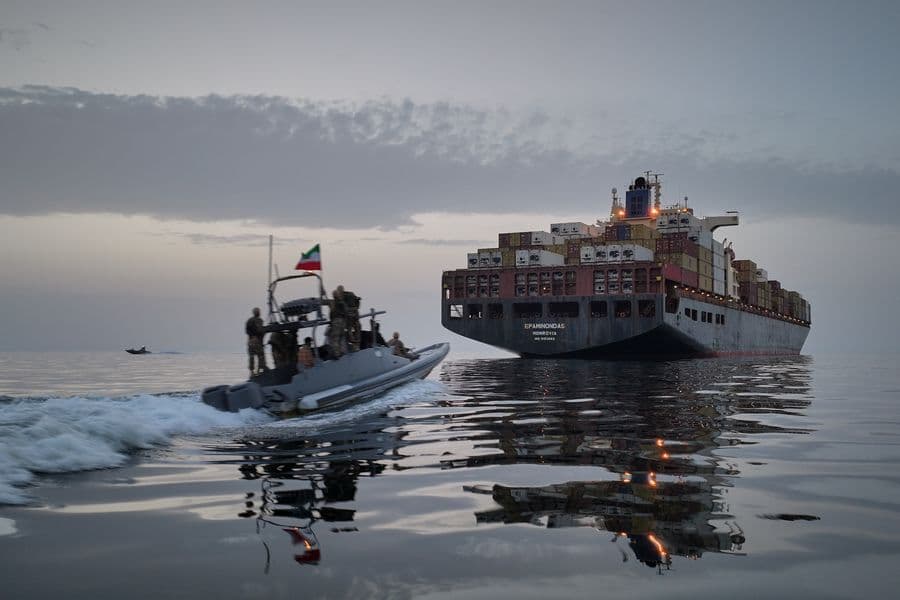
image: In this photo released by Tasnim News Agency, a Revolutionary Guard Navy (IRGC) speedboat approaches the cargo ship Epaminondas during what state media described as the seizure of one of two vessels accused of violations in the Strait of Hormuz, April 21, 2026. (Meysam Mirzadeh/Tasnim News Agency via AP)

Iranian Cyber Operations
By Michael Groen • RealClearDefense
Reflecting on an Epic Horse Campaign in the Mountains of Afghanistan
By Brian Glyn Williams • RealClearDefense
The Godfather of American Foreign Policy Realism Speaks to Today’s World
By Francis P. Sempa • RealClearDefense
In Pursuit of Nuclear Abolition
By Peter Huessy • RealClearDefense
Innovation Alone Won’t Prepare the U.S. for the Future Battlefield
By Joshua Segal • RealClearDefense

26th MEU – U.S. Needs Crisis Response MAGTF
By Marine Corps Compass Points
The Influence of History on a Sea Power
By CDR Salamander
Navy Civilianizes Six Former Flag Billets, Reduces Six to Captains
By Mongilio, USNI N.
Raytheon's $8B Contract for Strategic Comms Terminal Modernization
By M+A El
America’s Maritime Moment Will Not Wait
By CDR Salamander