
Honors
Last updated 03:30 AM EDT • Read time: 7m
He was a WWII fighter pilot. His ashes rested in a polished wooden urn at the front of the little funeral chapel. His life had been full of years, years of success, of joy, of respect, of love of country. A man who had led a Godly, honest life.
The chapel is spare but tasteful, a few rows of polished wooden pews. Suitable for use by any religion or no religion for the last farewell to one who had served his or her country in uniform.
This day it was crowded with people come to say their final goodbyes to this veteran, husband, businessman, father, brother, cousin, uncle, neighbor, friend, philanthropist, civic servant. His beloved wife of more than 60 years sat in the center of the first row, surrounded by family. One person after another came forward at the invitation of the pastor to relate a brief anecdote about the good man who had touched so many lives, painting a rich tapestry of a well-lived life. There were many more who wished to pay tribute, but the clock was ticking.
A flag, folded in the proper triangle, was presented to the widow by an Air Force captain. From somewhere, a recording of taps was played. A volley of shots from an unseen rifle squad outside rang out. It sounded like a live final salute, not a recording, although a percussive shock wave of rifle fire could not be sensed through closed doors and windows.
In the silence that followed, a casually-dressed cemetery employee, a young woman, walked in, picked up the urn and walked out with it. Another employee invited the mourners to the patio outside the chapel, and they obediently filed out into the sunshine.
With the grieving widow, they watched the young woman get on a four-wheeler with the urn and drive down a slope to a spot where two men leaned on shovels. The employee in control of the mourners, having allowed a few respectful minutes, directed them toward the exit to the parking lot.
One of the mourners muttered that it was like seeing someone take out the trash when that woman took the urn from the podium.
When I moved to Western North Carolina, I was drafted for the Honor Guard at my new Legion post. The team was busy, rendering honors at several funerals a week. They needed an officer, and even better, I was field grade, a lieutenant colonel (retired.) Tradition calls for the folded flag to be presented to the next of kin by a uniformed member of the branch of service and the same or higher rank as the deceased whenever possible.
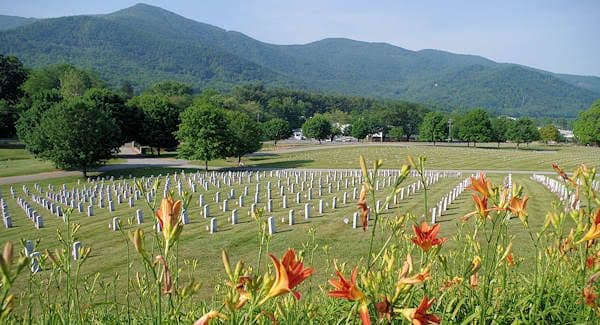
The services in the chapel were solemnly and movingly conducted by a retired Chief Master Sergeant of the U.S. Air Force. But the mourners could not accompany the deceased to the grave site, would not experience the moving ceremony of the traditional military graveside honors ceremony and the closure it offers.
I asked the cemetery director why we didn’t have graveside services. “Prohibited by OSHA,” he snapped. OSHA? What does OSHA have to do with funerals? So I called the Occupational Safety and Health Administration in Washington. “We don’t have anything to do with funerals,” period, full stop, was the response.
So I contacted the office that administers North Carolina State Veterans Cemeteries. The State Veterans Cemetery Program Manager wrote a letter to me, which was considerate of him, saying that, well, “There are many reasons for the procedures we use during burial operations. The ‘OSHA’ reason given to you is just one of the many reasons, but not the primary reason...” In a facile deflection he explained the history of how there came to be three NC veterans cemeteries. And, “We do not conduct or allow graveside services, because we follow the procedures used by the National Cemeteries... This procedure is done at all National Cemeteries. This is the procedure that we use in the conduct of interment services. It is an efficient procedure, and I hope you can understand our reasoning even though you may disagree with our procedure.”
I’m an old soldier. I have attended and participated in many military funerals in national (and civilian) cemeteries, including Arlington. There might be a service in a chapel, but the burial was always with graveside honors. I called Arlington National Cemetery to see if there had been a change in policy. There had not. I was referred to the National Park Service (it administers national cemeteries) Reference Manual 61: National Cemetery Operations. Paragraph 3.6.1 directs that:
National cemeteries provide a dignified burial place and lasting memorial for veterans and their eligible family members. Interments may be conducted at the graveside or an area designated for committal services. The interment process, from the arrival of the funeral party to their departure, should be conducted in a dignified and professional manner with the interment given the highest priority.
The State Veterans Cemetery Program Manager concluded his letter with:
I care about what you think and feel about our cemeteries and I care about the veteran and his family who come to us in their time of need. And it’s not only me, but all of the staff in the veterans cemetery program and those of us who provide services in the NC Division of Veterans Affairs. I hope you take my explanations as just that, explanations and not excuses. Should you like to discuss this matter further, I would be only too glad to meet with you at your convenience. Should you desire to do so, please contact me at 919-733-3851...
Thank you for allowing me to explain our operational procedures regarding this matter.
I did call that number--I was blocked. I tried email again, and it was blocked. Then our Honors team commander told me that he had been ordered by our local cemetery director to get rid of me or the Legion team would not be permitted to perform Honors in the future at his cemetery. Furthermore, while they could not prevent my being buried there, I was not to set [live] foot again on the premises.
It is not good to mess with a bureaucrat’s fiefdom.
A few years later, in a veterans meeting, I had the opportunity to ask this same cemetery director again about graveside services. He told us that graveside services were not permitted because it would be offensive to the mourners to see the backhoe next to the grave.
More years passed, and the director again addressed a veterans meeting in which I was present. I raised my hand and asked if graveside services were permitted. No. Why? “Well, it could be snowing, or raining, or very hot,” he said. “We don’t want our mourners to be uncomfortable.”
Some religious customs require graveside services, I pointed out. Jewish mourners, for example, led by the next of kin, line up to help fill the grave—shovels are provided by the funeral home for the purpose.
“Not in my cemetery,” said the director.
That is the fact. The North Carolina Department of Military and Veteran Affairs prohibits graveside services in its veterans cemeteries:
Graveside services are not permitted. Committal services will be held in the chapel or at a committal shelter on the cemetery grounds. All services are 30 minutes long. Family members and other attendees are required to exit the cemetery when the service ends. Family members may return to the gravesite after the burial of the casket or urn is complete and the area is cleared of all equipment and materials.
Why? It just is. Because they can set their rules. But they are not the rules of national cemeteries. And they do not provide the dignity and honor that the deceased veteran deserves, and the closure his or her mourners need.
Karen McKay is a retired U.S. Army lieutenant colonel. She is a Foreign Area Operations Officer (Middle East/SW Asia), and Airborne, Civil Affairs, and Psyops qualified. Her PhD dissertation at Hebrew University in Jerusalem was on the failure of Allied air forces to bomb Auschwitz and the rail lines transporting Jews to death camps. She was the Executive Director of the Committee for Free Afghanistan, and president of Americans for Freedom, an NGO supporting the Contras, especially on the Atlantic coast of Nicaragua.

In Pursuit of Nuclear Abolition
By Peter Huessy • RealClearDefense
Innovation Alone Won’t Prepare the U.S. for the Future Battlefield
By Joshua Segal • RealClearDefense
The sUAS Tactical Trifecta
By Bryan T. Woody • RealClearDefense
The Revolutionary War: When Strategic Options Share the Same Weakness
By Henry Yep • RealClearDefense
The Houthis Are Testing the Limits of Collective Defense
By Saima Afzal • RealClearDefense

Who Shoots Down the Drone Over the Shipyard?
By John Ferrari & Dillon Prochnicki • RealClearDefense
Northrop Grumman Breaks Out the Big Guns at AUSA
By Daniel Terrill, Defense News
Army Pursuing Diverse Array of New Anti-Air Interceptors
By Trevithick, The WarZoneWho Shoots Down the Drone Over the Shipyard?
By John Ferrari & Dillon Prochnicki, RCD
F-35C Lands for the First Time on a Ford-Class Aircraft Carrier
By The Aviationist