
Lessons on Leadership: Stop Arguing and Start Collaborating
Last updated 05:04 PM EST • Read time: 4m
Next Time, Start With ‘No.’
Imagine you are bargaining for a new car. You have gone back and forth several times with the salesman. Finally, you are ready to make your best offer—the maximum amount of money you intend to spend on the car, a sum you have decided is fair to both parties and reasonable for the quality of the car.
"$20,000," you say, hopeful that this final offer will elicit a 'yes' from the salesman, putting the keys in your hand and ending what has been an uncomfortable experience.
The salesman shrugs his shoulders.
"Is that the best you can do?"
Well, 'no,' you say to yourself, flustered and unsure.
"I suppose I could do better."
Here, the salesman has succeeded in getting you to admit you could offer more for the car—that the deal could be sweeter for him. And yet, that doesn't mean you should quit now and fork over the money, nor does it mean you should let the deal fall apart, backing out for what might be perceived as "showing your hand" to the other side, feeling embarrassed you admitted that "final offer" was not so final after all.
Instead, you should realize your 'no' creates new possibilities for you and new opportunities for the negotiation.
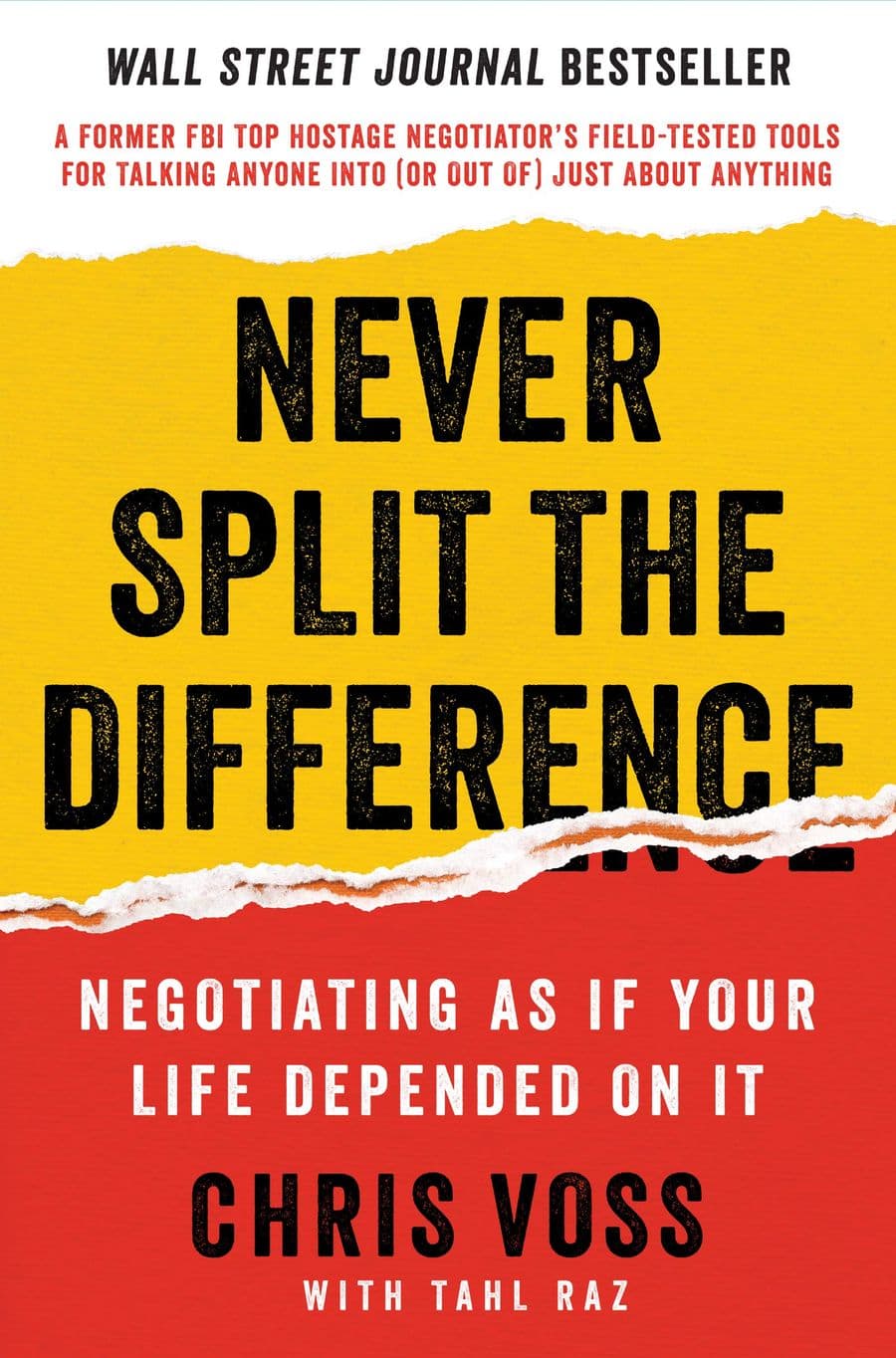
In his book Never Split the Difference: Negotiating as If Your Life Depended on It (Harper Business, 2016), author Chris Voss explains that great negotiators seek 'no' because they recognize how often the real negotiation begins once somebody drops the façade of niceness. "Triggering 'no' peels away the plastic falsehood of 'yes' and gets you to what's really at stake," he writes.
Born and raised in Iowa, Voss joined the FBI after working as a beat cop in Kansas City. In 1992, he entered the FBI's program for hostage negotiation, embarking on a 24-year career with the Bureau's Crisis Negotiation Unit, including five years as the chief international hostage and kidnapping negotiator. By the time he retired in 2007, Voss had worked more than 150 international hostage cases in some of the most chaotic and complex parts of the world.
"I wasn't a genius," he writes in a chapter titled "How to Become the Smartest Person…in Any Room." But he understood how to deal with people.
"Over the years, I had picked up skills, tactics, and a whole approach to human interaction that had not just helped me save lives, as I recognize now looking back, but had also begun to transform my own life. My years of negotiating had infused everything from how I dealt with customer service reps to my parenting style."
Therein lies the theme of Never Split the Difference, a practical book filled with memorable hypothetical scenarios, helpful instructions listed in bullet points, and plenty of reflections from Voss's deep experience applying his craft and teaching it to others. The theme is what he calls 'tactical empathy,' that the art of negotiation begins with a basic premise that people want to be understood and accepted and that being successful in a bargaining situation demands you make the other person, your counter-party, the center of your attention.
Where books like Thinking Fast and Slow or Getting to Yes focus on psychology and abstract concepts—the theory of negotiation—Voss gets down to brass tacks. In chapters titled "how to quickly establish rapport" and "how to gain the permission to persuade," Voss frames each subject area as a problem, placing himself in the readers' shoes before showing the way toward solutions. The goal of this method is straightforward: to provide tools you can use right now, whether negotiating a better salary, selling a product, or even trying to convince an adult child it's time to leave the house. Regardless of the circumstances, this book aims to give you a competitive advantage in your next negotiation, and it delivers.
Let's go back to our example.
So, now that you've admitted $20,000 is not the "best you can do," take Voss's advice: calmly tell the salesman what about this car makes you feel uncomfortable paying more money. Maybe the mileage is higher than you expected, or maybe you noticed a competitor is selling a similar model for a lower price. Whatever the reason, use your 'no' as an opportunity to stop arguing and start collaborating, to undo the tension of 'getting to yes' and, instead, explore all your interests in the deal, seeing which interests have the potential to create more value for you and, hopefully, the salesman, too.
Who knows, applying even a few of Voss's battle-tested techniques might produce results you never thought possible.
Able Magwitch is a U.S. government employee. His views are his own and not representative of the U.S. government or its agencies.

The First Test of Peace Lies in Ukraine's Borderlands
By Dennis T. Cosgrove • RealClearDefense
The VFW’s Gambling Addiction Victimizes Veterans
By Jack Yoest • RealClearDefense
Superintelligence Exposes a Gap in the Law of Delegated Authority
By Sue Ghosh Stricklett • RealClearDefense
When the Network Goes Dark, Who Controls the Battlefield?
By Jonathan K. Corrado • RealClearDefense
We Cannot Build Tomorrow's Weapons With Yesterday's Alloys
By Joseph F. Krause • RealClearDefense
When the Network Goes Dark, Who Controls the Battlefield?
By Jonathan K. Corrado • RealClearDefense
Air Force Should Buy 250 Blended-Wing Tankers, as 2027 Demo Looms
By A&SF Mag.
Long Deployments to Be Navy Standard For Next Couple Years
By Mongilio, USNI NewsWhen the Network Goes Dark, Who Controls the Battlefield?
By Jonathan Corrado, RCD
Marines Deploy Neros Archer Drone in Live Fire Exercise for First Time
By USNI News