
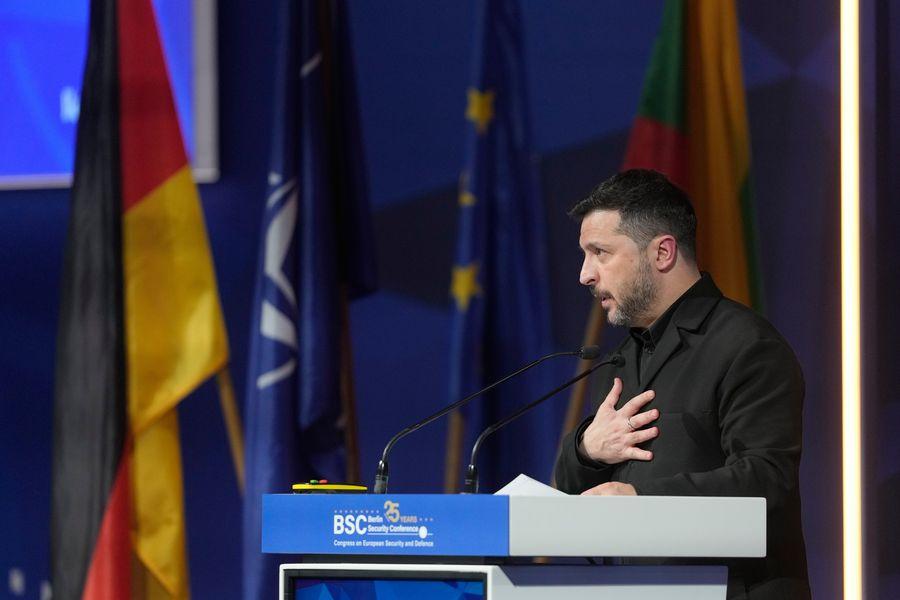
Ukrainian President Volodymyr Zelenskyy delivers his speech at the BSC, Berlin Security Conference, a Congress on European Security and Defence, in Berlin, Germany, Tuesday, Nov. 3, 2026. (AP Photo/Markus Schreiber)
How Seoul’s Break With Kyiv Serves Trump’s Russia Turn
Last updated 12:23 AM EST • Read time: 5m
Join the Conversation
0On Oct. 9, President Donald Trump announced that Russia would supply nearly five million tons of diesel to American and global markets, and the Treasury licensed the trade shortly afterward. The next day he said it was time for Ukraine to get a new president, and demanded that Kyiv stop striking Russian refineries while making no matching demand of Moscow over Ukraine's power grid. On Oct. 16, two days before its tariffs on buyers of Russian energy were due to take effect, he waived the main provisions of the Graham Sanctioning Russia and Iran Act, a law he had signed on Sept. 18.
Seoul, meanwhile, has recalled its ambassador to Ukraine and is withdrawing about half of its embassy staff in Kyiv, although it says its aid to Ukraine will continue. The quarrel began on Sept. 23, when Zelensky told the UN General Assembly that Ukraine had handed two captured North Korean soldiers to Seoul. South Korea says both sides had agreed to keep the transfer secret, and Ukraine denies that any such agreement existed. Seoul did not mean any of this as a favor to Washington. The effect does not depend on intent, because an Asian democracy publicly breaking with Kyiv lowers what Trump pays at home for turning toward Moscow.
The break comes out of Korean politics, where the two soldiers, the only known surviving North Korean prisoners of the war, count as citizens under South Korea's constitution. Officially, the secrecy was meant to protect their families in the North, though it also suited a government that wants to reopen contact with Pyongyang. Once the transfer became public, the opposition People Power Party accused President Lee Jae Myung of hiding it to avoid upsetting Kim Jong Un. If Kyiv's account stands, the secrecy was Seoul's choice alone, which is the opposition's charge; if Kyiv broke a promise, Lee is the injured party. He has every domestic reason to insist on the second version, and the escalation from a demanded apology to a recalled ambassador follows that logic rather than any judgment about Ukraine.
Relations with Washington have soured in parallel, with 55% of South Koreans viewing the United States unfavorably in Pew's spring survey, the first majority in more than two decades of Pew polling, and 85% opposing Trump's tariffs. The survey came before Trump ordered the Pentagon in August to scale back joint exercises, citing Seoul's refusal to help against Iran and his rapport with Kim. It also came before he threatened in October to "double it up" unless Seoul committed more than $50 billion to an Alaska gas project. Yet 84% of South Koreans still name the United States as their most important ally, so the erosion shows up in sentiment and in specific forms of cooperation while alignment holds.
Washington set its course on Russia for its own reasons, with diesel above $6 a gallon a month before the midterms and a president who blames Ukrainian refinery strikes for the price. Bipartisan critics called the waiver a gift to Putin, and their case rests on allied solidarity with Ukraine, because pressuring Kyiv is hard to defend while other democracies stand behind it. European diplomats in Seoul have already begun to say, as the Financial Times reported on Oct. 28, that South Korea is not really like-minded. A Western-aligned Asian democracy publicly accusing Zelensky of breaking his word makes Trump's complaints about him look less isolated, and each such defection, even by a second-tier ally, makes the next concession cheaper.
The waiver also widens Seoul's options, since before Oct. 16 a country that knowingly bought Russian oil risked U.S. tariffs of up to 100% on its exports to the United States. With Russian diesel now trading under a Treasury license that runs to April 2027, the remaining barriers to Korean purchases of Russian crude are Seoul's sanctions policy and its standing with Europe and Ukraine's other backers. The quarrel with Kyiv has already worn down the second of those two barriers.
The cost to Seoul falls on intelligence, where Washington has withheld part of its satellite reporting on North Korea's nuclear and technology programs since early April, after Unification Minister Chung Dong-young publicly named a suspected enrichment site at Kusong. On Oct. 8, the chairman of the Joint Chiefs of Staff told the National Assembly that sharing had still not fully returned to normal. The quarrel with Kyiv now endangers a second source, since the National Intelligence Service itself assesses that North Korea's army gained modern combat tactics and battlefield data in Russia at a cost of about 6,000 casualties. Ukraine fought those units and is the outside party best placed to know what they learned. That same service pledged in January 2025 to work with Ukraine's intelligence services on North Korea's role in the war, and that cooperation depends on goodwill the quarrel is eroding.
Seoul bears the cost of this quarrel while Washington collects the benefit, since Kyiv now faces pressure from two allied capitals instead of one and Washington never had to ask Seoul for its share. Kyiv and its European backers should keep that pattern from spreading to Washington's other Asian partners. Ukraine has the means through Brussels since the EU signed security and defense partnerships with both Japan and South Korea in 2024 and Seoul's diplomats and arms makers need goodwill in Europe. Closing the dispute with Seoul quickly, on terms Lee can present at home as the apology he demanded, would remove the precedent before anyone else in the region is tempted to follow it.
Sang Won Pyo is a research assistant to Dr. Bader Al-Saif, associate fellow at Chatham House. His work has appeared in Cambridge Manara Magazine, the Middle East Institute at the National University of Singapore, and the S. Rajaratnam School of International Studies. He previously served as a legislative assistant in the office of the chairperson of the National Policy Committee and in the offices of members of the Foreign Affairs and Unification Committee of the National Assembly of the Republic of Korea.
Don’t Be Swayed by Tactical Nukes
By Benjamin Giltner • RealClearDefense
How Seoul’s Break With Kyiv Serves Trump’s Russia Turn
By Sang Won Pyo • RealClearDefense
When the Grid Goes Down, the Mission Must Go On. Solar and Storage Can Help.
By John Szoka • RealClearDefense
Data and Communications Technology are the Hidden Keys to Success for Golden Dome
By Eric Velte • RealClearDefense
The Dual Threat: Why Beijing’s Collapse Is Just As Dangerous as Its Rise
By Efraín Vázquez-Vera • RealClearDefense
USS Stout Loses Power During Port Visit Due to ‘Engineering Casualty’
By USNI News
Air Force Lessons Learned From Operation Epic Fury
By Tabitha Reeves, National Defense
Marines Need Nine More Amphibious Warships To Carry Out Its Missions
By TWZ
AFRL, ACC Fly XQ-67A Drone To Test Autonomous Teaming
By Airforce Technology
F-35B Releases Meteor BVRAAM for the First Time
By Parth Satam, The Aviationist