
Winning the AI Race Isn't Enough
Published July 2, 2026 • Read time: 6m
Pope Leo XIV's encyclical Magnifica Humanitas, the first papal document dedicated to artificial intelligence, made a claim Washington has yet to reckon with: technology takes on the character of those who build it. The Intelligence Community's 2026 Annual Threat Assessment makes the same point from the opposite direction, naming China as the most capable AI competitor to the United States and identifying AI as a defining force behind nearly every major threat the country faces.
Most in Washington will treat those two documents as unrelated. They are the same story.
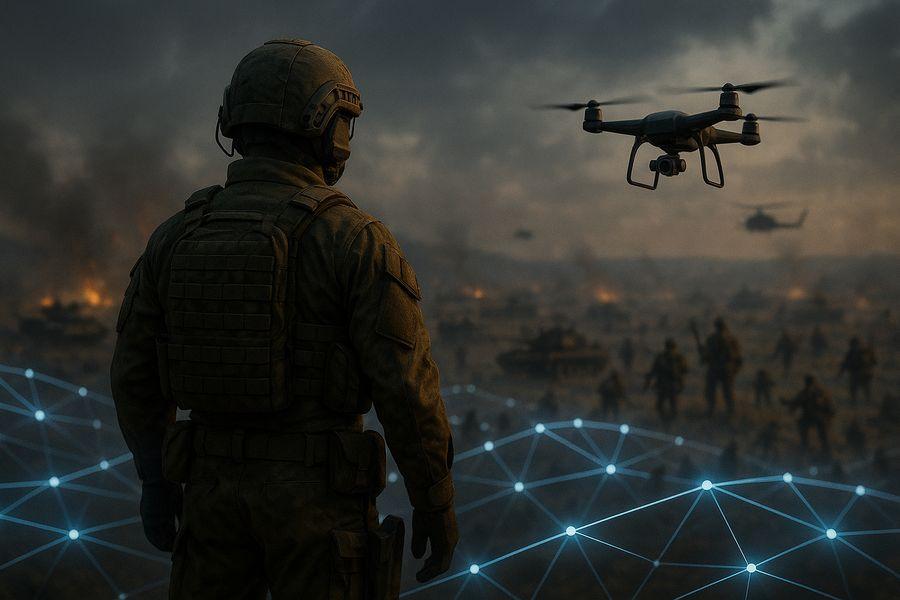
Leo XIV’s central claim is not merely theological. Technology, he writes, takes on the character of those who build it. A system designed to optimize without ethical constraint will do exactly that. In January, as reported by multiple defense analysts, a single People’s Liberation Army soldier operated a formation of 200 autonomous drones—the deliberate removal of human judgment from lethal decisions, at scale, on purpose.
America is racing to answer it. The Department of Defense declared 2026 the year it would raise the bar for military AI dominance, directing every branch to become an AI-first warfighting force. The investment is real, the urgency is vital, and the competitive instinct is right. The doctrine question, what American AI power is actually for, remains unanswered.
China Has a Doctrine. America Only Has Speed.
Beijing’s concept of “intelligentized warfare” has been under active development for nearly a decade. It integrates AI into command, control, intelligence, and strike, with an explicit goal of pushing decision cycles beyond the speed at which humans can meaningfully intervene. As PLA scholars have openly mapped, the progression runs from human-in-the-loop to human-on-the-loop to human-out-of-the-loop. The endpoint is a system that does not need the soldier at all.
The Pentagon's Next Readiness Test Should Begin When the Cloud Goes Dark
The New ‘Cold’ War
America Should Unleash Cyber Privateers
The Pentagon’s AI Agents Could Complete the Mission and Still Leak Secrets
China unveiled an AI-powered electronic warfare platform in 2025 capable of suppressing American radar signals as far away as Guam. It expanded its nuclear arsenal by 20 percent in a single year. It fielded autonomous ground platforms publicly, before the world’s cameras. Beijing has pursued this vision since at least 2017, when Xi Jinping made AI supremacy a stated national priority. Russia is building on the same logic through its own autonomous weapons programs.
Both nations have made a deliberate choice to develop AI unconstrained by the accountability standards that govern American military action. That is the strategy, not a gap in their thinking.
America’s response has been to move faster. A strategy built entirely around deployment velocity has deferred the harder question: not how fast we build, but what we are building toward.
The Premise Washington Is Missing
Magnifica Humanitas insists that human dignity is not acquired or earned, and does not depend on a person’s abilities, productivity, or utility. It precedes all of that. As Leo XIV writes, dignity “is a gift that precedes and transcends each person.”
That is also the premise of the American founding. The Declaration of Independence does not say rights are granted by governments or earned through contribution. It says they are inherent. National security, at its core, exists to protect the conditions under which people can live as human beings, not as assets to be optimized, not as data points in a targeting system, not as acceptable losses in an algorithm’s calculation. The American experiment is only possible because human dignity is treated as the starting point, not a variable.
China’s intelligentized warfare doctrine answers the dignity question differently. A system designed to push human judgment out of lethal decisions has already decided that human beings are bottlenecks. Beijing made that choice deliberately, and it shows in the design. When a PLA scholar writes that the goal is human-out-of-the-loop, he is not describing an engineering preference. He is describing a civilization’s answer to what people are worth.
Allied interoperability depends on trust, and trust depends on accountability. The U.S. cannot build the coalition it needs to compete with China at scale if the AI systems it asks allies to adopt operate without meaningful human oversight and without clear standards for when lethal decisions are made. That friction is already present in alliance conversations about AI-enabled command and control.
Technology takes on the character of those who build it. America’s character—accountability, transparency, rule of law, the inherent dignity of every person—produces better systems. That is the argument Beijing cannot make, and the one Washington has not yet made deliberately.
What the Current Approach Is Missing
The administration's instinct to move fast and remove bureaucratic friction from AI development is defensible. The U.S. cannot cede the speed competition to Beijing. But moving fast is not the same as setting the standard. The nation that defines what accountable AI in warfare looks like will write the rules every other democracy follows. That role is available. America is not currently pursuing it.
The doctrine question, what level of human judgment is required before an AI-enabled system takes lethal action, has not been answered by the current strategy. Deferring it does not make it go away. The answer will eventually be written under pressure, after something goes wrong, in a way that serves no one’s long-term interest.
Three Things Worth Doing
The U.S. needs a published, specific doctrine on human judgment in lethal autonomous systems. Clear redlines, stated publicly and defensible to allies, make American systems auditable and harder for adversaries to manipulate. Vague standards are not standards.
America should build a democratic AI coalition through existing alliance structures, such as NATO, the Quad, and AUKUS, around shared standards for military AI. The goal is to ensure that the systems allies build, and buy are interoperable with American platforms and governed by principles that isolate Beijing’s model. China is not racing alone. America should not be either.
The moral argument for American AI leadership needs to be made explicitly and consistently—that accountability, rule of law, and the inherent worth of every person produce better systems—and treated as doctrine, not afterthought. The free world does not face a choice between speed and principle. That framing is Beijing’s argument, and America keeps conceding it by default.
What We Are Actually Deciding
The U.S. did not prevail in the Cold War by becoming its adversary with better hardware. It prevailed because it could explain, with clarity and conviction, what it was defending and why. That argument fractured alliances, moved populations, and made the other system unsustainable from within. No weapons program accomplished that alone.
The American answer to China’s AI doctrine has to be grounded in the same conviction. A doctrine that says something about what kind of wars America fights, what kind of force it builds, and what kind of world it is trying to preserve. One where human dignity is the premise, not a variable.
Leo XIV framed the choice at the opening of his encyclical: build Babel or build something worth inhabiting. That is the oldest strategic question America has ever faced, appearing again in a new form.
Winning the AI race matters enormously. What America does with the lead, and what it believes about the people it protects, is the question that will define the rest of this century.
Nick Weston is a St. Petersburg, Florida resident, a former congressional staffer, and a national security scholar. He holds a Juris Master in national security from George Mason’s Antonin Scalia Law School.
The Pressure Is the Message: What Xi and Putin Faced in Shenzhen
By Emzari Gelashvili • RealClearDefense
China’s Revised Mobilization Law and the Expanding Reach of National Defense
By Muhammad Shoaib • RealClearDefense
U.S. Putting Weapons in Space: A Strategic Blunder?
By Ajey Lele • RealClearDefense
The Clearance Myth Is a Readiness Problem
By Elijah Fernandez • RealClearDefense
The Pentagon's Next Readiness Test Should Begin When the Cloud Goes Dark
By Colton Overcash • RealClearDefense
U.S. Putting Weapons in Space: A Strategic Blunder?
By Ajey Lele • RealClearDefense
U.S. Senate Seeks to Exchange Shipbuilding Funds for More Munitions
By Naval News
F-35C Completes First Launch and Recovery Trials on a Ford-Class Carrier
By Navy T.
USS George Washington Leaves Mideast As Trump Mulls Ending Iran War
By S&S
ULA’s Latest Launch Failure Spells Trouble for Space Force
By Greg Hadley, A&SF