

U.S. Putting Weapons in Space: A Strategic Blunder?
Published Nov. 20, 2026 • Read time: 6m

In December 2025, President Donald Trump issued Executive Order 14369, titled “Ensuring American Space Superiority.” The order clearly outlines U.S. priorities to secure and defend its national security interests in, from and through space. It calls for the development and prototyping of missile defense capabilities by 2028, countering orbital & cislunar threats and restructuring the national security space architecture. These priorities were further expanded by Under Secretary DiNanno in his remarks at the 9th Prague Space Security Conference in June 2026, where he emphasized the need to develop a wider range of military capabilities in the space domain. Together, these policy statements signaled a more assertive U.S. approach to space security, moving beyond traditional defensive measures. It was in this strategic context that U.S. Air Force Secretary Troy Meink announced on September 15, 2026, that the United States had deployed weapons in space.
Since the establishment of the U.S. Space Force in 2019, the United States has taken several significant steps to strengthen its military capabilities in space. These include increased funding for Space Force programs, the Golden Dome missile defense initiative and increased efforts to develop kinetic and non-kinetic counterspace capabilities. The creation of the Space Force was primarily intended to address existing and emerging threats in the space domain, particularly those posed by China and Russia. While these developments do not, in themselves, confirm an intention to deploy weapons in space, they indicate a broader shift toward preparing for military operations in this domain. The ongoing Russia-Ukraine war and the U.S. clash with Iran may have further reinforced Washington's concerns about potential hostile actions in space and the need to be prepared for them.
In principle, the United States has maintained that it does not favor the weaponization of outer space. Historically, it has supported this position through diplomatic initiatives and international legal commitments, most notably its status as a signatory to the 1967 Outer Space Treaty (OST). It has also strongly condemned China's 2007 anti-satellite (ASAT) test and Russia's 2021 ASAT test. At the same time, its continued commitment to missile defense programs has been a major obstacle to its participation in, and acceptance of, proposals for a legally binding, rules-based ban on space weapons. Through initiatives such as the Artemis Accords, the United States has also sought to establish a parallel framework for space governance that aligns with its economic and strategic interests. Thus, while Washington continues to formally endorse the United Nations (UN) framework, its growing reliance on alternative governance arrangements increasingly sidesteps established UN governed multilateral processes.
Against this backdrop, it is worth examining whether the United States deliberately chose to publicize its deployment of weapons in space as part of a broader strategic signaling exercise or whether this move has further clouded the debate surrounding the weaponization of outer space.
Washington has conveyed to the world, particularly its adversaries, that it possesses advanced military capabilities in space and that any attempt to target its space assets could invite serious consequences. Such a declaration could reinforce America's technological and strategic standing while serving as an attempt to establish credible deterrence in the space domain.
However, the concept of strategic deterrence in the space domain is still evolving and has not yet attained the clarity associated with nuclear deterrence. This raises an important question: Has the United States made a strategic miscalculation by moving toward the deployment of weapons in space without first developing a sufficiently mature conceptual and policy framework for space deterrence?
Nuclear deterrence evolved through historical experience, particularly the devastating consequences of the use of atomic weapons during World War II. Over the decades, the possibility of a nuclear exchange, the threat of retaliation, and the doctrine of Mutually Assured Destruction (MAD) established a relatively clear understanding about the nature of the beast. The central premise was that a nuclear attack would invite devastating retaliation, making the consequences unacceptable for all parties involved. This understanding became the foundation of strategic stability. It could be said that in general, the intent of nuclear deterrence has worked.
The space domain presents a fundamentally different challenge. Unlike nuclear weapons, the effects of counterspace operations may not be immediately visible or attributable. Any attack on satellites could produce cascading consequences for communications, navigation, intelligence and weather forecasting and other critical services invading financial services. These effects may even affect countries that have no direct involvement in hostilities. Moreover, the threshold between military and civilian consequences in space is particularly difficult to distinguish since satellites are mostly dual use in nature. Presently, there is very little understating about the ideas like escalation thresholds and proportional retaliation in space domain.
Thus, deploying weapons in space without first establishing a clear conceptual framework for deterrence could create more uncertainty than stability. The United States should have first prioritized developing a shared understanding of credible space deterrence before announcing the presence of weapons in space.
It would be unrealistic to assume that the U.S. announcement of deploying weapons in space would, by itself, deter countries such as China and Russia. Actually, the U.S. action could provoke Beijing and Moscow to accelerate their own efforts to deploy counterspace capabilities. It is also possible that they may already have covertly deployed certain weapons in space. In that case, Washington's announcement could provide them with an opportunity to acknowledge such deployments publicly and use the U.S. move to legitimize and justify further expansion of their own programs. Thus, instead of establishing deterrence, the U.S. initiative could trigger reciprocal military responses and make space domain more unsafe.
Moreover, developing counterspace capabilities does not necessarily require highly sophisticated expertise in space technology, particularly when such capabilities are ground-based. Direct-ascent anti-satellite (DA-ASAT) missiles, electronic jamming, cyber operations and certain directed-energy weapons offer states different options for targeting or disrupting adversaries' space-based assets. Countries such as Iran and North Korea, which have demonstrated independent satellite-launch capabilities, could potentially develop or acquire some of these technologies. This may encourage countries such as Israel, Japan and South Korea to reassess their thinking about weaponization of space. Today, the changed geopolitical landscape of the space domain is expected to trigger space arms race. Thus, the U.S. approach of establishing space deterrence and deployment of weapons in space could prove counterproductive. Rather than stabilizing the space domain, this move risks accelerating its weaponization and making the possibility of warfare in space more tangible.
Ajey Lele is a Deputy Director General, MP- IDSA, a New Delhi based think-tank and author of book Asian Space Race: Rethoric or Reality.
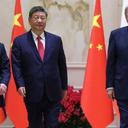
The Pressure Is the Message: What Xi and Putin Faced in Shenzhen
By Emzari Gelashvili • RealClearDefense
China’s Revised Mobilization Law and the Expanding Reach of National Defense
By Muhammad Shoaib • RealClearDefense
U.S. Putting Weapons in Space: A Strategic Blunder?
By Ajey Lele • RealClearDefense
The Clearance Myth Is a Readiness Problem
By Elijah Fernandez • RealClearDefense
The Pentagon's Next Readiness Test Should Begin When the Cloud Goes Dark
By Colton Overcash • RealClearDefense
U.S. Putting Weapons in Space: A Strategic Blunder?
By Ajey Lele • RealClearDefense
U.S. Senate Seeks to Exchange Shipbuilding Funds for More Munitions
By Naval News
F-35C Completes First Launch and Recovery Trials on a Ford-Class Carrier
By Navy T.
USS George Washington Leaves Mideast As Trump Mulls Ending Iran War
By S&S
ULA’s Latest Launch Failure Spells Trouble for Space Force
By Greg Hadley, A&SF