
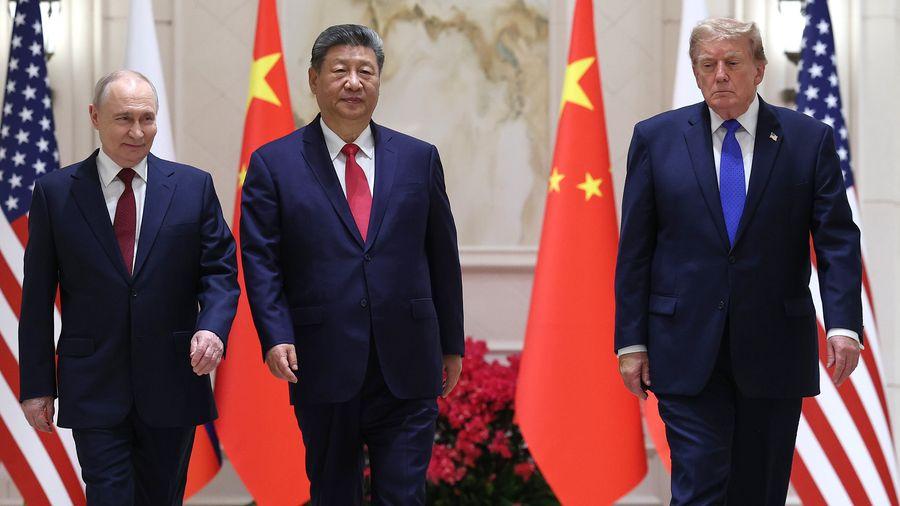
President Donald Trump, right, China's President Xi Jinping, center, and Russia's President Vladimir Putin arrive for a trilateral meeting at Kylin Villa Thursday, Nov. 19, 2026, in Shenzhen, China. (Win McNamee/Pool Photo via AP)
The Pressure Is the Message: What Xi and Putin Faced in Shenzhen
Published Nov. 20, 2026 • Read time: 20m
Join the Conversation
0Shenzhen produced a photograph, a declaration, and a seating chart. The pressure behind them, from Russia's refineries and the Kerch Strait to Panama, Greenland, and the South Caucasus, is the real story.
The photograph from Shenzhen shows three powerful men at one table. On November 19, Donald Trump, Xi Jinping, and Vladimir Putin sat together for 90 minutes. Cameras love a table. Analysts should look under it.
The most important thing about Shenzhen is not what the three men announced when they left the room. It is what each of them carried into it: how many options he still has, how many of them are getting more expensive, and how much room he has left to maneuver.
Xi and Putin arrived with the familiar vocabulary of multipolarity, sovereignty, and resistance to Western pressure. On November 18, as Trump landed, they criticized Western policies together. The script was predictable. The pressure behind it was not.
Washington does not need to win every confrontation, close every route, or force every government to choose sides. It needs to make Beijing's and Moscow's alternatives less reliable, and to make both capitals calculate several unpleasant developments at once.
That is where pressure becomes strategy. In Shenzhen, even the protocol applied it.
A ranking disguised as hospitality
Start at the airport, because Beijing did. Xi waited at the foot of Air Force One's stairs, embraced Trump, and stood beside him while both anthems played. The last time a Chinese leader walked out to a foreign leader's plane, it was Mao, and the plane belonged to Khrushchev. That was 1959.
Putin had landed shortly after 2 a.m. He got Cai Qi: Xi's chief of staff, No. 5 on the Politburo Standing Committee, a serious man at an unserious hour. Russian television assured viewers that the welcome was worthy of a state visit. The South China Morning Post noted that no other arriving leader had been met by anyone so senior. Both claims expired when Air Force One touched down.
In May, Beijing sent its vice president to Trump's plane and its foreign minister to Putin's. This time both men were upgraded. Only one was upgraded to Xi, who was returning Trump's welcome at Joint Base Andrews in September. Reciprocity is a ranking, too.
Dinner finished the lesson. Trump entered to the American anthem. Putin entered to the Trepak, the Russian dance from Tchaikovsky's Nutcracker. In the group photo, Trump stood at Xi's shoulder; Putin stood on the far side of Xi's wife, Peng Liyuan. Bloomberg framed the photo as Putin's return from a decade of isolation. He returned with the hostess between him and the host. At the table, Trump sat beside Xi. Putin, NPR reported, was seated at a separate table. Kremlin aide Yuri Ushakov explained why the two presidents never spoke over the meal: "They did not sit next to each other at the table." Putin did get two private hours with Xi earlier that day. Beijing comforts Moscow behind closed doors and ranks it in front of the cameras.
Trump told Xi, "As long as you and I are in charge of things, we're never going to have a problem." Count the pronouns. Putin was in the same city.
I spent 12 years in Georgia's security services. In Moscow, as in Beijing, the seating chart is the one document everyone reads and nobody signs. Kremlin-friendly commentators had spent the week promising a new Yalta. At Yalta, China was on the menu. In Shenzhen, China owned the restaurant and seated each guest by what he can do for China, and to it.
The declaration and its silences
At the trilateral, Xi opened with a warning: "When great powers clash, the world is in chaos." What came out was a four-point "Declaration toward Peace." Read it twice: once for what it says, once for what it does not.
It says the three permanent members of the U.N. Security Council will reform the United Nations. It says they will increase the production and supply of refined petroleum products, and it reaffirms the importance of "stable energy flows." It says the immunities of state officials are paramount and the International Criminal Court "must not abuse" its jurisdiction. And it says a nuclear war cannot be won and must never be fought, with a three-way dialogue on nuclear risks and proliferation to prove it.
It does not say Ukraine. It does not say Iran. It does not say North Korea, Taiwan, sanctions, or the Middle East. Every war being fought or threatened was left at the door.
The nuclear clause names no treaty, because none is left to name. New START expired in February, leaving the two largest arsenals without legally binding limits for the first time since the early 1970s. Beijing has long refused three-way arms control talks, and analysts expect it to keep refusing until Washington and Moscow cut their arsenals toward parity. In Shenzhen, it agreed to a dialogue. A dialogue is not a limit. Beijing agreed to talk about risk. It did not agree to count warheads.
The man who signed the nuclear sentence came with props. The day Putin flew in, two nuclear-capable Tu-95 bombers flew past Japan and Taiwan to Vietnam. Outside his hotel, a Russia-1 host showed viewers the nuclear briefcase. When the seating chart disappoints, there is always the briefcase.
The other clauses have beneficiaries, too. The ICC language is a courtesy to the one signatory the court wants to arrest; Putin has been wanted since 2023. Washington, which already sanctions the court's officials, gave up nothing it had not already given. The energy clause is a promise from a country that has had to restrict its own fuel exports. More on that below.
Putin's private meeting with Trump lasted about 40 minutes, on the day Ukraine hit his bridge for the third time. A Kremlin aide said he left "in an excellent mood." Then the mood met the press. "After the strikes on the Crimean bridge, there will be no negotiations," Putin said. He also defended Yalta, which, he said, "merely codified the existing reality," and argued that today's conflicts must likewise accept the realities on the ground. Ukraine's foreign minister, Andrii Sybiha, offered one: Russia "has practically lost its bridge to the real Yalta."
The same day, Trump's envoys were in Berlin with Volodymyr Zelensky and the Europeans. Putin wanted Yalta. He got its seating plan in reverse: the conversation about Ukraine went on, and Moscow was the one not in the room.
Russia's energy system: three vulnerabilities, not one
Russia's energy sector is usually described as one machine. It is not. Production, refining, transport, exports, and revenue are connected, but they are not interchangeable. A country can pump oil while losing its refineries. It can export crude while struggling to keep its own gas stations supplied. It can load tankers and still not know where, or whether, the cargo will land.
The International Energy Agency reported that Russian refinery throughput fell to about 3.8 million barrels a day in June 2026, the lowest in more than two decades and roughly 30 percent below a year earlier. In the first eight months of the year, a Russian refinery was hit, on average, once every three days. Gasoline output was reportedly down about 20 percent. Moscow restricted fuel exports.
That is the country that promised in Shenzhen to increase the world's supply of refined petroleum products. A man whose kitchen is on fire has offered to cater the neighborhood.
None of this means Russia has stopped producing or exporting oil. It means the system is under pressure at several points at once, and the Kremlin cannot move a barrel from one part of the chain to another and pretend nothing happened.
This month, Ust-Luga, Russia's largest Baltic port, burned. A fire is not a blockade. Primorsk, Novorossiysk, and other export routes have their own geography and their own problems. But fires add up.
Then there is the bridge. Putin opened the Kerch Bridge in 2018 by driving a truck across it. Ukraine hit it three times in four days. Overnight on November 16–17, a road span fell into the strait; road traffic stopped, and the rail line was damaged. Trains resumed on November 18 and stopped again after the third strike. The fallen arch now lies in the shipping channel. If it stays there, the ports of the Sea of Azov and the Volga-Don waterway, Russia's route for moving naval forces between the Caspian and the Black Sea, could be cut off from the Black Sea. In July, I wrote that Ukraine had closed the Sea of Azov without a fleet. It may now have closed it with Russia's own bridge.
Russia has not lost the world's oceans. It has lost a bridge built to make an annexation look permanent and, for now, the free use of a strait it needs for a war it is still fighting. Putin flew to Shenzhen without mentioning any of it.
Pressure is cumulative. Every hit forces Moscow to spend, reroute, guard, and choose. A government already paying an enormous price for its war has fewer painless ways to absorb the next bill.
And the next bill is domestic. Russian regions have begun cutting the payments that come with the coffins. Euronews reported that "coffin money" for soldiers' families has been cut by up to 95 percent in some areas, and that some regions have diverted money meant for foster children and orphans to war payments. These are regional supplements, not the federal death benefit. But a regime that survives by hiding the war's cost is now sending the invoice to local budgets that were never built to carry it.
Russia's 2027 budget, as submitted to the Duma, puts a record 44 percent of spending into defense and security, double the share for social programs; defense alone takes about 35 percent. Moscow can keep paying for the war. The question is what it will stop paying for.
The diesel episode: a cargo is not a delivery
Remember the Russian diesel "breakthrough"? In October, the Treasury Department licensed Russian diesel cargoes, and Trump waived key provisions of the sanctions law that threatens secondary tariffs on the biggest buyers of Russian energy, China among them. The outrage was instant. Shipping data showed tankers bound for the United States. Russian fuel was supposedly coming back to the American market.
The tankers sailed. Then they turned away one by one. The last made a U-turn about 400 nautical miles off New York. Not one barrel of Russian diesel was delivered.
A cargo loaded is not a cargo delivered. A commercial intention is not a completed transaction. A temporary license is not a strategic concession.
Washington opened a bargaining space without surrendering the pressure campaign. Moscow got a headline. Washington kept the terms, the timing, and the outcome. Putin got the order. America never got the diesel.
The waiver is a pause, not a repeal. The tariff authority aimed at Russia's biggest customers is still on the books, and one of those customers was hosting the summit. In Shenzhen, Moscow signed a promise to supply the world with more refined products. It could not get a single cargo into the one market Washington had opened for it.
China's exposure: the problem is not one supplier
China's vulnerability is different from Russia's, but it runs through the same contest. Beijing has spent years buying access to energy, ports, technology, and markets far from home. An agreement with a government, however, is not a guarantee that the government can deliver under pressure.
Look at the suppliers. Venezuela sent most of its crude to China last year. This year, the U.S. Energy Information Administration reports, it has sent none, and the United States has become its largest customer. Beijing has not lost every investment, claim, or friend in Caracas. It has lost the oil.
Most of Iran's oil also went to China. As the leaders met, two American carrier strike groups, built around the USS Theodore Roosevelt and the USS George H.W. Bush, were backing a blockade of Iranian ports. A few days earlier there had been three. Two carrier groups do not mean an attack is imminent. They mean Tehran cannot treat American power as a theory. And a blockade is not a threat. It is a policy already in force, against a supplier whose barrels went mostly to China.
The Shenzhen declaration praises "stable energy flows." It does not mention Iran. Beijing chose the photograph over the complaint.
Then there is Russia, the supplier with the burning refineries and the broken bridge. A portfolio of suppliers is reassuring only until the whole portfolio is under pressure at once.
The technology front: access is not control
The contest is no longer only about oil, ports, and carriers. It is about chips, data centers, and knowing where American technology ends up.
The Megaspeed case shows how hard that is. U.S. authorities have examined whether advanced Nvidia chips were diverted through intermediaries to restricted Chinese customers. The investigation began in 2024. In June 2025, Nvidia put Megaspeed on a no-sell list, and U.S. officials conducted an end-use check and interviewed its then-chief executive, Alice Huang. The Justice Department now leads the criminal investigation. Megaspeed denies wrongdoing.
On November 12, the case reached the top of Nvidia. Jensen Huang resigned as chief executive amid reports of his relationship with Alice Huang. U.S. intelligence reportedly suspects her of spying for China. Beijing denies it, and the Justice Department has reached no conclusion. Trump, who said in May that "we spy like hell on them, too," now says, "I don't know that she's a Chinese spy."
In Shenzhen, Bloomberg's Annmarie Hordern called out to Trump, asking whether Jensen Huang had been "disloyal to the United States." Trump did not answer. Beijing did. Chinese officials barred her from the trilateral despite a White House push to let her in, and told the press pool that shouting questions is "extremely rude." On the flight home, reporters aboard Air Force One had to surrender their phones "for security reasons." Nobody said whose.
There is no public proof that Alice Huang was a Chinese agent or that Nvidia's secrets were compromised, and I will not pretend otherwise. But my old trade suggests a question. A service that has turned an agent never exposes her. A service that has only watched a channel, or fed it, may expose it when exposure is useful, then watch who runs to check what else is known. When evidence on hostile officers ran dry, I used that method myself. I have no evidence the FBI did anything of the kind. I note only that in May, two days before Trump landed in Beijing, prosecutors charged the mayor of Arcadia, California, with acting as an illegal agent of China. She has since pleaded guilty. Both capitals read the calendar.
The strategic question is real: how does Washington protect advanced technology when customer, intermediary, data center, and end user are separated by shell companies and borders? Three days before the trilateral, the Commerce Department answered part of it. Its November 16 rule requires licenses to send advanced AI chips to data centers anywhere in the world that would provide substantial computing power to companies in China or other restricted destinations. It targets the rental of American computing power from abroad, not just the shipping crate.
For Beijing, the question is no longer whether it can buy a chip. It is whether it can reliably rent the future. Access on paper is not access in practice.
Panama, Canada, Mexico: influence is not ownership
In January, Panama's Supreme Court annulled the contracts held by a subsidiary of Hong Kong's CK Hutchison to run the container terminals at both ends of the Panama Canal. Beijing never owned the canal. It had a commercial foothold at both entrances, and the court ruled the contracts unconstitutional.
Mexico offers a different lesson. On November 11, Mexican officials said they had removed about 1,100 steel mills from the country's approved import registry, many of them in Asia, after discovering they did not exist. Steel imports from Vietnam fell by 80 percent in some months. The steel was real. The mills were not. That is what tariff evasion looks like on paper.
Canada is the counterexample, and it should humble anyone who thinks pressure moves only one way. In January, Mark Carney became the first Canadian prime minister to visit China in more than eight years. On the morning of November 17, in Shenzhen, he and Xi agreed on more Chinese tariff cuts on Canadian goods, including meat and seafood, and on reviving a bilateral currency swap that had been on ice for nine years. Carney hailed "greater predictability and stability," a compliment Ottawa has not paid Washington lately. That afternoon, Xi met Mexican President Claudia Sheinbaum, who proclaimed "a new era" with China. Both of America's partners in the U.S.-Mexico-Canada Agreement sat down with Xi on the same day.
Pressure produces counterpressure. Washington wants to limit China's reach in North America, and its own tariffs give its neighbors reasons to hedge. This is not a map of countries obediently changing camps. It is a market in which every relationship has a price, and Beijing is shopping.
Greenland, Cuba, Nicaragua, Brazil: the wider map
The September 22 agreement among the United States, Denmark, and Greenland tightened Arctic security cooperation and addressed hostile foreign presence and sensitive investment. Greenland is not a mineral deposit with a flag. It is geography: military access, surveillance, shipping lanes, and the balance among North America, Europe, Russia, and China.
On November 5, Washington expanded sanctions on Cuba's electronics, manufacturing, maritime, and technology sectors, including two China-based firms accused of supplying Cuba's military. In January, Trump signed an executive order threatening tariffs on any country that supplies Cuba with oil; the order names Havana's alignment with Russia, China, and Iran. In April, the Treasury Department sanctioned officials and companies in Nicaragua's gold sector, including two sons of co-presidents Daniel Ortega and Rosario Murillo. In July, the U.S. Trade Representative imposed a 25 percent tariff on many Brazilian goods after a Section 301 investigation into digital trade, electronic payments, ethanol, intellectual property, anticorruption enforcement, and deforestation.
These cases are not identical, and not every American measure is aimed at China. The common thread is broader: Washington now contests the relationships through which outside powers build influence in its hemisphere. The result is not expulsion. It is uncertainty, higher costs, and fewer guarantees. Washington keeps a drawer full of old files, and it opens them wherever Beijing is not looking.
The South Caucasus: the contest moves through the corridors
The most revealing part of this contest is unfolding far from the Pacific and the Caribbean, in my part of the world.
On November 6, Chinese Vice President Han Zheng, the man Beijing sent to Trump's plane in May, landed in Tbilisi. He met President Mikheil Kavelashvili and Prime Minister Irakli Kobakhidze, who personally saw him off at the airport. The visit followed the upgrade of China-Georgia relations to a comprehensive strategic partnership in June. Beijing does not pick its envoys at random.
Georgia sits where the Black Sea, the South Caucasus, and the road from Europe to Central Asia meet. For China, it is a link in a trade network. For Russia, it is unfinished business.
But the region is not frozen. The day Han landed, the United States, Armenia, and Azerbaijan launched technical planning groups for the Trump Route for International Peace and Prosperity, covering transport and electricity links. A month earlier, Secretary of State Marco Rubio met the foreign ministers of all five Central Asian states.
None of this means Armenia, Azerbaijan, or Central Asia has moved into Washington's orbit. They have their own interests, constraints, and relationships with Moscow and Beijing. They are not pieces on anyone's chessboard. But a monopoly does not have to be abolished to weaken. It only needs a competitor: another route, another investor, another security partner, another option. And a route around Russia is worth more in a week when Russia's own outlets can be closed by force.
Of all the governments on the road from the Caspian to the Black Sea, only one gives Beijing and Moscow no reason to hedge: Georgia's. Its patron, Bidzina Ivanishvili, has been under U.S. sanctions since December 2024. Han Zheng's visit was not ceremony. Beijing knows exactly what this corridor is worth, and exactly whom to call.
Kim Jong Un: even Xi has limits
Before Shenzhen, Trump floated a meeting with Kim Jong Un and said it was "up to President Xi." Not up to Putin, for whom North Korean soldiers bled in Kursk. Up to Xi.
Kim stayed home, inspecting a naval university. The declaration does not mention North Korea.
Xi has influence over Kim. He does not command him. Pyongyang pursues its own priorities, and Moscow now offers it a second patron, which makes Beijing less indispensable. Xi was asked to deliver something he could not guarantee. Whether he could not deliver Kim or would not, Washington learned something either way. Influence is valuable. It is not control.
The summit was an audit of options
It would be a mistake to call every American move in every region one perfectly coordinated master plan. Governments pursue different goals. Policies collide. Allies push back. Events ignore everyone's planning.
But pressure does not need a single command room. Separate developments interact, reinforce one another, and ruin the calculations of governments that prefer to handle one crisis at a time.
Russia faces pressure on its refineries, its war budget, its bridge, and its customers. China faces doubts about its suppliers, its chips, its ports, and its corridors. Both must reckon with American carriers, sanctions, tariffs, and diplomacy that keep narrowing their room to maneuver. Neither is powerless. Neither is about to disappear. But neither can assume its partners will deliver, its routes will stay open, or its alternatives will be there when needed.
Trump called Xi "an incredible leader." Walking up to Putin, he said, "Who is he? He's my friend." Poland's Donald Tusk posted, naming no one: "God, protect us from such friends." Tusk judged the words. The Kremlin has been living with the deeds since October. I call Trump's method controlled chaos, and its signature move is aikido: praise the strongman in public, squeeze him in practice, and let his own weight bring him down.
The summit produced a declaration, photographs, and handshakes. The real test was what happened after the cameras left. Within hours, Putin ruled out negotiations, Trump's envoys were with Zelensky in Berlin, the Kerch Bridge's road span was still in the strait, two carrier groups were still on station, and not one Russian diesel cargo had reached an American port.
The question for Xi and Putin was never simply what Trump wants from them. It is how much leverage they still have, how many options still work, and how much they must pay to keep them open.
Shenzhen was not a photograph of three men at one table. It was an audit of how many exits each still has. One of them flew home with fewer than he brought.
Emzari Gelashvili is a San Francisco–based geopolitical analyst and columnist who monitors Russian-language media. From 1996 to 2008, he held senior positions in Georgia's Ministry of State Security, Ministry of Defense, and Ministry of Internal Affairs, with a counterintelligence career focused on Russian and Iranian intelligence operations, and he was a member of the Georgian Parliament from 2008 to 2012.
The Pressure Is the Message: What Xi and Putin Faced in Shenzhen
By Emzari Gelashvili • RealClearDefense
China’s Revised Mobilization Law and the Expanding Reach of National Defense
By Muhammad Shoaib • RealClearDefense
U.S. Putting Weapons in Space: A Strategic Blunder?
By Ajey Lele • RealClearDefense
The Clearance Myth Is a Readiness Problem
By Elijah Fernandez • RealClearDefense
The Pentagon's Next Readiness Test Should Begin When the Cloud Goes Dark
By Colton Overcash • RealClearDefense
U.S. Putting Weapons in Space: A Strategic Blunder?
By Ajey Lele • RealClearDefense
U.S. Senate Seeks to Exchange Shipbuilding Funds for More Munitions
By Naval News
F-35C Completes First Launch and Recovery Trials on a Ford-Class Carrier
By Navy T.
USS George Washington Leaves Mideast As Trump Mulls Ending Iran War
By S&S
ULA’s Latest Launch Failure Spells Trouble for Space Force
By Greg Hadley, A&SF