
America's Defense Industry Needs Budget Certainty
Last updated 06:21 AM EDT • Read time: 5m
For decades, Washington measured national defense by a simple formula: appropriate money, assume industry responds. That worked when America possessed unmatched manufacturing capacity and a defense industrial base built for sustained production. It doesn't anymore.
Today, Washington expects America's defense industrial base to increase production of submarines, precision-guided munitions, autonomous systems, satellites, semiconductors, and advanced manufacturing technologies while simultaneously rebuilding supply chains that have atrophied over decades of reliance on foreign suppliers.
The Department of War has warned that the industrial base has shrunk dramatically. Since the 1990s, the number of major aerospace and defense prime contractors has fallen from 51 to five, according to the Pentagon's 2022 State of Competition within the Defense Industrial Base. Consolidation and just-in-time production have created vulnerabilities in a major conflict.
This is not primarily a spending problem. It is a predictability problem—one that Washington created and continues to exacerbate.
The contradiction is elementary. Policymakers ask companies to make ten-year investments while funding the government month-to-month through continuing resolutions.
A machine shop considering advanced manufacturing equipment faces uncertainty that makes the decision obvious: wait. A second-tier supplier deciding whether to expand production sees the same problem: Congress cannot reliably pass a budget. A community bank considering financing a facility expansion requires confidence in sustained demand that Washington refuses to provide.
America’s defense industrial base depends on thousands of small manufacturers, software companies, foundries, robotics firms, electronics suppliers, startups, and family-owned businesses that provide components and innovation the military needs. When uncertainty causes that ecosystem to pull back, capacity is lost.
Predictability has become a strategic capability. Former Deputy Secretary of Defense Kathleen Hicks warned that "one of the most serious obstacles" to defense innovation "has been the lack of stable, predictable, timely funding."
The Government Accountability Office has documented the consequences. In January 2026, GAO found that continuing resolutions affected dozens of major acquisition programs, delaying contracts and equipment deliveries and restricting new programs and production increases.
Washington has created a perverse incentive structure and then expressed surprise when industry responds rationally to the signals it sends.
Congress already demonstrates it understands this. It has explicitly embraced multiyear procurement authority for critical defense programs because stable funding lowers costs, strengthens supply chains, encourages capital investment, and gives industry confidence to expand production. Multiyear procurement works because it commits funding across multiple years, giving industry the certainty that annual appropriations cannot provide. Annual appropriations, even at record levels, create uncertainty: industry cannot assume Year 3 funding will materialize if Congress stumbles again.
Then Congress turns around and systematically undermines that logic.
A continuing resolution is not technically a funding failure. It is a failed signal. It tells industry that Washington cannot commit to sustained spending. Recurring omnibus packages amplify it. Supplemental appropriations reinforce it. Emergency requests that become routine weaken the expectation of sustained commitment.
Some of this is simply fiscal dysfunction. Congress cannot agree on spending levels, so it punts through continuing resolutions. Budget negotiations collapse into brinkmanship, and emergency supplementals become politically easier than difficult appropriations choices.
You cannot surge industrial capacity through emergency legislation. A submarine supplier cannot be established overnight. A skilled workforce cannot be trained in weeks. An advanced manufacturing facility cannot be financed on the expectation that Congress may eventually reach agreement.
This is not an argument for unlimited Pentagon budgets. Whatever Congress decides to spend on defense should be appropriated in a way that enables the capacity Congress says it wants.
Nor is this an argument for abandoning regular order. Annual authorization and appropriations remain essential to congressional oversight. But Congress can use other mechanisms to provide greater certainty for strategic investments without sacrificing oversight.
The objective is straightforward: give industry a reason to invest for the next five or ten years instead of forcing companies to make decisions based on the next five or ten months.
America's competitors are not waiting for repeated appropriations negotiations to determine whether they should modernize shipyards, expand manufacturing capacity, or secure critical supply chains. The United States should never adopt China's centralized state model, but neither should it handicap its own industrial base through self-inflicted fiscal instability.
America's manufacturers are ready to invest. What they lack is confidence that Washington will provide the funding certainty to justify those investments.
The defense industrial base cannot be rebuilt one continuing resolution at a time. It can be rebuilt if Congress decides to do the basic work of governing.
James Carter, Principal at Navigators Global, previously served as Chief Economist of the Senate Budget Committee and Deputy Assistant Secretary for Economic Policy at the U.S. Treasury.
Timothy Maney directed the Chamber of Commerce's Federal Budget and Appropriations portfolios from 2000 to 2024.
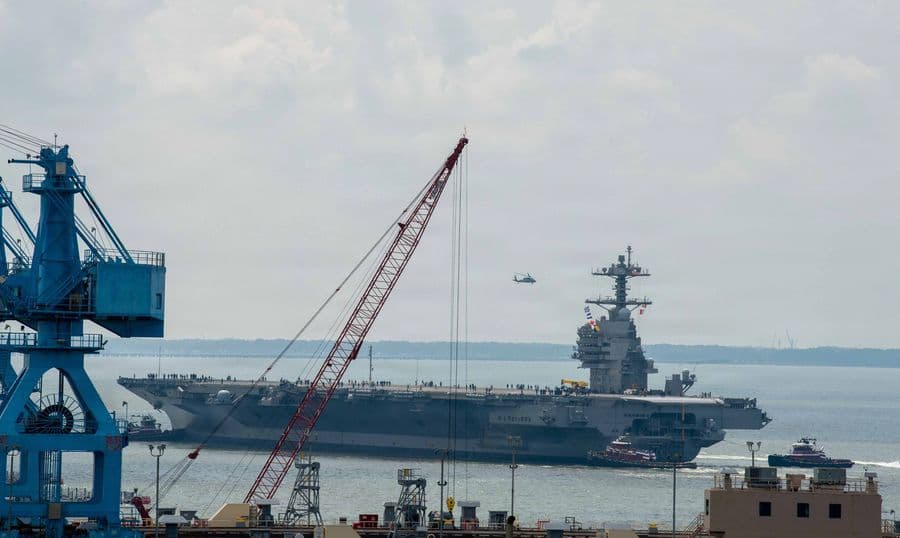
image: (Aug. 12, 2026) Pre-Commissioning Unit (PCU) John F. Kennedy (CVN 79) departs from Newport News Shipbuilding for Acceptance Trials at sea in Newport News, Virginia, August 12, 2026. Acceptance Trials is a series of crew-led events designed to demonstrate to the U.S. Navy’s Board of Inspection and Survey that the ship is constructed in accordance with contract specifications, and that the crew is adequately trained to conducted operations at sea. (U.S. Navy photo by Mass Communication Specialist Seaman Morgan Altom)

In Pursuit of Nuclear Abolition
By Peter Huessy • RealClearDefense
Innovation Alone Won’t Prepare the U.S. for the Future Battlefield
By Joshua Segal • RealClearDefense
The sUAS Tactical Trifecta
By Bryan T. Woody • RealClearDefense
The Revolutionary War: When Strategic Options Share the Same Weakness
By Henry Yep • RealClearDefense
The Houthis Are Testing the Limits of Collective Defense
By Saima Afzal • RealClearDefense

Who Shoots Down the Drone Over the Shipyard?
By John Ferrari & Dillon Prochnicki • RealClearDefense
Northrop Grumman Breaks Out the Big Guns at AUSA
By Daniel Terrill, Defense News
Army Pursuing Diverse Array of New Anti-Air Interceptors
By Trevithick, The WarZoneWho Shoots Down the Drone Over the Shipyard?
By John Ferrari & Dillon Prochnicki, RCD
F-35C Lands for the First Time on a Ford-Class Aircraft Carrier
By The Aviationist