
Capital Must Become Capability
Last updated 05:40 AM EDT • Read time: 8m
The Pentagon is asking the right financial questions. The risk is treating vastly different financial problems as though they require the same solution.
Deputy Secretary of War Steve Feinberg is addressing an important question: does the government understand enough about the economics of the companies supplying America’s military?
Where competition is limited, that question matters. The Pentagon cannot negotiate intelligently if it is effectively flying blind on price.
But Feinberg’s August 18 directive on supplier cost and pricing transparency goes considerably further than asking for better information. It seeks greater access to actual cost data throughout contractor and subcontractor tiers, including circumstances where certified cost or pricing data may not otherwise be required, and contemplates automated access to contractor financial systems.
That has understandably caused concern across industry.
Bill Greenwalt has warned that extending traditional defense cost-accounting requirements too broadly risks recreating the government-unique business environment that decades of acquisition reform sought to dismantle. Commercial companies with alternative customers may simply decide doing business with the Pentagon is not worth the trouble.
His warning deserves attention, particularly because the policy arrives as the Pentagon is trying to attract more commercial companies, more private capital, and more competition into defense. The government’s need to negotiate intelligently is legitimate. Whether this degree of cost visibility is the right mechanism deserves closer scrutiny.
The controversy exposes a larger weakness in how we think about defense finance. Cost transparency is only one part of the problem.
The Department is simultaneously trying to increase weapons production, expand the supplier base, attract commercial technology, and mobilize private capital. Those objectives involve different companies operating under very different financial models. Treating financial sophistication as simply acquiring more cost information risks missing the larger point.
Finance is also an industrial-capacity problem. The Pentagon needs to distinguish among three forms of financial discipline.
The first is price discipline.
Where competition is weak and the government is effectively the only buyer, it needs sufficient information to negotiate intelligently. A sole-source supplier operating in a government-dependent market presents quite a different economic problem from a company competing in an established commercial market.
Government should not be expected to negotiate blind. But greater visibility should be a means to better acquisition outcomes, not an end in itself. The information government requires should reflect the market in which a company actually operates.
The second is market discipline.
Where genuine commercial competition exists, markets can provide information that government cost accounting cannot. Commercial prices reflect intellectual property, research and development, risk, scale, expected returns, and what customers are willing to pay.
For a traditional defense prime, the Pentagon is a core customer. For many commercial companies, it is one customer among many. If participating in defense requires a commercial company to reorganize its financial systems around government-unique requirements, the Pentagon may obtain greater visibility into a shrinking pool of suppliers.
That would be a poor trade.
Acquisition policy should distinguish between markets where underlying cost information is genuinely necessary and those where competition, price and performance provide better discipline.
Returns matter in that equation because capital has alternatives. Investors will not indefinitely commit money to businesses that cannot earn an adequate return. Within large companies, defense programs also compete with other uses of scarce investment capital; expected returns inevitably influence which factories, technologies and product lines receive it.
Talent responds to opportunity as well. Growing companies can invest in people, create career opportunities, and compete more effectively for scarce technical skills. A healthy defense industrial base therefore depends on companies that can attract both capital and talent. That leads to the larger question. Pricing tells us what happens at the point of purchase.
Industrial capacity depends on what happens to capital after the contract is awarded. Just before the cost-transparency directive, Feinberg asked industry to identify the capital investments and facility expansions required to accelerate weapons production. That is the other side of defense finance: not simply determining what government should pay, but understanding what companies must invest to produce more.
The financial fragility of lower-tier suppliers is increasingly understood. What remains less connected to the acquisition debate is how that vulnerability relates to cost transparency, commercial-market incentives, and the push for faster production.
That is where the third form of discipline matters.
Capital discipline, in this context, is the ability to convert demand, financing and cash flow into sustainable production without creating financial fragility along the way.
Washington has become increasingly focused on getting more capital into the defense industrial base. That is necessary. Companies need financing to expand facilities, purchase equipment, build inventory and increase production. But access to capital is not the same thing as industrial capacity.
Capital only becomes capacity after a company turns it into people, material, equipment, inventory, and output. Companies have to finance growth before they can harvest its returns.
A manufacturer may need to purchase raw material months before receiving payment. A supplier may need new equipment before additional production creates additional revenue. Those timing differences matter even more as you move down the supply chain.
Large defense primes generally possess the financial infrastructure and credit capacity to manage these cycles. Smaller suppliers often operate with far less room for error. A payment delay that is manageable for a major corporation can determine whether a smaller company buys inventory, adds a shift or hires another worker. That is why the defense supply chain should not be viewed only as a physical supply chain.
It is also a financial chain.
One company’s accounts payable is another company’s accounts receivable. When cash moves slowly at the top of the industrial base, financial pressure moves downward. Eventually financial pressure becomes an industrial problem.
We spend enormous effort mapping physical vulnerabilities across the defense industrial base. We want to know where critical minerals originate, who produces energetics, where castings and forgings are made and which companies manufacture components for key weapons systems.
We should also understand where financial fragility exists.
A financially fragile sole-source supplier can represent a serious production vulnerability, just as shortages of machine tools or raw materials can. This does not mean the Pentagon should manage private-company balance sheets. Nor should financial readiness become another compliance regime layered onto smaller businesses.
The objective should be the opposite.
Government should understand how its contracting and payment practices affect working capital. Primes should recognize financial fragility as a potential source of supply-chain risk without simply creating another layer of reporting requirements. Supplier-readiness efforts should recognize that production capability includes not only machines, workers, and technical performance, but also the financial capacity to sustain growth.
The goal should be stronger suppliers, not more paperwork.
The disagreement over Feinberg’s cost-transparency directive therefore exposes a larger problem in defense industrial policy. Financial accountability, commercial competition and supplier resilience are all necessary. But they cannot be pursued with the same tools.
Price discipline protects the taxpayer. Market discipline protects innovation. Capital discipline protects production.
Treating a major defense prime, a venture-backed technology company and a 75-person machine shop as though they operate under the same financial model is not financial discipline.
It is financial simplification.
Feinberg’s focus on capital and corporate incentives creates an opportunity to bring a more sophisticated financial perspective into defense policy. Greenwalt’s critique highlights what can happen when financial oversight is applied without sufficient regard for how commercial markets operate. Their arguments expose different problems that should not be solved with the same financial tools.
Where competition is weak, government should have the information genuinely necessary to negotiate. Where genuine commercial competition exists, it should preserve the market incentives that produced it. And where suppliers are being asked to scale, it should understand the working capital demands created by growth.
America’s capital markets remain one of its greatest strategic advantages. So does its commercial innovation ecosystem. Defense policy should harness both without abandoning the government’s responsibility to the taxpayer. The Pentagon does not need to choose between financial accountability and functioning markets. It needs the financial fluency to know which tool belongs in which market and to understand how capital moves through the industrial base before it becomes military capability.
Capital that cannot attract talent, finance growth, and sustain suppliers never completes that journey. Ultimately, that is the test of defense finance. Not simply whether capital is available. Whether capital becomes capability.
Ryan P. McDermott is an Iraq War veteran, former Pentagon official, and author of the book, Downriver: Memoir of a Warrior Poet. His views do not reflect those of his employer or any affiliated organization.
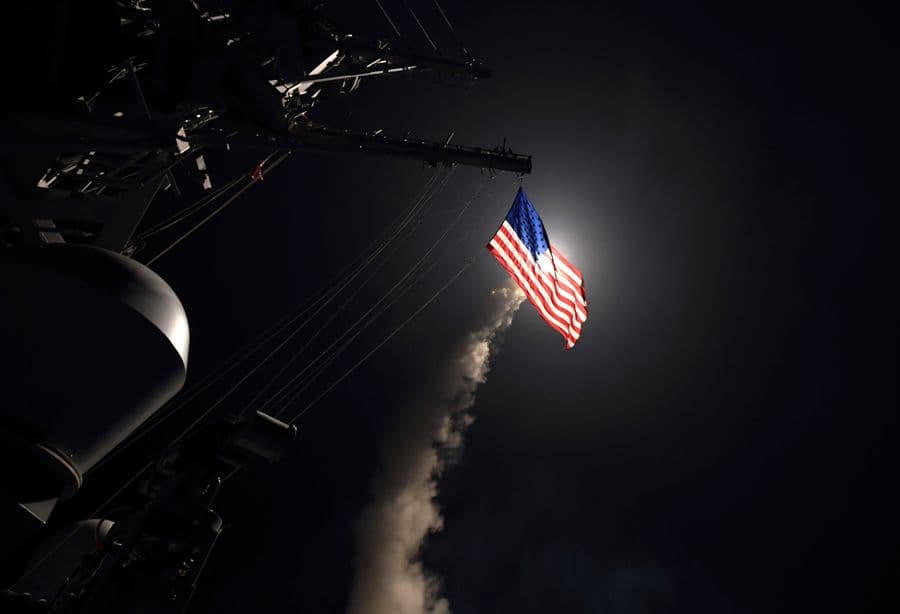
image: In this image provided by the U.S. Navy, the guided-missile destroyer USS Porter (DDG 78) launches a tomahawk land attack missile in the Mediterranean Sea, Friday, April 7, 2017. The United States blasted a Syrian air base with a barrage of cruise missiles in retaliation for a chemical weapons attack against civilians. (Mass Communication Specialist 3rd Class Ford Williams/U.S. Navy via AP)

In Pursuit of Nuclear Abolition
By Peter Huessy • RealClearDefense
Innovation Alone Won’t Prepare the U.S. for the Future Battlefield
By Joshua Segal • RealClearDefense
The sUAS Tactical Trifecta
By Bryan T. Woody • RealClearDefense
The Revolutionary War: When Strategic Options Share the Same Weakness
By Henry Yep • RealClearDefense
The Houthis Are Testing the Limits of Collective Defense
By Saima Afzal • RealClearDefense

Who Shoots Down the Drone Over the Shipyard?
By John Ferrari & Dillon Prochnicki • RealClearDefense
Northrop Grumman Breaks Out the Big Guns at AUSA
By Daniel Terrill, Defense News
Army Pursuing Diverse Array of New Anti-Air Interceptors
By Trevithick, The WarZoneWho Shoots Down the Drone Over the Shipyard?
By John Ferrari & Dillon Prochnicki, RCD
F-35C Lands for the First Time on a Ford-Class Aircraft Carrier
By The Aviationist