
Weekly Recon: Welcome Sandra Erwin, Navy's Mothballs, Mattis on the Hill
Last updated 05:50 PM EDT • Read time: 5m
Good Saturday morning and welcome to Weekly Recon. On this day in 2006, The Second Battle of Ramadi was fought for control of the capital of the Al Anbar Governorate in western Iraq. A combined force of U.S. Soldiers, U.S. Marines, U.S. Navy SEALs, and Iraqi Security Forces fought insurgents for control of key locations in Ramadi, including the Government Center and the General Hospital. Coalition strategy relied on establishing a number of patrol bases called Combat Operation Posts throughout the city. U.S. military officers believe that insurgent actions during the battle led to the formation of the Anbar Awakening.
RealClearDefense Welcomes Sandra Erwin – Sandra Erwin joined RealClearDefense last Monday. Sandra will write exclusively for RealClearDefense, reporting on the broad spectrum of defense issues, national security, and much more. She joins us following her tenure as Editor-in-Chief of National Defense Magazine.
Sandra wasted no time in her first week covering defense-in-depth from Secretary of Defense Mattis’ testimony to Congress on the defense budget and ongoing wars, the Boeing shaking up its defense business, to signaling broader shifts within the defense industry and foreign military sales (FMS). Sandra’s extensive experience stands out in her detailed and contextual reporting beyond the headlines. Make sure to read her reporting from this week, and follow her on Twitter.
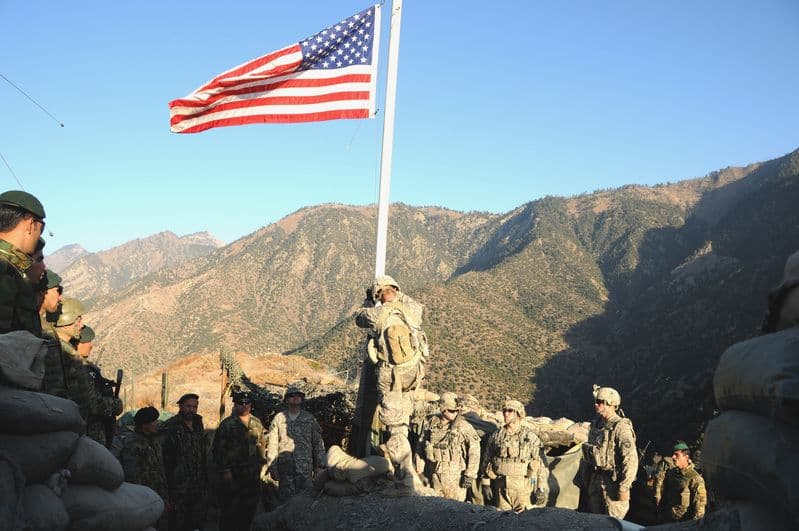
Afghanistan: Trump’s War Plans – President Donald Trump gave Secretary of Defense James Mattis the authority to determine troop levels in Afghanistan this week, a war that Mattis says the U.S. is currently “not winning.” As Sandra Erwin stated, Mattis is under pressure to produce a “winning strategy.” Testifying before the Senate Appropriations Subcommittee on Defense, Mattis defined his version of winning as an Afghan government that can defend itself against the Taliban and other violent factions. With this, the goalposts remain largely the same as they have been for most of the sixteen-year long war. One notable exception is that the White House is delegating decisions on troop numbers. Numbers that are expected to increase by roughly four thousand U.S. troops deploying to Afghanistan to “break” the stalemate. The decision to give Mattis this authority has faced intense. Furthermore, Mattis promised lawmakers a “new” strategy for the war in Afghanistan by mid-July.
Though the overall Afghan strategy is still being formulated, Vice President Mike Pence and National Security Advisor H.R. McMaster briefed Senators John McCain and Lindsey Graham on the new plan. Graham said the strategy is something that he is “very excited about,” going on to say, “I’ve never been more proud of President Trump and his team than I am right now.”
After sixteen years of troop surges and withdrawals, the Taliban, and now ISIS-K, are making significant territorial gains, and deadly, symbolic attacks against the Afghan government and security forces. Secretary Mattis is, however, uniquely suited to work on a “new” strategy for Afghanistan having led Task Force 58 during the initial invasion of Afghanistan and later as commander of U.S. Central Command. Already the plan seems to have won over key senators, but selling it to the American people will be hotly contested.
Out of Mothballs: Should the Navy Reactivate Decommissioned Ships? - The U.S. Navy is under pressure from the Trump administration to follow through on the promise to build a 355-ship fleet. A difficult but not insurmountable task. Getting to the magic number of 355-ships is, however, a matter for debate. Chief of Naval Operations Admiral John Richardson released a memo last month laying out the Navy’s vision to get to the magic number. Such steps include increased funding, reliance on more autonomous marine vehicles, and extending the service life of existing vehicles. Richardson further stated that he is now “taking a hard look” at a different approach: reactivating and modernizing some of its retired Oliver Hazard Perry-class frigates.
Admiral Richardson’s plan has drawn a flurry of responses, including Navy veteran Bryan Clark of the Center for Strategic and Budgetary Assessments (CSBA). As Clark told USNI News, “The Perry class are going to be an expensive proposition to bring out of mothballs and maintain just for the purpose of going out and doing some presence missions.”
Writing for RealClearDefense this week, Navy veteran, Steven Wills, says the reactivation of decommissioned ships has a long track record of being a high cost, low yield remedy to an immediate problem with little long term effect. As Wills notes, not only do the ships need to be repaired, refitted, and modernized, but the entire training and manning infrastructure needs to be rebuilt, almost entirely from scratch.
Setting cost aside, Wills further says the Navy must examine why it is considering this path forward, concluding:
The service should also issue a comprehensive Naval Strategy for a new era of great power competition. Choices in naval forces structure should be shaped by strategic needs rather than a set number of ships or their tactical employment. Additional ships are always welcome, but they should be the right ships for current and future strategic need and not those of the Cold War past.
SEND RCD YOUR INPUT: Please send your tips, suggestions, and feedback to editors@realcleardefense.com. Make sure to follow us on Twitter at @RCDefenseand follow Blake Baiers @BlakeBaiers.

In Pursuit of Nuclear Abolition
By Peter Huessy • RealClearDefense
Innovation Alone Won’t Prepare the U.S. for the Future Battlefield
By Joshua Segal • RealClearDefense
The sUAS Tactical Trifecta
By Bryan T. Woody • RealClearDefense
The Revolutionary War: When Strategic Options Share the Same Weakness
By Henry Yep • RealClearDefense
The Houthis Are Testing the Limits of Collective Defense
By Saima Afzal • RealClearDefense

Who Shoots Down the Drone Over the Shipyard?
By John Ferrari & Dillon Prochnicki • RealClearDefense
Northrop Grumman Breaks Out the Big Guns at AUSA
By Daniel Terrill, Defense News
Army Pursuing Diverse Array of New Anti-Air Interceptors
By Trevithick, The WarZoneWho Shoots Down the Drone Over the Shipyard?
By John Ferrari & Dillon Prochnicki, RCD
F-35C Lands for the First Time on a Ford-Class Aircraft Carrier
By The Aviationist