
Grand Strategy for World War III: Weaponizing Oil and Gas
Last updated 07:59 PM EDT • Read time: 6m
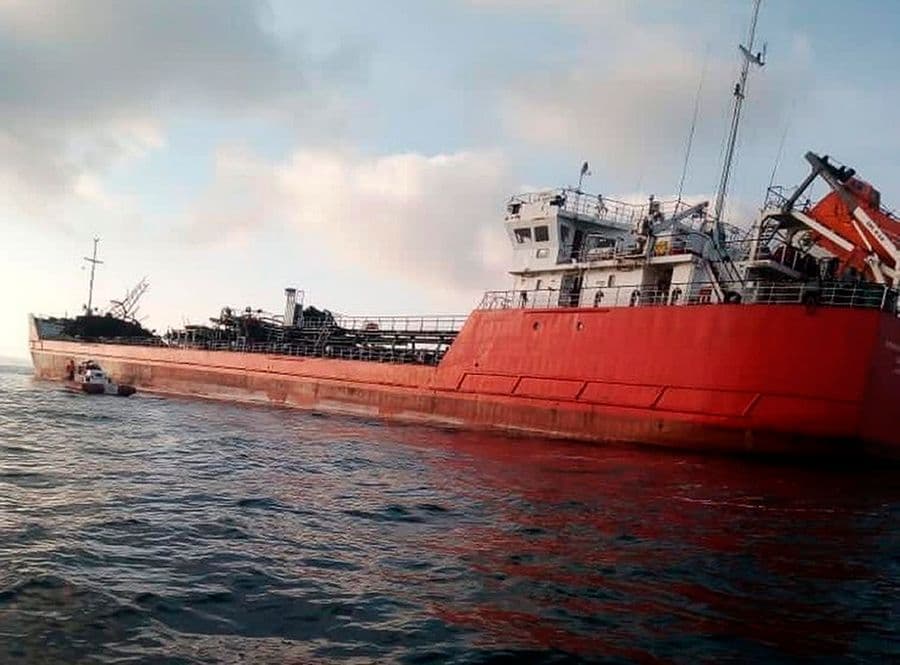
In this photo released by the Russian Emergency Situations Ministry Press Service, a view of a Russian oil tanker damaged by an explosion, in the Sea of Azov, Russia, Sunday, Oct. 25, 2020. Officials say a rescue operation is underway for three missing crew members of a Russian oil tanker that experienced an explosion in the Sea of Azov The Russian Emergencies Ministry said the explosion on the General Azi Aslanov took place Saturday as the tanker was en route from the port of Kavkaz to the city of Rostov-on-Don. (Russian Emergency Situations Ministry Press Service via AP)
How should the United States confront China, Russia, and Iran as the world looks as if it might descend into World War III? What economic tools can be deployed to gain strategic effect and generate advantages, asymmetric or otherwise, for the United States and the West? Secretary of State, Antony J. Blinken is now advocating for Ukrainian use of U.S. supplied weapons to attack military targets in Russia. Meanwhile, Ukraine has begun destroying Russian refineries to good effect with domestically produced drones, but this effort is far short of a comprehensive hydrocarbon strategy for the West.
One of the keys to victory in the Cold War was cheap oil, as Peter Schweitzer pointed out in his book, Victory. The United States must again use hydrocarbons as its economic “nuclear” weapon. Most critically, formulating and implementing a grand strategy for the United States that encompasses ways, means and ends with regard to the price of oil and gas is both necessary and urgent.
The Cold War alliance between the House of Saud and the United States was founded on an exchange of security in the form of U.S. military assistance in return for suppressing oil prices and stabilizing the market. The Saudis used their spare production capacity to suppress and stabilize oil prices.
The price manipulation had a double benefit: First, low oil prices for the West enhanced economic growth and kept inflation down. Second, these reduced prices devastated the Soviet Union's main export industry, thereby dramatically reducing its access to foreign currency exchange. Without that foreign currency, the Soviet Union’s ability to back the currencies and debt of the Warsaw Pact countries was dramatically curtailed, and its capacity for purchasing and stealing critical technologies from the West (often through “neutral” countries) was significantly reduced.
But reducing prices was not enough: The Reagan administration went further, working tirelessly to curtail Soviet access to Western capital, technology, and especially the ability to sell into Western markets. By preventing the construction of pipelines and export terminals, the U.S. was able to cripple the Soviets’ ability to generate desperately needed hard currency.
In today's world, a hydrocarbon strategy is less obvious: Some of the United States’ allies are energy exporters, while others are importers. The same holds true for U.S. adversaries. Are higher or lower oil and gas prices desirable for the United States? Higher oil prices help Russia and Iran but harm China. Lower prices harm Russia and Iran but help China. What about volatility and supply interruptions? High volatility harms and destabilizes U.S. allies who are net importers of hydrocarbons (such as European nations and Japan). Is stability desirable, or are price fluctuations strategically beneficial? This paper seeks to outline how a hydrocarbon weapon should be deployed in the current geopolitical circumstances.
As an oil and gas producing nation, the U.S. interest is in maintaining relatively high but stable oil and gas prices in the West, with a secure energy supply nationally and for its allies. The opposite is true for China, which wants low and stable oil and gas prices. Western advantage lies in encouraging high prices, price volatility and supply uncertainty for China, while preventing Russia and Iran from successfully selling their hydrocarbons.
Here we propose a new strategy, called kinetic decoupling: Given the ongoing wars in Ukraine, the Levant, and the Persian Gulf, there is a perfect opportunity to disable Russian and Iranian oil-production assets. Export terminals, oil pipelines and tankers in port in Iran and Russia could be targeted by U.S. proxies.
The Israelis and Ukrainians should be encouraged and armed to hit these facilities repeatedly and to comprehensively disable them. The tankers using these facilities can be targeted and sunk. Disrupting the Belt and Road oil pipeline projects through ethnic proxies in Central Asia will make China more dependent on trans-oceanic shipping even as the export terminals and ports come under attack.
With the United States acting as a partner to buffer supply shocks, allies of the United States get high but stable prices and a supply assurance, along with a closer relationship with the U.S. China gets high and uncertain prices, with supply shocks. Russia and Iran lose the physical ability to sell oil and gas into the global market and are forced to renege on their agreements with China. The Saudis benefit from increased prices, which allows them to enhance their defense against Iranian aggression.
In short, this strategy is: US production up, Russian and Iranian exports out, and the Chinese economy down.
During the Cold War, the Reagan Administration worked tirelessly to hobble Russian efforts to export oil. At that time, a combination of investment in offshore drilling with a Saudi alliance was needed in order to stabilize oil prices for the West. The Saudi regime might be willing once again to lower oil prices in exchange for a security guarantee from the United States for protection from Iran, but this would not serve the United States’ broader interests. Today, with forty years of technological improvements since the Reagan Administration, the United States should not only support its proxies and allies but also invest in innovative new sources of energy, including in particular small modular nuclear reactors, space-based solar and fusion power.
Michael Hochberg earned his PhD in Applied Physics from Caltech. He is currently a visiting scholar at the Centre for Geopolitics at Cambridge University and the President of Periplous LLC, which provides advisory services on strategy, technology, and organization design. He co-founded four companies, representing an exit value over a billion dollars in aggregate, spent some time as a tenured professor, and started the world’s first silicon photonics foundry service. His publications include a co-authored, widely used textbook on silicon photonics and his articles have appeared in Science, Nature, National Review, The Hill, American Spectator, RealClearDefense, Fast Company, Naval War College Review, Gatestone, etc. Michael’s writings can be found at longwalls.substack.com, and his twitter is @TheHochberg.
Leonard Hochberg is a Senior Fellow at the Foreign Policy Research Institute (FPRI) and serves as the Coordinator of the Mackinder Forum-U.S. (www.mackinderforum.org). He taught at Stanford University (among other institutions), was a Fellow at the Hoover Institution, and co-founded Strategic Forecasting, Inc. (i.e., STRATFOR). He has published work in Social Science History, Historical Methods, The Journal of Interdisciplinary History, Orbis, National Review, The Hill, American Spectator, RealClearDefense, Cartographica, Naval War College Review, Gatestone, etc. Len earned his PhD in political theory and European history from Cornell University.

The Godfather of American Foreign Policy Realism Speaks to Today’s World
By Francis P. Sempa • RealClearDefense
In Pursuit of Nuclear Abolition
By Peter Huessy • RealClearDefense
Innovation Alone Won’t Prepare the U.S. for the Future Battlefield
By Joshua Segal • RealClearDefense
The sUAS Tactical Trifecta
By Bryan T. Woody • RealClearDefense
The Revolutionary War: When Strategic Options Share the Same Weakness
By Henry Yep • RealClearDefense

Navy Civilianizes Six Former Flag Billets, Reduces Six to Captains
By Mongilio, USNI N.
Raytheon's $8B Contract for Strategic Comms Terminal Modernization
By M+A El
America’s Maritime Moment Will Not Wait
By CDR Salamander
Armor Up?
By Marine Corps Compass Points
Who Shoots Down the Drone Over the Shipyard?
By John Ferrari & Dillon Prochnicki • RealClearDefense