
Our Restraint Destroys Your Deterrence
Last updated 06:46 AM EST • Read time: 7m
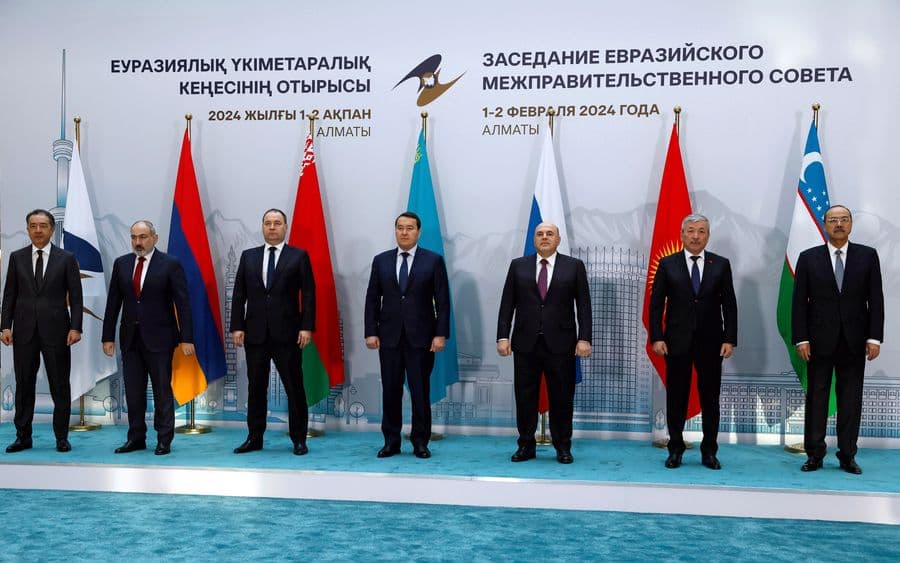
From left: Chairman of the Board of the Eurasian Economic Commission (EEC) Bakytzhan Sagintayev, Armenian Prime Minister Nikol Pashinyan, Belarusian Prime Minister Roman Golovchenko, Kazakhstan's Prime Minister Alikhan Smailov, Russian Prime Minister Mikhail Mishustin, Kyrgyzstan's First Deputy Prime Minister Adylbek Kasymaliev and Uzbekistan's Prime Minister Abdulla Aripov pose for a group photo ahead of a meeting of the Eurasian Intergovernmental Council of the EAEU countries in an expanded format at the Atakent Business Cooperation Center in Moscow, Russia, Friday, Feb. 2, 2024. (Dmitry Astakhov, Sputnik, Government Pool Photo via AP)
Dear Allies: Do not look to the United States for your defense.
The wars in Gaza, Ukraine, and the Red Sea, as well as the ongoing Chinese harassment of Taiwan, are not individual brush fires. They are hotspots in a world-wide forest fire.
Recent events have shown that the United States will not vigorously and reliably defend you. The United States cannot credibly threaten escalation to defend our allies. Nuclear-armed, autocratic, Eurasian regimes have developed a formula for deterring the United States.
Consider Ukraine. A Western-oriented, prosperous Ukraine, integrated with NATO, would present severe challenges for a revanchist Russia. The United States and NATO had a long window, from 1989 to 2013, in which to enhance Ukraine’s defenses. Instead, the U.S. focused on removing Ukraine’s nuclear weapons and on avoiding ‘provocation’ of Russia. Ukraine was left devastatingly vulnerable.
After the 2014 invasion, the U.S. emphasized negotiation and peace. While peace is a laudable aspiration, accommodating a bellicose Russia rewarded aggression.
While there were quiet efforts to train Ukrainian forces, the measures that could have deterred an invasion were ignored: Western air defenses, artillery, tanks, long range fires, and aircraft were not provided. Bases were not established. Only after the invasion of 2022 did equipment arrive – slowly – after a surge of support from the American public. Every enhancement to U.S. support for Ukraine since has been telegraphed in advance to Russia.
The United States has provided Ukraine with the means to avoid losing and, hopefully, to survive, but it has not provided the support that would enable victory. Many distinguished foreign policy and strategic thinkers in the U.S. believe it is a foolish risk to surprise the Russians with a sharp conventional escalation.
Rather than supporting the Pax Americana, fiscal conservatives worry about the cost of supporting our allies, preferring to disengage and avoid the danger of nuclear escalation. The American progressive left advances an anti-war agenda that (at best) does not distinguish between the defense against genocidal aggression and the aggression itself.
Progressives believe that by being ‘nice’ to the enemies of the US, these enemies can be converted into friends – despite all evidence to the contrary. And the propaganda being delivered through social media to the American polity has generated intense internal division.
The social media blitz, coupled with Russian nuclear threats, have successfully deterred the U.S. from underwriting a Ukrainian victory.
In Gaza, a more extreme situation prevails: As of the writing of this memo, no nuclear power backs Hamas. While both Hamas’ and Russia’s war aims are genocidal, Hamas’ legitimacy rests on not only wiping out the state of Israel, but on their intent to kill all Jews, worldwide. And yet, despite the atrocities of October 7, and in the presence of repeated Iranian attacks on US military facilities, the leaders of the United States continue to restrain Israel.
Worse, the Biden administration calls for a Palestinian state, which would be a magnificent reward for the atrocities of October 7. The rhetoric deployed revolves around a desire to avoid escalation into a regional war – a war that is already being fought. U.S. unwillingness to retaliate against Hamas’ sponsors has ensured escalation by Iran and their proxies. Instead of using U.S. military power to engage in reprisals against Iran, US-driven restraint has telegraphed weakness. By denying Israel the support needed to achieve victory, the U.S. handed Hamas – which is still abusing both Israeli and American hostages – a victory.
And what about Taiwan? The United States has many options to strengthen Taiwan. American troops could be quietly shipped in, and a basing arrangement announced (or kept ambiguous) once they are in place. The U.S. could be denying China access to U.S. markets, cutting off their access to key tools in high-value supply chains, and imposing sharp tariffs on imported goods. The U.S. could be providing Taiwan with a surge in weapons shipments. At the very least, the U.S. could ban TikTok (for instance by adding ByteDance to the Entity List), which delivers a stream of adversaries’ propaganda directly to our citizenry and to our children. None of these things are being done.
To all our allies under threat from autocratic regimes – Estonia, Latvia, Lithuania, Poland, Georgia, Taiwan, Israel, Japan, and others: Look to your own defense.
Make economic and political sacrifices now to construct your own deterrence. Invest in long-range weapons systems for reprisals and deep strikes. Develop special forces and grey-zone capabilities. Mine your bridges and dams. Stand up manufacture of munitions. Buy and distribute small arms to make every household into a defensive position and train your people for a Swiss defense. Demand that the United States back security guarantees with actual troops on the ground and offer to pay the costs and provide bases. Engage with other liberal-democratic countries to buy weapons and to share expertise. Develop nuclear weapons if that’s your best option.
Remember the advice the great geopolitical thinker, Halford Mackinder, provided in 1906, “[N]one but a powerful nation is a desirable ally. Moreover, to accept an ally, and to depend upon his aid for needful power, is to give a hostage to fortune….”
Do not rely on the United States to march or sail to your relief. The less you need our help, the more likely we are to help you. When your adversaries attack, the United States, in service of ‘peace’ and in thrall to domestic politics, will prevent you from achieving victory. Far too many of our citizens either align with adversaries, or they believe that the peace of accommodation and weakness is superior to victory.
The autocracies of Eurasia – China, Russia, and Iran, with their proxies – have entered an alliance and are coordinating their actions, aimed at destroying the Pax Americana and the Westphalian order.
Eighty years of America’s wars have ended in stalemate or in ignominious withdrawal, thanks to the ineptitude, fecklessness, or pusillanimity of America’s political elite. Why would that elite support an unambiguous victory in Ukraine or Israel – or in Taiwan?
American unwillingness to sponsor the conventional defeat of nuclear powers, should it continue, will result in revanchist nuclear states each developing an empire within their near abroad. Your only bulwark is your willingness to make the sacrifices and investments needed in order to deter aggression. It is a question of spending time and money now, or blood later.
Hopefully where you lead, the United States will follow, once the public recognizes that this challenge from an alliance of the Eurasian autocrats is an existential threat to America’s allies and its position in the world.
Michael Hochberg earned his PhD in Applied Physics from Caltech and is currently a visiting scholar at the Centre for Geopolitics at Cambridge University. He is the President of Periplous LLC, which provides advisory services on strategy, technology, and organization design. He co-founded four companies, representing an exit value over a billion dollars in aggregate, spent some time as a tenured professor, and started the world’s first silicon photonics foundry service. He co-authored a widely used textbook on silicon photonics and has published work in Science, Nature, National Review, The Hill, American Spectator, RealClearDefense, Fast Company, Naval War College Review, etc. His writing can be found at longwalls.substack.com
Leonard Hochberg taught at Stanford University (among other institutions), was appointed a Fellow at the Hoover Institution, and co-founded Strategic Forecasting, Inc. (i.e., STRATFOR). He has published work in Social Science History, Historical Methods, The Journal of Interdisciplinary History, Orbis, National Review, The Hill, American Spectator, RealClearDefense, Cartographica, Naval War College Review, etc. He is a Senior Fellow at the Foreign Policy Research Institute and serves as the Coordinator of the Mackinder Forum-U.S. (www.mackinderforum.org). Len earned his PhD in political theory and European history from the Department of Government, Cornell University.

The Godfather of American Foreign Policy Realism Speaks to Today’s World
By Francis P. Sempa • RealClearDefense
In Pursuit of Nuclear Abolition
By Peter Huessy • RealClearDefense
Innovation Alone Won’t Prepare the U.S. for the Future Battlefield
By Joshua Segal • RealClearDefense
The sUAS Tactical Trifecta
By Bryan T. Woody • RealClearDefense
The Revolutionary War: When Strategic Options Share the Same Weakness
By Henry Yep • RealClearDefense

Navy Civilianizes Six Former Flag Billets, Reduces Six to Captains
By Mongilio, USNI N.
Raytheon's $8B Contract for Strategic Comms Terminal Modernization
By M+A El
America’s Maritime Moment Will Not Wait
By CDR Salamander
Armor Up?
By Marine Corps Compass Points
Who Shoots Down the Drone Over the Shipyard?
By John Ferrari & Dillon Prochnicki • RealClearDefense