
The Cornerstone of Europe and Indo-Pacific Conventional Deterrence Is Also the Indo-Pacific's
Last updated 05:47 PM EST • Read time: 6m
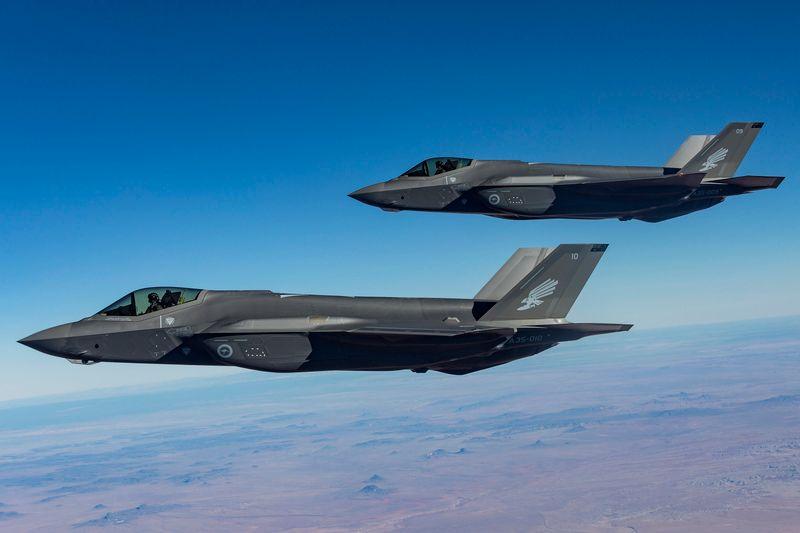
The F-35 is the common thread stitching European deterrence. The program’s maturity needs to be matched in the Indo-Pacific.
In 2022 Ukraine made “deterrence” a household term as proof-positive of what happens when it’s in short supply. Reeling from Hamas’s attack in October, Israel has underscored the dire necessity of a swift and networked response for the catastrophic moment when deterrence fails.
In contrast to both heinous attacks, the world can also see where deterrence is working – the NATO Alliance. The integration and alignment of its member militaries in Europe is replicable elsewhere in the world outside a formal alliance structure, so long as some of the same tool sets are in place. As US and allied defense leaders respond to a new crisis in the Middle East – and assess how to avert conflict in the Indo-Pacific –– they should look at which tools can be most readily surged to meet the moment.
One of the most effective is the F-35 weapon system, which is a primary delivery vehicle of that alliance-based deterrence.
As the global security situation worsens, with greater uncertainty arising from the war in Israel, it is essential to maintain a networked, highly capable deterrent. The F-35 exemplifies that capability. In the all important and vast Indo-Pacific theatre, the fifth-generation aircraft has the potential to curb nation-state level conflict, but the US, its allies and partners have additional work to unleash its full potential.
The F-35 is the common thread stitching together European deterrence
The F-35’s presence alone is a powerful example of alliance-based deterrence. Case in point: the noted drop in Russian harassment of U.S. drones in Syria coincided with the F-35’s arrival in the Middle East. As the tip of the deterrence spear, having F-35s in theatre bolsters NATO readiness for a high-intensity conflict in contested environments.
That F-35 presence in Europe is also growing: NATO has established F-35 maintenance and supply depots from Italy to the Netherlands, and every F-35 fleet in the region has achieved initial operational capability, with combat-ready jets. The U.S. and international F-35 operators regularly train together to bolster readiness and interoperability. F-35s were also front and center during Air Defender 2023 – NATO’s largest-ever air exercise.
Also of note, during this year’s Arctic Challenge exercise, American, Dutch, and Italian F-35s operated with a common Mission Data File for the first time in the European theatre. The allies were able to plan, fly and execute a combined debrief with shared data in a common classified environment.
What’s more, the collective fleet of F-35s across NATO countries can also share information seamlessly through its secure Multifunction Advanced Data Link. This provides unprecedented situational awareness and interoperability. Equipped with the NATO standard Link 16, F-35s can also share information with fourth-generation aircraft, naval systems, or ground assets for joint all domain operations.
More than 600 F-35s are expected to be stationed in European by the 2030s – arguably the most networked assembly of firepower ever amassed in Europe. But Europe is not the only place where such deterrence is desperately needed.
Israel
It is still early in the war between Hamas and Israel, but as the U.S. and its partners seek to keep the conflict from spreading into a broader, regional war, one thing is clear: the ability to project hard power is essential to backing up western diplomatic efforts. While it remains to be seen what will emerge from this highly fluid situation, a networked deterrent of the kind the F-35 offers will have a central role.
The vastness of the Indo-Pacific requires a more muscular F-35 presence
China's assertive posture in the South China Sea – and beyond – and its highly sophisticated, rapidly growing military capabilities have raised concerns of another Ukraine in waiting. Here in the Indo-Pacific, the F-35 has a pivotal role in deterring aggression.
The F-35’s ability to operate and survive in contested environments, including the South China Sea, is a critical advantage. However, more must be done to strengthen and grow the connective tissue between F-35 allies and partners in the Indo-Pacific. While several efforts are already under way, the west should not wait for another crisis like Ukraine to accelerate this connectivity.
In August, Australia announced plans to build a factory that will produce the stealth coating and provide support as a “regional hub for maintenance” for F-35s in the South Pacific region. Japanese F-35s also made their first foreign deployment to Australia last month to “further deepen defense cooperation for a free and open Indo-Pacific.” This follows a June 2023 announcement that Japan-based companies would begin servicing F-35 engines for both U.S. and Japanese aircraft in Tokyo. In September, the U.S. State Department approved a sale of 25 more F-35s to South Korea, a deal that Congress recently approved.
By 2030, the U.S. and partner nations expect to have 400 F-35s in the Indo-Pacific. This is a good baseline for deterrence, but the vast distances of the theatre and the sophistication of the threats posed by China requires quality and quantity. In other words: more F-35s.
Everyone in the defense ecosystem has heard the aphorism “good progress so far, but much more remains to be done.” That is indeed true of F-35s in the Pacific. More does need to be done to realize the full potential of F-35s in the region. Anyone who doubts the value at stake should take another look at Ukraine.
Wars don’t begin because someone was considered too strong. Part of being strong is demonstrated, unequivocal commitment – which an increased F-35 presence would clearly signal both to America’s friends and potential adversaries. But hardware alone doesn’t win wars; people trained to fight together do. This means it isn’t just the aircraft or the investments in infrastructure alone that are needed, crucial as they are.
Enhancing F-35 interoperability with regional partners is key. The basic work of “getting the reps in,” including collaborative training and multinational exercises, underpins a networked and agile force of F-35s that can respond in times of crisis.
America and its partner nations must increase investment in the F-35 program and related infrastructure for the Indo-Pacific. We need to make “deterrence” a household term here, too – proof-positive of the free and open future that can be when it’s abundantly available.
Rob Schroder is a retired Marine aviator and founder of SteerBridge Strategies. Keith Webster is President of the Defense and Aerospace Council.

A Defense Win for Americans and Israelis in Arkansas
By Bradley Bowman • RealClearDefense
A Path to Success Against Iran
By Michael Schwartz • RealClearDefense
The World Cup Is Over. The Drone Threat Isn’t.
By Mitzi Perdue • RealClearDefense
AI Should Speed Veterans’ Benefits, Not Decide Them
By Rob Schroder • RealClearDefense
Don’t Be Swayed by Tactical Nukes
By Benjamin Giltner • RealClearDefense
USS Stout Loses Power During Port Visit Due to ‘Engineering Casualty’
By USNI News
Air Force Lessons Learned From Operation Epic Fury
By Tabitha Reeves, National Defense
Marines Need Nine More Amphibious Warships To Carry Out Its Missions
By TWZ
AFRL, ACC Fly XQ-67A Drone To Test Autonomous Teaming
By Airforce Technology
F-35B Releases Meteor BVRAAM for the First Time
By Parth Satam, The Aviationist