
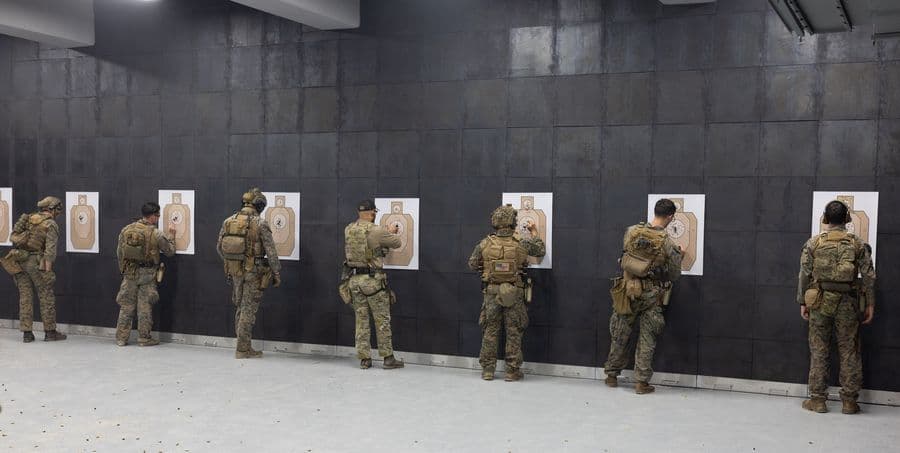
Finding the right target: Korea Coast Guard Training Compound, South Korea, 22 October 2026 (Kindsey Calvert/DVIDS)
OPCON: Washington Wants Flexibility, Seoul Wants Control
Last updated 06:43 AM EDT • Read time: 5m
A South Korean push for operational control won’t give it a say over how the U.S. uses its forces beyond the Peninsula.
Lieutenant General Joseph Hilbert, commander of the US 8th Army in South Korea, recently argued that it would be “irresponsible” for American troops stationed on the Korean Peninsula to focus exclusively on threats there. While reaffirming Washington’s commitment to defending South Korea, Hilbert stressed that U.S. forces must remain prepared for missions beyond the Peninsula. His remarks revived a longstanding debate over the strategic flexibility of U.S. Forces Korea (USFK), which gained prominence when Washington redeployed approximately 3,600 U.S. troops from South Korea to Iraq in 2004, raising concerns about both weakened deterrence and unwanted involvement in overseas conflicts.
Hilbert’s remarks reflect Washington’s changing strategic priorities. The Trump administration’s 2026 National Defence Strategy assigns South Korea primary responsibility for deterring North Korea, with “critical but more limited” U.S. support. This shift could give Washington greater flexibility to employ its forces across the Indo-Pacific amid intensifying strategic competition with China. For Seoul, however, a more regionally oriented U.S. military presence raises two concerns.
First, the diversion of American forces could weaken deterrence against North Korea. Despite its substantial conventional military capabilities, South Korea still depends on U.S. extended nuclear deterrence, intelligence and surveillance assets, missile defence systems, and strategic airlift and logistical support.
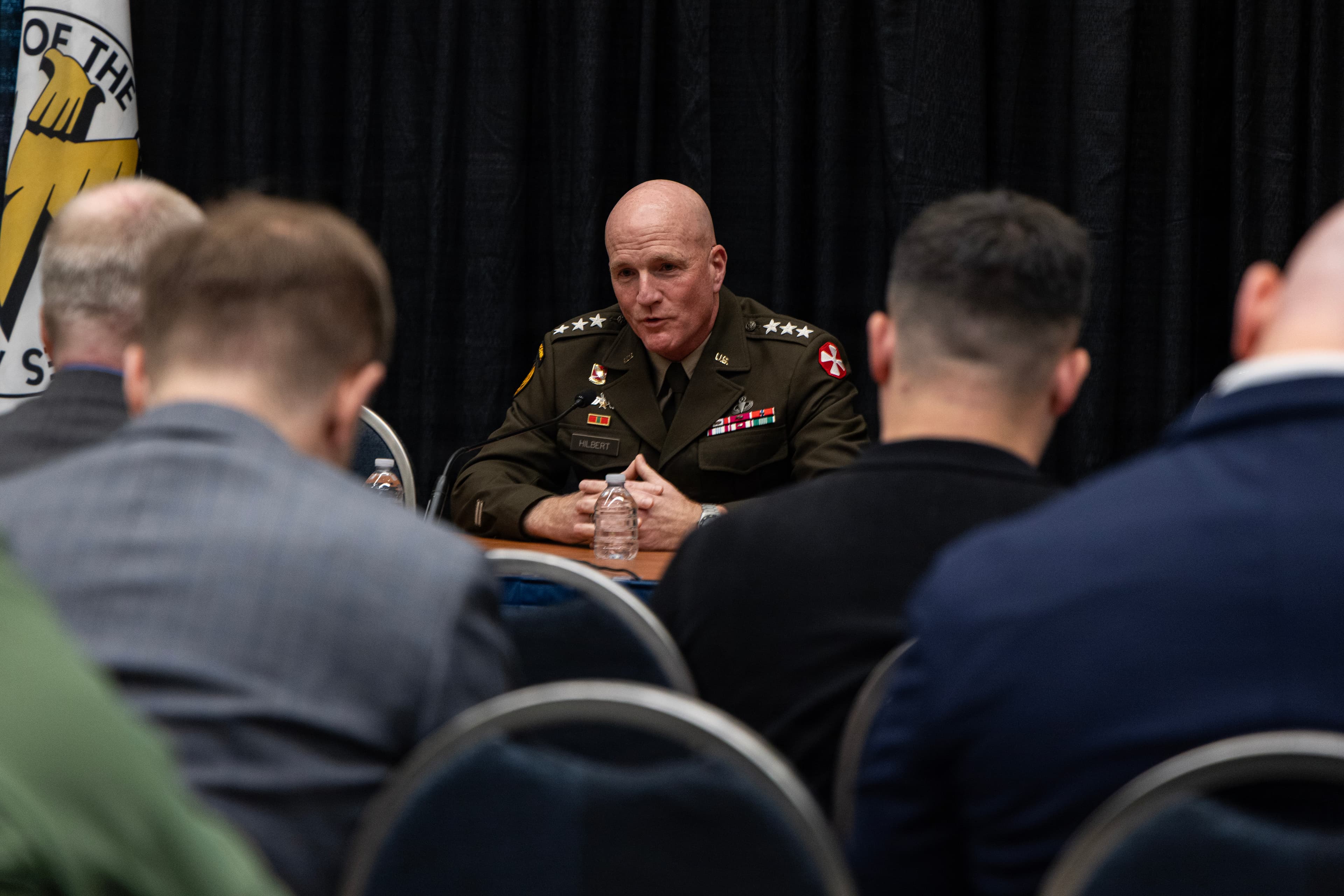
U.S. Army LTG Joseph E. Hilbert argued that it would be “irresponsible” for American troops stationed on the Korean Peninsula to focus exclusively on threats there (Jared Simmons/DVIDS)
U.S. Army
Second, Seoul is reluctant to become entangled in a U.S.–China confrontation. A Taiwan Strait crisis could involve U.S. forces or military facilities in South Korea, exposing Seoul to Chinese retaliation even without its direct participation. It could also invite opportunistic North Korean provocations while US. .attention and resources are concentrated elsewhere, raising the prospect of simultaneous crises.
This concern is particularly relevant to the Lee Jae-myung government, whose pragmatic diplomacy emphasises restoring stable relations with Beijing after years of strained ties under former President Yoon Suk-yeol, partly to secure China’s cooperation in re-engaging North Korea. Lee’s preference for avoiding entanglement in cross-strait tensions is also consistent with his controversial 2024 remarks as opposition leader, when he suggested that South Korea should avoid taking sides in a potential Taiwan Strait conflict.
In short, South Korea fears both reduced American protection and unwanted involvement in a wider clash.
Against this backdrop, Lee has renewed his emphasis on the early transfer of wartime operational control (OPCON), arguing that South Korea possesses sufficient capabilities to take greater responsibility for its own defence. Yet OPCON transfer may serve different strategic purposes for the two allies. Washington may view a South Korean-led command structure as a means of shifting greater conventional defence responsibilities to Seoul while freeing its own forces for regional contingencies. Seoul, meanwhile, sees OPCON transfer as a way to strengthen its control over Peninsula defence, with the United States shifting to a supporting role. Both governments may consequently support the same institutional transition for different strategic reasons.
Yet this convergence obscures a deeper limitation. OPCON transfer would not, by itself, grant Seoul authority over independent USFK operations or guarantee a meaningful say in decisions about employing U.S. forces based in South Korea in a Taiwan Strait contingency. This limitation leaves Seoul in a difficult position. It cannot easily oppose Washington’s efforts to adapt its military posture to strategic competition with China. Yet accepting an expanded regional role for USFK without clear consultation could weaken Seoul’s influence over decisions about whether and how U.S. forces and military infrastructure based on its territory become involved in conflicts beyond the Peninsula. Even if OPCON transfer is successfully implemented, South Korea’s greater operational authority over Peninsula defence would not necessarily translate into greater influence over U.S. regional military decisions.
Recent tensions over intelligence cooperation underscore the importance of effective consultation. South Korea’s National Intelligence Service was excluded from a trilateral meeting with the United States and Japan on North Korean cyber threats, raising questions about mutual confidence. South Korea’s ambassador to the United States Kang Kyung-wha also acknowledged limitations in high-level communication with the White House. These incidents illustrate the challenges of maintaining effective coordination at a time when the two allies face potentially divergent strategic priorities.
Seoul’s most realistic option is therefore neither to reject American strategic flexibility outright nor to accept it unconditionally. It should seek clearer consultation arrangements governing regional U.S. military operations that could affect South Korea’s security or territory, alongside credible assurances that essential U.S. capabilities will remain available for Peninsula defence, even as Washington expands its regional commitments.
Without effective consultation and agreement on how responsibilities and risks should be shared, the allies may continue moving along parallel tracks. Such differences could become particularly consequential in a regional crisis, when Washington and Seoul may hold conflicting expectations about the use of USFK and the extent of South Korean involvement.
Kuyoun Chung is an Associate Professor at Kangwon National University. Her research focuses on US foreign policy, East Asian affairs, alliance politics, and emerging technologies.
This article appeared originally at Lowy Institute's the interpreter.
We Cannot Build Tomorrow's Weapons With Yesterday's Alloys
By Joseph F. Krause • RealClearDefense
Americans Will Sacrifice for Their Country, Not for Politicians
By Jane Li • RealClearDefense
No Need for a New World Order
By Will Thibeau • RealClearDefense
Congress: Don’t Let the NDAA Hand China Our Defense Blueprints
By Richard Newton • RealClearDefense
Washington Cannot Ignore Afghanistan’s Weapons Legacy
By Saima Afzal • RealClearDefense
Marines Deploy Neros Archer Drone in Live Fire Exercise for First Time
By USNI News
Confessions Of An SR-71 Blackbird Pilot
By Howard Altman, The WarZone
Air Force Exploring Creative Ways to Produce More Pilots
By Laura Heckmann, NatDef
"Super F-22' Propels Rator to Fly With F-47 Into 2060s
By Kris Osborn, Warrior Maven
GA-ASI and Saab Test AEW Payload on MQ-9B
By Stefano D'Urso, The Aviationist