
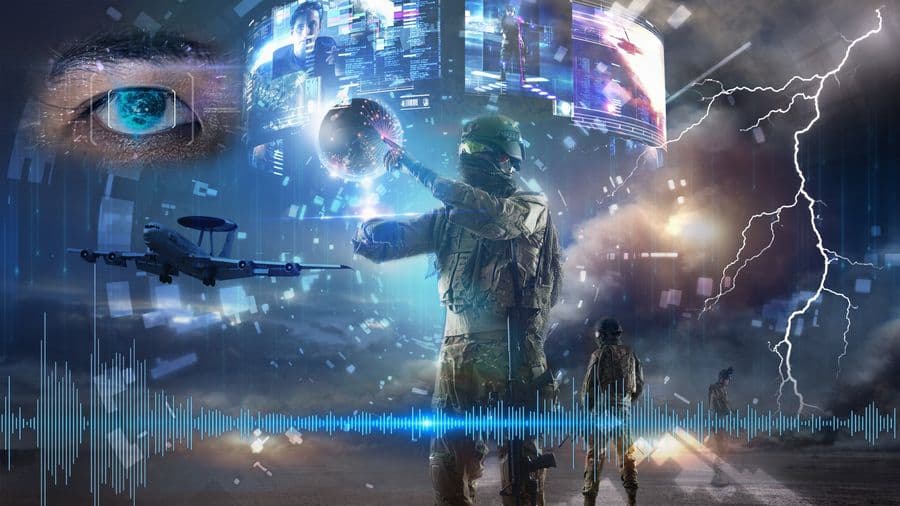
What's Special About Ukraine's Frontline Information Warfare?
Last updated 06:51 AM EDT • Read time: 5m
Tactics in Ukraine That Might Surprise U.S. Generals, Admirals, and Politicians but Reveal Exactly the Soldier They’re Looking For
“Keep your mouth open,” recommends a towering soldier as he strolls past “it helps your ears with the blast.” Behind him, downhill, more explosions hit a tree line. They echo back through our small valley, punctuating the steadier fire. Occasionally, men in camo jog across the field, crouching with guns to reach a position and lay fire on the target from a new angle. Behind Bakhmut, Ukraine’s eastern front, we are observing a combined arms warm-up for the counteroffensive.
This grey-bearded soldier, soon-to-be grandfather, is a seasoned fighter. His life took a sudden turn on the first day of the war when Russia’s VDV airborne troops landed at Hostomel airport near Kyiv, where he ran his businesses, one dealing with hydrogen-powered cars and another in cryptocurrency. He wants us to join the gunplay, just to try target practice with the guys.
Despite his enthusiasm, we abstain from shooting. We’ve come to help. I, an ex-Navy officer, and Jake, a US Army veteran, have our experiences with guns. “Save the ammo,” we say, politely turning down the invitation, “…for the Russians.” Everywhere we go, men complain of ammo shortages. The soldier's disappointment, however, leaves us questioning our role and the impact we can have in this environment.
We came to the front to deliver vital supplies and to understand the frontline troops' needs. Yet, it feels strange, almost tourist-like, as we watch the preparations for a counteroffensive against the Russian lines.
Our journey takes us through command posts, equipment inspections, and interactions with the frontline soldiers. At one unit, holding an especially dangerous position on the Bakhmut line, a six-month-pregnant soldier has become a local celebrity. When we stop by, we record a video with her, explaining her unit’s need for more night vision equipment. We discover the power of social media in this war – sergeants and company commanders have turned to these platforms, conducting a charm offensive to secure more resources.
This public relations effort by soldiers seems unusual from a US military perspective, where information sharing is strictly controlled. The US approach can be best captured in the OPSEC-focused guidance passed to junior sailors: “loose lips sink ships” and its echo in admiral-filled conference rooms “loose tweets sink fleets.”
Even with President Zelensky leading the strategic-level information warfare, securing $69 billion in military aid, we observe that Ukraine has managed to harness the power of information warfare at the lowest-echelon of troops. This whole-of-society information warfare approach involves everyone – from politicians to foot soldiers – and seems to yield impressive results.
The Ukrainians appear to have unearthed the "strategic corporal" concept long desired by western military leaders. These junior soldiers adeptly leverage the internet and social media platforms, transforming them into a potent tool for information warfare.
The tactics used by the Ukrainian soldiers, though counterintuitive to US generals, present an intriguing lesson for future conflicts. They may not comply with traditional western military doctrines, yet the success of their information warfare on both strategic and tactical levels indicates there might be room for adaptation.
Despite the high-tech equipment flooding Ukraine, frontline troops still express their need for night vision gear, drones, and expendable vehicles. The supply and demand dynamics of this conflict go beyond the government-to-government mil-tech which most press coverage discusses. More, the mass provisioning of informal aid is driven almost exclusively by these unit-level social media campaigns about front-line need.
Western militaries are probably not ready to adapt similar tactics. First, calls for stronger tactical-level information warfare focus on training. Our soldiers and sailors probably don’t need training in how to use social media – I’m thinking back to a junior cryptologist I worked with, an influencer, but more lethal for her digital nativism than for her NSA training – but empowerment and trust. I’m not arguing that ship captains tweet for help when they run low on parts (the USS Theodore Roosevelt saga showed us how that ends). But I am saying that the US military approach to information warfare and propaganda is the exact opposite of the most successful information campaign in recent decades.
These observations lead me to argue that the Ukrainians are onto something. Their methods of information warfare, though distinct from the western military approach, are worth studying. Regardless of the next battleground, it's clear that maintaining dominance in the information environment is critical for democracies hoping to leverage their societies’ deep resources and stay close with their allies.
Austin Gray, an ex-US Navy intelligence officer and current Masters in Public Administration candidate at the Harvard Kennedy School, shares insights from his time in Ukraine working with the NGO, Zero Line, and the Kyiv Engineering Corps. His unique perspective on modern warfare tactics highlights the importance of information warfare in current and future conflicts.

Reflecting on an Epic Horse Campaign in the Mountains of Afghanistan
By Brian Glyn Williams • RealClearDefense
The Godfather of American Foreign Policy Realism Speaks to Today’s World
By Francis P. Sempa • RealClearDefense
In Pursuit of Nuclear Abolition
By Peter Huessy • RealClearDefense
Innovation Alone Won’t Prepare the U.S. for the Future Battlefield
By Joshua Segal • RealClearDefense
The sUAS Tactical Trifecta
By Bryan T. Woody • RealClearDefense

Navy Civilianizes Six Former Flag Billets, Reduces Six to Captains
By Mongilio, USNI N.
Raytheon's $8B Contract for Strategic Comms Terminal Modernization
By M+A El
America’s Maritime Moment Will Not Wait
By CDR Salamander
Armor Up?
By Marine Corps Compass Points
Who Shoots Down the Drone Over the Shipyard?
By John Ferrari & Dillon Prochnicki • RealClearDefense