
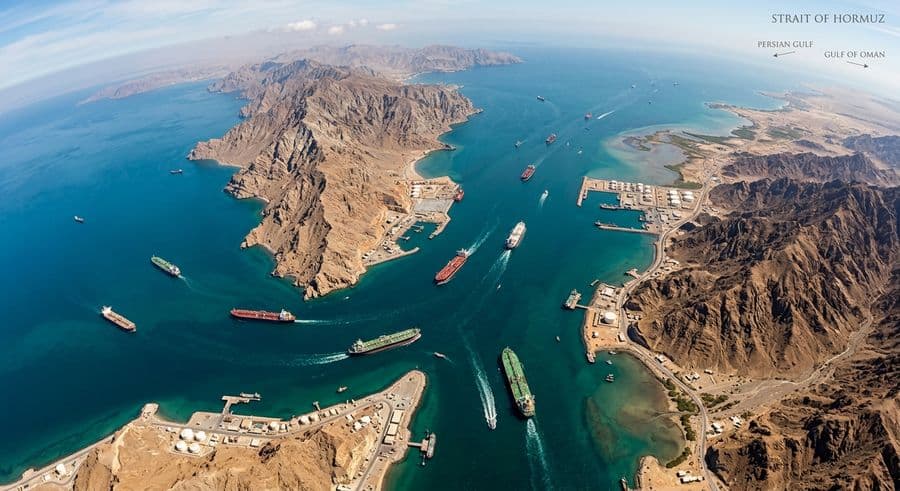
Build Around the Blackmail
Last updated 04:27 PM EDT • Read time: 9m
A Strategy to Break Iran's Hormuz Leverage
Iran's chokehold on the Strait of Hormuz is not a geographic fact but a temporary infrastructure gap. Gulf producers and Turkey already have seven bypass pipelines built, under construction or in planning; phased, funded and defended, they could carry most of what the strait once did. Reopening the waterway to routine commercial shipping could require a major ground operation, and even military control might not satisfy the insurers. Building around it requires no Iranian consent. Announcing such a program is itself the coercive act: it turns Tehran's central asset into a depreciating one and makes waiting stop paying.
Introduction
Iran spent $1.8 billion and seven years on a pipeline it does not use — a thousand kilometers from Goreh to Jask on the Gulf of Oman, built to move a million barrels a day into open water without passing through Hormuz. The International Energy Agency rates the pipeline and terminal effectively non-operational: a test load was exported in late 2024, and no further oil has left Jask since. Iran cannot escape its own chokepoint; the world can escape Hormuz.
Against 21.6 million barrels a day transiting the strait before the war, most of what still moves now goes around it — through the Saudi East–West line to Yanbu, the Emirati line to Fujairah, and Kirkuk to Ceyhan. The workarounds already carry the Gulf.
The Toll, Not the Closure
The danger now is not that Iran closes the strait. It is that Iran opens it, on Iranian terms, at an Iranian price. The Persian Gulf Strait Authority, established in May, requires a lengthy declaration before transit, with some vessels reportedly paying as much as two million dollars. Owners stay away because of the missiles, not the invoice, so the fee is nowhere near its ceiling, and at scale even modest charges become a recurring source of hard currency. Such tolls endure: Denmark’s Sound Dues lasted four centuries before ending by purchase, not war.
Forcing the Strait Open
Reopening the waterway by force may be possible, but costly in American lives. The Council on Foreign Relations describes a forced reopening as potentially requiring naval operations, mine countermeasures, strikes on Iranian infrastructure and ground forces for coastline security. Jason Campbell of the Middle East Institute indicated ground forces of tens of thousands would be needed; others believe Marine ready groups could reopen the lower half. But the experiment has already been run. On 18 August the President declared the strait open and operating, all mines removed; Central Command declined to confirm it. That same day a projectile struck a cargo ship a mile off Oman, killing a crew member. Crossings stood at ten a day against about 130 before the war. Opening a lane for escorted convoys is not restoring commercial traffic. The test is not whether warships can pass but whether underwriters will price the risk. You can destroy launchers. You cannot bomb an insurance market. And a significant share of the world's spare capacity sits behind the strait: as one analyst put it, a barrel trapped behind a chokepoint is not spare capacity.
Moving Gulf Oil Around the Strait
The first phase needs no construction. Qatar’s LNG trade moves in a fraction of the 130 vessels that normally transit Hormuz — a different protection problem — though it must be the right kind. American ships already assist on the southern route, and one was struck there on 18 August. General escort of a corridor is not a scheduled convoy of named vessels with cover written against that arrangement. A scheduled convoy could be organized in weeks.
The second phase, within twelve months, uses steel already in the ground. Terminal capacity, as much as pipe, constrains Saudi throughput: the East–West line runs at its seven million barrel ceiling while the berths at Yanbu load four and a half. Debottlenecking adds several hundred thousand barrels a day; restoring the Kirkuk line to Ceyhan adds more, its constraints political rather than geographic.
The third phase is under way: a second Emirati line to Fujairah, being accelerated, doubling that corridor to 3.6 million barrels a day by 2027. The fourth is structural. Iraq’s new line to Baniyas would move two million barrels a day to the Mediterranean, though sources told Reuters on 17 August it needs four years and fifteen billion dollars. Add Aqaba and Duqm on the Arabian Sea, decisive because it ends outside the Gulf.
The categories separate. About 6.1 million barrels a day flows around the strait today through pipelines. The Ceyhan line alone runs at a tenth of its 1.6 million barrel design for political rather than engineering reasons, and Saudi crude reaches the Red Sea faster than Yanbu’s berths can load it. Together that is well over two million barrels a day of throughput requiring no new pipeline construction — only political unblocking and jetty work. If every announced project were completed and operated at full capacity, total bypass capacity would approach sixteen million; Goldman Sachs takes the conservative view, estimating that more than sixty percent of pre-war Gulf exports could be insulated from Hormuz by the end of 2028. Against 21.6 million transiting the strait before the war, neither replaces Hormuz, and neither needs to. Add lower structural demand and non-Gulf production replacing Iranian barrels kept off the market, and the residual becomes small enough that closing the strait is a price event rather than a supply crisis. The aim is not to make the strait unnecessary but to make closing it unprofitable.
Every phase should be accelerated; the value of the program is a function of how fast it arrives. It is paid for by the producers it rescues. Washington’s role is to underwrite and unblock, not to spend. What Americans get is not cheaper gasoline but a cap on the next spike.
Defending the Corridors
Iran is already attacking them, and not opportunistically. An April strike on a pumping station along the Saudi East–West line cut throughput by seven hundred thousand barrels a day; the ministry announced full capacity restored three days later. In July the Houthis claimed strikes on Aramco facilities at Yanbu and Jazan: Jazan burned, Yanbu was intercepted. Arab intelligence reported in mid-August describes the Revolutionary Guard deliberately expanding the battlefield to the Red Sea, the route Saudi Arabia uses to get around the chokehold. Tehran identified the workaround as the thing to destroy. Nobody builds a campaign against something that does not threaten them.
Analysts told CNBC that pipelines are as vulnerable to cheap attack as the tankers they replace, and are a hedge rather than a replacement. Both true; neither an objection. But note the targets — loading facilities, pumping stations, terminals, storage. All sit on friendly soil and can be hardened, defended and repaired. Ships a few miles off a hostile shore cannot. An attack on sovereign territory is also a clear violation that can justify striking fixed Iranian infrastructure in return — an option no one has against a mine at sea.
Much of the defense is unglamorous: vulnerability mapping and low-tech hardening of the fixed nodes. The rest is air defense built for swarms, where one-shot interceptors lose by arithmetic and the answer is area effect and magazine depth: high-power microwave systems and cheap interceptor drones. Redundancy is also a defense: Yanbu’s cargo sails north through Suez, and Fujairah, Ceyhan and Duqm exit on three other seas. The program does not produce a safe route; it produces five routes on four seas, forcing an adversary to contest a distributed network rather than dominate one chokepoint.
Gas needs a different mechanism. No pipeline carries liquefied natural gas across land: oil is solved by bypass, gas by substitution and escort.
Five instruments: a gas escort corridor with a war-risk backstop; integrated Gulf air and missile defense drawing on Israeli technology and Ukrainian counter-drone expertise, structured so Doha can join without normalizing; allied insurance rules, building on Lloyd’s new model clause, penalizing payment of Iranian transit fees; Development Finance Corporation reinsurance conditioned on route choice; and a permanent declaration rejecting Iranian control of the strait or any fee regime.
The program needs one accountable authority directed from the White House: a civilian owning delivery and financing, a flag officer movement and protection.
Announcement as Coercive Leverage
Announcing the program is itself the coercive act. A published schedule turns Iran’s central asset into a wasting one: every month Tehran holds out, the chokehold’s value falls. Treasury Secretary Scott Bessent said in mid-August that within two years the strait would become irrelevant, just another body of water, with more than half of prewar volumes moving by pipeline. The ambition is right; the schedule and money are missing. It is an argument for acting now and requires nothing from Iran. The risk is real, a depreciating asset invites use-it-or-lose-it escalation, which is why the defense architecture cannot lag the announcement.
Economic pressure need not bring down the Iranian regime. Pressure plus an inability to impose costs leaves Iran a floundering economy, a security apparatus it cannot fund, and no coercive hold on the region’s exports. The distinction is between reversible pressure and structural constraint. Sanctions reverse on a signature: after the 2015 nuclear agreement, Iranian exports recovered from roughly one million barrels a day to over two million within a year. A pipeline to Duqm does not unbuild itself when an administration changes.
Conclusion
Iran’s strategy is to wait. The calculation is that Washington will lose interest before Tehran loses the strait. The corridors defeat that calculation without requiring the regime to fall. Each year of waiting leaves Iran holding a smaller asset than the year before. In time the Gulf exports around it while Iran’s revenue stays squeezed, leaving an Iran less able to coerce and less able to rebuild, without a military campaign to seize and hold the strait.
A chokepoint is worth only the absence of alternatives. Build them and the blackmail ends — not because Iran consents, but because consent stops mattering.
CAPT Lance B. Gordon (U.S. Navy, ret.) is a retired Navy intelligence officer, graduate of the Army War College and NYU School of Law, and former Partner/Principal at Ernst & Young LLP. He has written on the 2026 Iran campaign at RealClearDefense and Small Wars Journal.
The Unfinished Reform
By Mark W. Castillon • RealClearDefense
Winning the Data Advantage
By Turin Pollard • RealClearDefense
The Pentagon’s Quantum Race Needs a Warfighter’s Scorecard
By Burak Oktenli • RealClearDefense
The F/A-XX and the AIM-260 Reclaim the Perimeter
By Bruce Allen Lubbering • RealClearDefense
Iranian Cyber Operations
By Michael Groen • RealClearDefense
Winning the Data Advantage
By Turin Pollard • RealClearDefenseThe F/A-XX and the AIM-260 Reclaim the Perimeter
By Bruce Allen Lubbering • RealClearDefenseWinning the Data Advantage
By Turin Pollard, RealClearDefenseThe F/A-XX and the AIM-260 Reclaim the Perimeter
By Bruce Allen Lubbering, RCD
F-22 Pilot Directs CCA in Flight as ‘Airborne QB’
By Stephen Losey, Air & Space Forces