
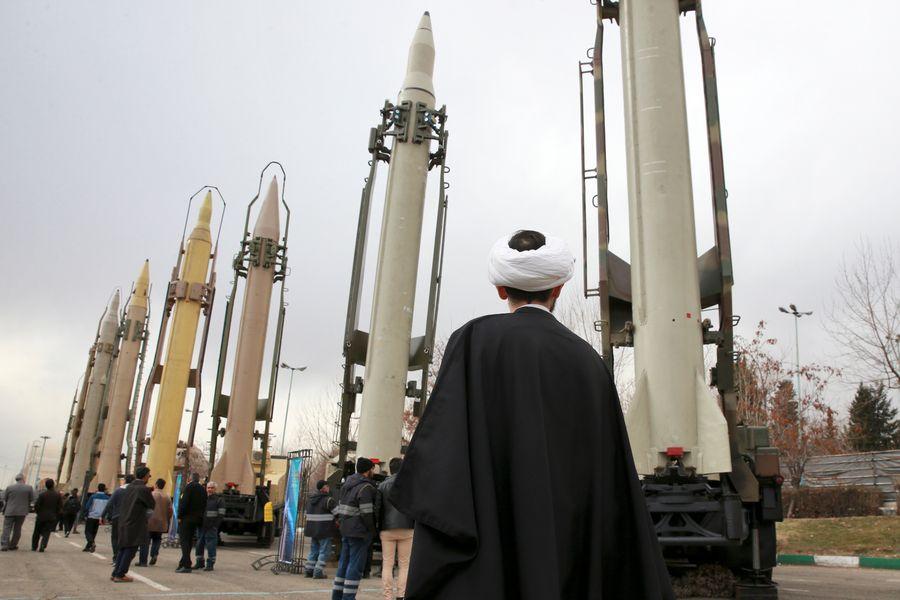
Iranian clergyman looks at domestically built surface to surface missiles displayed by the Revolutionary Guard in a military show marking the 40th anniversary of the Islamic Revolution, at Imam Khomeini Grand Mosque in Tehran, Iran. On Monday, April 8, 2019. (AP Photo/Vahid Salemi, File)
Going After the Cyprus Money Laundering Hub
Published Nov. 27, 2026 • Read time: 4m
With no appetite in Washington or Jerusalem for a costly ground occupation of Iran, the campaign to prevent the Islamic Revolutionary Guard Corps (IRGC) and its regional proxies from regenerating has become a war of economic pressure and financial and legal attrition. Over the past year, the United States and Europe have begun building the architecture for that fight.
In February, the European Union unanimously designated the IRGC as a terrorist organization, stripping Tehran of critical diplomatic legitimacy and criminalizing its fundraising networks across the continent. Meanwhile, U.S. Treasury Secretary Scott Bessent has expanded secondary sanctions and launched Operation Economic Outcast to sever Iran’s shadow banking, gold, and cryptocurrency lifelines from the global financial system. Paired with maritime and land interdiction, these measures are tightening the vise on Tehran’s ability to bankroll Hezbollah, the Houthis, and Hamas.
Yet financial containment is only as strong as its weakest regulatory link. Right now, a massive backdoor remains wide open in the Eastern Mediterranean: Turkish-administered Northern Cyprus.
Because only Ankara recognizes the self-declared Turkish Republic of Northern Cyprus (TRNC), the territory sits outside European Union jurisdiction and global anti-money laundering oversight. At the same time, it remains plugged directly into the global economy through correspondent banks in mainland Turkey. That combination—international legal isolation paired with Turkish financial connectivity—has turned Northern Cyprus into an off-the-books clearinghouse for illicit capital.
The Need to Remove All Fissile Material from Iran
Operation Epic Fury and the Illusion of Victory
Why Iran Cannot Simply Surrender
After the Midterms, the Right Strategy Against Iran
Investigative journalists and anti-corruption watchdogs have repeatedly documented how Northern Cyprus’s rapidly expanding casino sector, loosely regulated cryptocurrency exchanges, and booming coastal real estate market act as prime washing machines for dirty money. For sanctioned Iranian entities, Hamas financiers, and regional smuggling networks squeezed out of traditional banking centers, the territory offers an ideal sanctuary to park assets, launder cash, and move funds undetected.
This vulnerability cannot be separated from Ankara’s broader financial track record. Although Turkey was removed from the Financial Action Task Force (FATF) "gray list" in 2024, the global watchdog’s September 2026 mutual evaluation put Ankara back on notice over persistent failures to curb Hamas-linked terror financing and Iranian sanctions evasion. Every international wire and dollar-clearing transaction entering or leaving Northern Cyprus relies on Turkish intermediary banks. In effect, Ankara provides the financial bridge that keeps an unregulated laundering hub connected to Western markets.
Closing this loophole does not require a single soldier, a new treaty, or a congressional appropriation. Washington and Brussels already have the regulatory tools to shut it down—and they have demonstrated a growing willingness to use financial enforcement to hold regional actors accountable, as seen in Europe’s recent move to tighten oversight and enforce strict conditions on infrastructure loans in the Balkans.
To seal the Northern Cyprus backdoor, the United States and Europe should execute three immediate, coordinated steps:
First, Treasury Secretary Bessent should deploy Section 311 of the USA PATRIOT Act. Under Section 311, Treasury has the unilateral authority to designate foreign jurisdictions or specific financial institutions as "primary money laundering concerns." Applying this designation to Northern Cyprus offshore banks—and to the mainland Turkish correspondent banks that clear their transactions—would immediately sever them from the U.S. dollar system. Even foreign banks indifferent to Cypriot politics will drop any institution flagged under Section 311 rather than risk losing their own dollar-clearing privileges.
Second, the United States and European members of FATF should link Turkey’s standing directly to compliance in Northern Cyprus. Washington and Brussels should make clear to Ankara that so long as Turkish banks serve as the clearinghouse for TRNC financial entities, Turkey bears direct responsibility for anti-money laundering enforcement in the north. If Ankara refuses to impose strict oversight on TRNC banks, casinos, and crypto brokers, it should be returned to the FATF gray list without delay.
Third, Treasury and the European Union should expand targeted designations against non-bank washing machines. Under Operation Economic Outcast and the EU’s updated sanctions-circumvention directives, regulators should blacklist virtual asset service providers, money exchanges, and major real estate developers in Northern Cyprus that facilitate capital flight for Iranian or Hamas-linked operatives, working closely with the Republic of Cyprus’s National Sanctions Implementation Unit to prosecute European facilitators.
The lesson of recent years is clear: removing senior terrorist commanders is only a temporary setback if the financial plumbing that funds their replacements remains intact. By extending their financial crackdown to Northern Cyprus, Washington, and Brussels can force Ankara to make a clear choice—either protect its own fragile access to Western capital markets or continue serving as a financial safe haven for the IRGC and its proxies.
Lise Korson is a political scientist and conflict resolution strategist specializing in Middle Eastern geopolitics, asymmetric threat.
Ending the Conflict with Iran
By Anthony Cowden • RealClearDefense
Going After the Cyprus Money Laundering Hub
By Lise Korson • RealClearDefense
Don’t Bet Against CMMC
By Thomas Graham • RealClearDefense
When Losing Control of AI Becomes a Weapon
By Yunus Emre Tumen • RealClearDefense
International Allied Reliability of States: Criteria and Evolution
By Sergey E. Ivashchenko • RealClearDefense
Marine Corps Offers Early Exit to Some Enlisted Troops
By Rachel S. Cohen, FNN
U.S. Navy Taps Raytheon to Advance SLCM-N Nuclear Cruise Missile
By Naval News
U.S. Coast Guard Takes Icebreaker on Maiden Voyage to the Arctic
By Navy Times
Monty: Riding the Pendulum
By Zachery Thomas, DODReads
Sign of the Times: CCAs Dominate a Major Fighter Conference
By Bill Sweetman • The Strategist (ASPI)