
Ensuring Iran Doesn't Procure Nuclear Weapons
Last updated 06:30 AM EDT • Read time: 6m
On June 21, in a Wall Street Journal op-ed, former Vice President Mike Pence sharply criticized the 14-point preliminary memorandum of understanding taking shape between the Trump administration and Iran, warning that it amounts to little more than appeasement. On the other hand, the next 60 days of negotiation to reach the final agreement can still provide an invaluable opportunity to achieve America’s goal. While his concerns regarding Tehran's past duplicity are entirely justified, the path forward is not to abandon diplomacy, but to rescue it by reinforcing the talks with unyielding leverage.
To deploy this unyielding leverage and prevent this fragile preliminary agreement from turning into a permanent strategic failure, Washington must wield its ultimate economic threat during the upcoming 60-day negotiation window: bombing Iran’s oil export hub at Kharg Island if Tehran continues the stalling tactics it used to secure the preliminary agreement. While the administration is eager to claim a diplomatic victory before the midterm elections, trading unprecedented military gains for a lopsided deal squanders the true payoff of the conflict. Instead, a three-step Kharg Island Escalation strategy can ensure Tehran accepts a final, binding agreement that is fair to both sides and achieves the primary U.S. goal: ensuring Iran fully commits to not procure or develop nuclear weapons in the final agreement. As President Trump emphasizes: “We’ll never let Iran have any nuclear weapon.”
Of the 14-point preliminary memorandum, only Point 8 addresses this nuclear commitment, stating that Iran "reaffirms that it shall not procure or develop nuclear weapons." This language is virtually identical to the 2015 Joint Comprehensive Plan of Action (JCPOA). To turn this into a permanent reality, the final arrangement must move beyond paper promises that allow Tehran to develop nuclear weapons under the guise of a peaceful nuclear program.
Moreover, it should be noted that no matter how perfect the final agreement turns out to be, it must be supplemented by measures outside the agreement. A critical one is a military enforcement mechanism of last resort to prevent a sudden nuclear breakout—defined as Tehran attaining a nuclear weapon capability before it can be detected and stopped. While Washington must continuously improve timely detection, it also requires military tools as a last resort to penalize any nuclear breakout so severely that Iran would never attempt to “procure or develop nuclear weapons” in the first place, thereby providing the United States with the genuine “trust, but verify” assurance it needs.
This military baseline already exists. President Trump executed two bold military actions to establish this credible last resort. Operation Midnight Hammer in June 2025 proved American capability and will by systematically bombing Iran’s three major nuclear facilities—Fordow, Natanz, and Isfahan. This was followed by a continuous bombing campaign beginning February 28, 2026, against key military targets. Supplementing diplomatic and economic pressures with military action as the ultimate penalty will deter Iranian nuclear weapon development both now and in the future.
To salvage this historic opportunity, Washington must pivot to a realistic strategy that Tehran cannot ignore: a three-step Kharg Island escalation model. Focusing on Kharg Island hits Iran where it hurts most—its oil revenue, which accounts for 90% of its oil exports and 50% to 60% of its government budget, the very funds critical to supporting the Islamic Revolutionary Guard Corps (IRGC). If Tehran stalls during the 60-day window or any mutually agreed extension, Washington executes a sequential response via precise airstrikes—first, bomb a minor section as a warning; if Iran continues to stall, second, disable a larger portion to deeply cut oil exports; and finally, at the sole U.S. decision, destroy the hub to sever their economic lifeline. Because this strategy avoids ground troops, the voters would support, making it clear that the U.S. would likely execute these strikes if Iran stalls or blocks a secure assurance of never nukes. Under this strategy, Iran would logically conclude that the optimal path is to collaboratively participate in the negotiation to save Kharg Island—its Achilles’ Heel, which it simply cannot live without.
To satisfy "trust, but verify," the agreement must mandate strict, intrusive verification measures for timely detection of cheating that have yet to be implemented. The final text must newly grant international inspectors unfettered, anytime-anywhere physical access to unannounced sites and require the future installation of real-time, continuous electronic tracking of centrifuge production lines. Establishing these precise baselines directly in the document ensures any hidden effort by Tehran to divert material is exposed without delay.
However, as the legendary strategist Fred Iklé famously warned, discovering a violation is meaningless without answering: "After Detection—What?" To overcome this historical hurdle, Washington must establish—outside the agreement—that a credible, external array of robust measures remains the ultimate last resort to deter or respond to any Iranian cheating after detection.
Ultimately, the administration must deploy this comprehensive strategy to recover from a lopsided preliminary memorandum favoring Iran and make necessary changes and additions during the negotiations to secure a final agreement ensuring Tehran permanently honors its commitment that it "shall not procure or develop nuclear weapons." In addition, this strategy requires executing two distinct programs outside the agreement: first, adopting the Kharg Island escalation model to prevent stalling during negotiations; and second, establishing robust external measures to deter or respond to cheating after detection. By doing so, Washington will maximize the return on the blood and money already spent on the bombings. In turn, Iran becomes the inaugural case for a long-term, globally enforceable, and fair nuclear nonproliferation regime to be established as soon as practical after the signing.
The administration will offer an olive branch to political opponents for their participation, drawing on their strengths and ideas to collaboratively develop this universal blueprint. Because it is accessible to the United States, allies, partners, nuclear aspirants, and adversaries alike, a universal system that benefits so many people across the entire world will yield a strategic payoff far higher than anyone can imagine. Elevating this 60-day window from a localized agreement with Iran to a foundational pillar of global security ensures a historic legacy—keeping the world safe from nuclear apocalypse not just for a decade or two, but for generations to come.
Brian G. Chow is an independent policy analyst with more than 190 publications on national security issues. He holds a Ph.D. in physics from Case Western Reserve University and an MBA with distinction and a Ph.D. in finance from the University of Michigan. He can be reached on X at @briangchow.
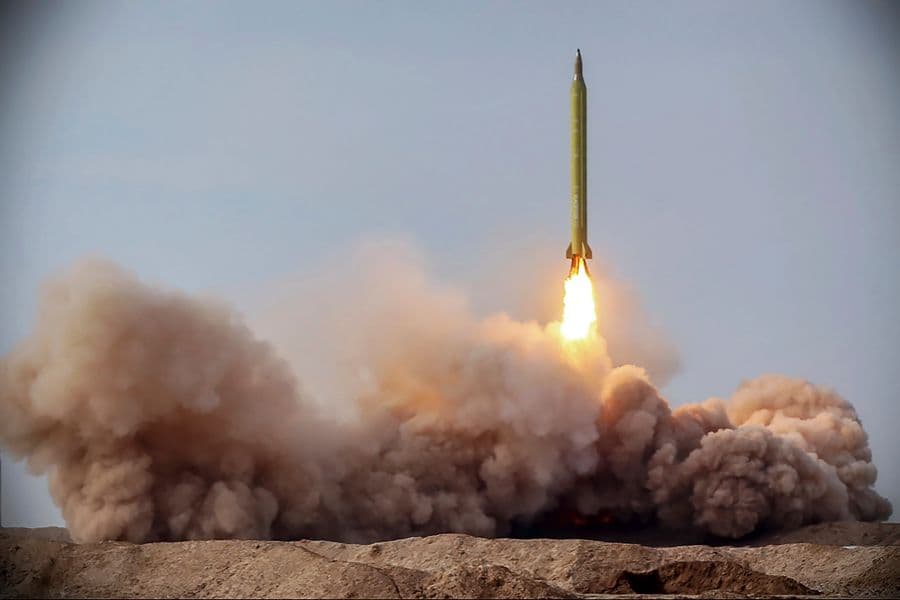
image: In this photo released on Saturday, Jan. 16, 2021, by the Iranian Revolutionary Guard, a missile is launched in a drill in Iran. Iran’s paramilitary Revolutionary Guard conducted a drill Saturday launching anti-warship ballistic missiles at a simulated target in the Indian Ocean, state television reported, amid heightened tensions over Tehran’s nuclear program and a U.S. pressure campaign against the Islamic Republic. (Iranian Revolutionary Guard/Sepahnews via AP)

In Pursuit of Nuclear Abolition
By Peter Huessy • RealClearDefense
Innovation Alone Won’t Prepare the U.S. for the Future Battlefield
By Joshua Segal • RealClearDefense
The sUAS Tactical Trifecta
By Bryan T. Woody • RealClearDefense
The Revolutionary War: When Strategic Options Share the Same Weakness
By Henry Yep • RealClearDefense
The Houthis Are Testing the Limits of Collective Defense
By Saima Afzal • RealClearDefense

Who Shoots Down the Drone Over the Shipyard?
By John Ferrari & Dillon Prochnicki • RealClearDefense
Northrop Grumman Breaks Out the Big Guns at AUSA
By Daniel Terrill, Defense News
Army Pursuing Diverse Array of New Anti-Air Interceptors
By Trevithick, The WarZoneWho Shoots Down the Drone Over the Shipyard?
By John Ferrari & Dillon Prochnicki, RCD
F-35C Lands for the First Time on a Ford-Class Aircraft Carrier
By The Aviationist