
Getting Deterrence and Diplomacy Right
Last updated 03:18 AM EDT • Read time: 4m
The war in Iran continues. Diesel prices rise. President Trump threatens to “annihilate” Iranians. Nowadays, headlines on such topics are as guaranteed as death and taxes. And it’s left Trump stumped. How can he, with the world’s most powerful military and wealthiest economy, not beat a much weaker country like Iran? By all measures, the United States should beat Iran.
Yet, this way of thinking, with its overreliance on rationality and empirical calculation, leaves out a crucial—the crucial—component of coercion and diplomacy: humans. For both to be successful, analysts and policymakers should consider the motivations, honor, culture, and fear that other countries’ decisionmakers have. The war in Iran and past wars which had a weaker power stand up to a stronger one showcase how deterrence is more than just making military threats, more than simple cause and effect. It’s a crucial lesson—better yet, warning—to be learned for nuclear deterrence.
As Thucydides wrote and Richard N. Lebow masterly explains, honor and fear are notable factors which determine the successes and failures of deterrence and compellence. If a country’s honor is at stake, compellence by another country is unlikely to be successful. The threatened country reasons that if it gives in to these threats, its leaders will look weak to their people, and giving in would open the door to further blackmail. Better to stand up now against the stronger country.
Honor is Tehran’s primary motive in opposing President Trump’s threats. The regime has an anti-American and anti-West reputation to uphold. It’s a main source of Tehran’s legitimacy in the eyes of Iranians. Tehran can’t accept President Trump’s threats, and because it can’t his coercion continues to fail.
Honor and fear explain why the North Vietnamese and the Vietcong stood up to the United States. The United States was one of, if not the, most powerful country in the world. Secretary McNamara and President Kennedy’s/Johnson’s “best and brightest” made statistical calculations and used rational models, like game theory, to determine that the United States would win this war and would coerce Ho Chin Minh to accept America’s demands. But it didn’t and they couldn’t. All their fine calculations couldn’t compute the psychological and human factors at play. Their use and notions of deterrence and coercion failed. The North Vietnamese viewed this war through the lens of anti-colonialism. They couldn’t capitulate to America’s escalation threats. Otherwise, they would have surrendered their honor and placed their country at risk to further threats and blackmail. Honor and fear drive the Vietnamese to fight, and ultimately win, against the United States.
This lesson is also applicable to cases not involving the United States. Take the war in Ukraine. Russia, the stronger power, attempted to coerce the weaker one, Ukraine. By economic and military calculations, Russia should have coerced Ukraine to accede to its demands. But Russia failed at this. Honor and fear, once again, account for Ukraine’s steadfastness against Russia, a fear of subjugation and honor for Ukraine’s distinct culture. Putin disregarded both, and Ukrainians and Russians continue to pay for his mistake.
For nuclear deterrence, the moral of this story is that deterrence is not simple. This is not to argue in favor of the United States getting more nuclear weapons or placing them on a more offensive footing. Quite the opposite. Threatening to use nuclear weapons in certain circumstances can increase the chances of deterrence failing and precipitate the very thing nuclear deterrence intends to avoid: nuclear war. Such instances are when honor is at stake and fear of worse outcomes from compliance to nuclear blackmail. For nuclear deterrence to be successful, less is more, less nuclear threats and less nuclear weapons.
All this is not to discount the arguments of Thomas Schelling. But his arguments on deterrence and compellence should be taker in junction with human factors and psychology. Doing so would successfully deter rivals and have a greater chance of keeping the peace. And in an age of nuclear weapons and multiple nuclear-armed countries, keeping the peace is necessary.
Benjamin Giltner is a policy analyst for defense and foreign policy at the Cato Institute, where he works on issues related to U.S. military strategy and foreign policy, great-power competition, nuclear weapons, and deterrence.
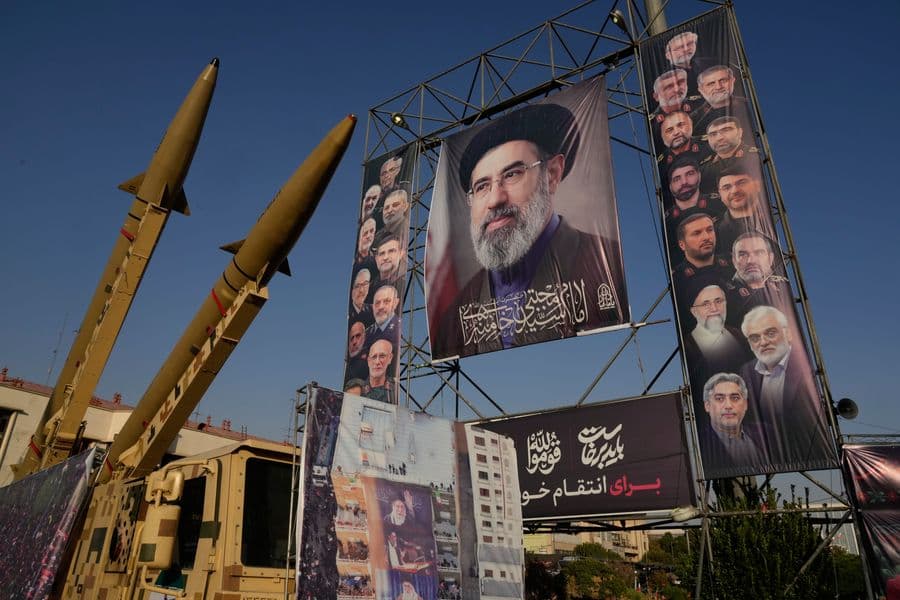
image: Iranian missiles and banners showing portraits of the Iranian Supreme Leader Ayatollah Mojtaba Khamenei, center, and the late armed forces commanders and nuclear scientists, who were killed in Israel and U.S. strikes, are displayed in a military exhibition commemorating the anniversary of the start of the 1980-88 Iraq-Iran war at Baharestan Square, in Tehran, Monday, Sept. 28, 2026. (AP Photo/Vahid Salemi)

Iranian Cyber Operations
By Michael Groen • RealClearDefense
Reflecting on an Epic Horse Campaign in the Mountains of Afghanistan
By Brian Glyn Williams • RealClearDefense
The Godfather of American Foreign Policy Realism Speaks to Today’s World
By Francis P. Sempa • RealClearDefense
In Pursuit of Nuclear Abolition
By Peter Huessy • RealClearDefense
Innovation Alone Won’t Prepare the U.S. for the Future Battlefield
By Joshua Segal • RealClearDefense

Navy Civilianizes Six Former Flag Billets, Reduces Six to Captains
By Mongilio, USNI N.
Raytheon's $8B Contract for Strategic Comms Terminal Modernization
By M+A El
America’s Maritime Moment Will Not Wait
By CDR Salamander
Armor Up?
By Marine Corps Compass Points
Who Shoots Down the Drone Over the Shipyard?
By John Ferrari & Dillon Prochnicki • RealClearDefense