
In Iran, the U.S. Could Learn from Other Wars
Last updated 06:17 AM EDT • Read time: 5m
Uneven U.S. conduct of the war on Iran suggests the absence of a clear idea of its purposes, risks, and benefits. and of inattention to lessons from other conflicts. With strategic coherence and competent leadership, the U.S. could accomplish more than it has.
Every living U.S. President has said Iran cannot have a nuclear weapon, a view that enjoys U.S. bipartisan and allied support. A 2015 accord slowed Iran’s nuclear program but could not stop it. Skillful U.S. and Israeli bombing last year – Operation Midnight Hammer -- severely damaged Iran’s nuclear facilities and may have entombed much highly enriched uranium. If a goal in the current war -- Operation Epic Fury -- was to further set back the enrichment program, it was not needed. The U.S. might have left well enough alone, at least for now.
If regime change was a goal of Epic Fury, it was beyond reach. Iran’s hardliners remain in power. They have survived also a large popular uprising earlier this year, violently suppressed. The militant Iranian Revolutionary Guard Corps may now be stronger. The 1991 Gulf War devastated Iraq’s military but Saddam’s brutal regime endured. U.S. leaders might have expected that a weaker blow against a larger Iran – the size of Alaska, with 90+ million people -- might not oust its rulers.
A country’s leaders should understand its military challenges. Midnight Hammer and the capture of Venezuelan President Nicolas Maduro were lightning strikes. They and the stunning victory in Iraq in 1991 might have misled inexperienced U.S. leaders. Dogged fighting in Korea, Vietnam, and the Iran-Iraq war in the 1980s hinted at what might lay ahead in Iran. Like the North in the Vietnam war, Iran receives key aid from Beijing and Moscow, including targeting and technology.
The U.S. might have better understood the revolution transforming fighting in Ukraine, a robotization of warfare. Iran’s short-range precision-guided missiles and long-range attack drones are potent. Iran was an attack drone pioneer with the long-range Shahed. Russia has developed an improved Shahed and sent it to Iran. Leveraging this technology and control of the Hormuz Strait on three sides, Iran was certain to be able to threaten shipping and neighbors’ infrastructure.
U.S. leaders seemed overconfident of a quick win in Iran, just as Russia did in 2022 in Ukraine. They could have learned from many U.S. war games over the years that highlighted the difficulties and disadvantages of fighting Iran. Awareness of other checkered wars might have been sobering.
Geographic depth helps Iran and Ukraine be resilient. Having relied on it to help defeat Napolean and Hitler, Moscow might have better appreciated Ukraine’s large area. U.S. leaders might have given more weight to Iran’s expanse.
Geographic depth can also beget complacency. The U.S. took risks, such as parking valuable aircraft in the open in neighboring countries. It might have deployed assault and sea control forces to Oman and the United Arab Emirates to lessen the impact of an Iranian closure of the Strait.
Political leaders should make a credible public case that a war is driven by strategic necessity. U.S. audiences were given little warning of or coherent rationale for this expanded war. In two previous Gulf crises, the U.S. worked hard to do this. In 1990, the U.S. engineered a United Nations Security Council resolution that authorized "all means necessary" to evict Iraq from Kuwait. The Senate and a majority o Americans agreed. In 2002, the U.S. failed to persuade the Security Council, but the Senate authorized the use of force and most Americans agreed.
The U.S. did not even try to obtain UN support for the current war. The Secretary-General warned of its “grave consequences.” Congress was divided and most Americans opposed the war. Allies were angry at not being consulted. The attempt last year to defund the Voice of America implied that U.S. leaders might not value persuading foreigners. In contrast, in World War II the robust Office of War Information was central to U.S. strategy at home and abroad.
The U.S. seems eager to avoid a resumption of full-scale hostilities. But because ceasefires or agreements with Iran could be unstable, the U.S. should continue to improve its military posture in the region, informed in part by lessons from other wars.
William Courtney was a career foreign service officer who served as deputy negotiator in U.S.-Soviet Defense and Space Talks (missile defense) and ambassador to the U.S.-USSR commission to implement the Threshold Test Ban Treaty. Peter A. Wilson is a defense strategist. He teaches a course on the history of military technological innovation at the Osher Lifelong Learning Institute.
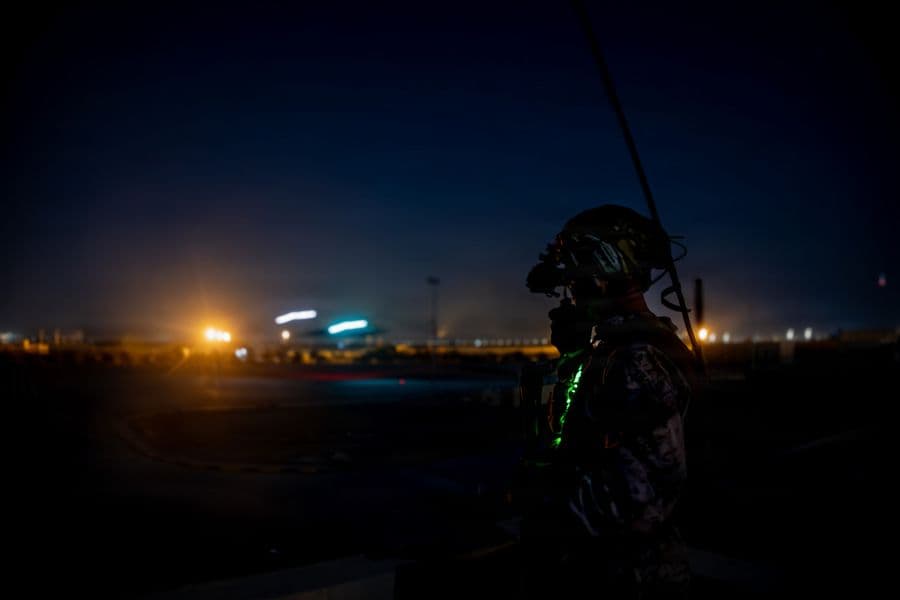
image: A U.S. Marine with Marine Medium Tiltrotor Squadron (VMM) 265 (Rein.), 31st Marine Expeditionary Unit, supervise and control communication networks at a forward arming and refueling point in support of Operation Epic Fury in the U.S. Central Command area of responsibility, May 3, 2026. (U.S. Marine Corps photo)

In Pursuit of Nuclear Abolition
By Peter Huessy • RealClearDefense
Innovation Alone Won’t Prepare the U.S. for the Future Battlefield
By Joshua Segal • RealClearDefense
The sUAS Tactical Trifecta
By Bryan T. Woody • RealClearDefense
The Revolutionary War: When Strategic Options Share the Same Weakness
By Henry Yep • RealClearDefense
The Houthis Are Testing the Limits of Collective Defense
By Saima Afzal • RealClearDefense

Who Shoots Down the Drone Over the Shipyard?
By John Ferrari & Dillon Prochnicki • RealClearDefense
Northrop Grumman Breaks Out the Big Guns at AUSA
By Daniel Terrill, Defense News
Army Pursuing Diverse Array of New Anti-Air Interceptors
By Trevithick, The WarZoneWho Shoots Down the Drone Over the Shipyard?
By John Ferrari & Dillon Prochnicki, RCD
F-35C Lands for the First Time on a Ford-Class Aircraft Carrier
By The Aviationist