
Iran and the Paradox of American Compellence
Last updated 06:29 AM EDT • Read time: 10m
As Washington broadens its campaign from Iranian military and security targets to the country’s economic infrastructure, its strategy rests on a straightforward proposition: greater pain will force Tehran to reopen the Strait of Hormuz and accept durable restrictions on its nuclear program. But what if military pressure succeeds in changing Iran’s incentives while weakening its capacity to act on them? Successful compellence requires more than an adversary willing to concede; it also requires one capable of delivering those concessions. Here lies the paradox: escalation may make some Iranian leaders more willing to yield while empowering those whose standing depends on continued resistance, eroding the coordination needed to convert any emerging consensus into durable compliance.
Thomas Schelling, who laid the foundations of modern coercion theory, defined compellence as the use of threatened or actual force to make an adversary stop, reverse, or undertake an action. Unlike deterrence, which seeks to prevent an action from occurring, compellence requires a visible change in established behavior. Strategists therefore focus on the clarity of demands, the credibility of threats, the severity of punishment, the availability of an off-ramp, and the target’s resolve. All are essential. But they presuppose something more fundamental: a political authority capable not only of deciding to concede, but also of ensuring that diplomats, militaries, bureaucracies, and security services carry that decision into effect.
History demonstrates the importance of this institutional requirement. During the Cuban Missile Crisis, Nikita Khrushchev could decide to withdraw Soviet missiles and direct the military and bureaucracy to implement that decision. NATO’s air campaign over Kosovo in 1999 likewise ended when Slobodan Milosevic accepted the withdrawal of Yugoslav military, police, and paramilitary forces and retained sufficient authority to carry it out. Lebanon after the 2006 war offers the more instructive counterexample. Its government accepted UN Security Council Resolution 1701, which envisioned extending state authority throughout the country and eliminating weapons and armed authority outside the state. Yet it lacked the power to disarm Hezbollah and enforce those commitments durably. The gap was not between acceptance and rejection; it was between formal assent and enforceable compliance.
Iran presents an even more consequential version of that problem: coercive pressure may itself widen the gap between political preference and institutional execution. Tehran may become more interested in accommodation while the system through which accommodation must be authorized and implemented becomes less integrated. Compliance is not merely a political choice; it is an organizational achievement, and coercion can erode the organization needed to deliver it.
The Islamic Republic is constitutionally hierarchical, and under Ali Khamenei major strategic decisions ultimately required the supreme leader’s approval. Yet Iranian governance also rested on overlapping institutions with distinct responsibilities, constituencies, and sources of power. The Office of the Supreme Leader, or Bayt-e Rahbari, operated alongside the formal government and reached deep into the state bureaucracy. The Supreme National Security Council coordinated security and foreign policy. The Islamic Revolutionary Guard Corps controlled major military, intelligence, political, and economic assets. The presidency, foreign ministry, regular armed forces, parliament, and clerical establishment retained their own authorities and constituencies.
Ali Khamenei held that arrangement together through more than the formal powers of his office. He had served as president, belonged to the revolutionary founding generation, controlled senior appointments, cultivated close relationships with the security establishment, and spent more than three decades accumulating political and religious authority. The system was never perfectly unified, but its competing centers generally recognized a final arbiter capable of settling major disputes.
Mojtaba Khamenei inherited the office’s extensive powers but not his father’s accumulated authority. At fifty-six, he assumed the leadership after decades of operating largely outside public view. He had never held elected office, managed a ministry, commanded a major institution, or acquired substantial public administrative experience. His earlier influence had been exercised principally through his father’s office and his relationships with the IRGC and Basij. His elevation converted informal access into formal supremacy without the long political and institutional apprenticeship through which his father had consolidated authority.
Nor does Mojtaba command comparable religious stature. He has not been broadly recognized as a marja al-taqlid, or “source of emulation,” the highest rank of religious authority in Shi’a Islam. The constitution no longer requires the supreme leader to be a marja, but it still calls for jurisprudential scholarship, political judgment, administrative competence, and leadership capacity. Mojtaba may legally hold the office while lacking the independent religious standing needed to impose unity across Iran’s fractious clerical and political system.
The manner of his succession compounds that weakness. The Islamic Republic emerged from a revolution against hereditary monarchy, yet its highest office has now passed from father to son. The Assembly of Experts formally selected Mojtaba, but the appearance of dynastic succession gives reformists, disaffected clerics, excluded political figures, and ordinary Iranians grounds to question the transition’s ideological legitimacy. The IRGC’s support for his elevation and his limited public visibility have reinforced the perception that a system built around velayat-e faqih (the guardianship of the Islamic jurist) now has a leader whose position appears to depend more heavily on military sponsorship than on independent religious preeminence.
That dependence increases the IRGC’s leverage without necessarily making Iran more coherent. The Guards have assumed a larger role in strategic decision-making, while their decentralized structure has allowed regional formations and replacement commanders to continue operating after severe leadership losses. This is a source of wartime resilience, but not necessarily of integrated political control. An institution built to survive decapitation and preserve operational autonomy can keep launching missiles and suppressing dissent even as the institutions responsible for diplomacy struggle to coordinate national policy.
The Supreme National Security Council is meant to provide that coordination. President Masoud Pezeshkian formally chairs it, but its membership brings together senior civilian, military, and intelligence officials, along with representatives of the supreme leader. Its secretary, Mohammad Baqer Zolqadr, is a former IRGC commander who has served in the Armed Forces General Staff, the Interior Ministry, the judiciary, the Expediency Council, and principlist politics. His appointment placed a figure deeply rooted in the military-security establishment at the center of the body meant to reconcile the state’s competing branches. That may strengthen coordination within the security sector while further reducing the relative influence of elected and diplomatic institutions.
Recent events have exposed the limits of that coordination. In March, Pezeshkian apologized to Gulf states for Iranian attacks and announced that Iran would refrain from striking neighboring countries unless attacks originated from their territory. Hours later, the IRGC announced another strike on a U.S. facility at Al Dhafra Air Base in the United Arab Emirates. The episode did not prove outright insubordination – operational timing and competing interpretations may explain the disconnect. But it raised a more important question: could a diplomatic commitment made by Iran’s elected president reliably bind the institutions conducting the war?
The same uncertainty shadows any future negotiation. Foreign Minister Abbas Araghchi can negotiate terms, but an agreement would have to be endorsed and implemented by institutions beyond the Foreign Ministry. Parliament Speaker Mohammad Bagher Qalibaf has emerged as a senior negotiator and intermediary among political, clerical, and security elites, while IRGC commander Ahmad Vahidi remains central to the implementation of any military commitments. The problem is not that Iran has several powerful officials – complex governments routinely do. It is that no single actor has demonstrated an uncontested ability to bind them all to a costly strategic reversal. Mojtaba formally holds the office that once arbitrated such disputes, but he has yet to show that he can impose a major concession on the security establishment that helped elevate him.
None of this means Iran is in disarray; its wartime performance suggests otherwise. Layered institutions, ideological loyalty, replacement mechanisms, and decentralized military commands have enabled the state to retaliate, repress, and endure after losing many experienced leaders. Power has consolidated around the IRGC, the Supreme National Security Council, and the Office of the Supreme Leader rather than splintering into open factional conflict. But resilience is not the same as strategic coherence. Iran may remain capable of fighting while becoming less capable of producing a durable, integrated decision across its political, military, diplomatic, and technical institutions.
That distinction bears directly on Washington’s objectives. Consider the nuclear file alone. Any agreement would require the Foreign Ministry to negotiate terms that Iran’s nuclear authorities, intelligence services, military organizations, and political leadership would all accept and implement despite differing institutional interests, threat perceptions, and domestic political incentives. The same logic applies to reopening the Strait of Hormuz or sustaining a ceasefire. A signature is not compliance. Institutions excluded from a decision may resist, reinterpret, or delay its implementation.
Further pressure could therefore produce opposing effects. It could increase the incentives of some Iranian leaders to negotiate while strengthening actors whose standing depends on resistance. It could make civilian officials more eager for relief while increasing their dependence on military institutions. It could raise the costs of continued fighting while deepening fears that any concession would invite further demands or expose accommodating officials to domestic rivals. Most importantly, it could weaken the relationships needed to turn an emerging consensus into enforceable commitments.
This does not mean Washington should rule out further force, or that an obvious alternative exists. Coercive pressure may be the most consequential leverage Washington possesses. But leverage is not a strategy, and pain is not a political mechanism. Before widening the campaign, American policymakers should answer three questions: Who inside Iran can authorize the concessions being demanded? Which institutions must implement them? And which actors can block, reinterpret, or reverse them?
Those questions should shape both coercion and diplomacy. Washington should judge any agreement not simply by the concessions it secures, but by the institutions capable of implementing them. It should treat institutional coherence as a strategic requirement rather than an analytical afterthought, recognizing that political agreement and durable compliance are not the same thing.
Washington must distinguish Iran’s capacity to endure from its capacity to comply. The former may remain formidable as the security establishment consolidates coercive power. The latter may decline if authority continues to shift among institutions that can act forcefully but cannot reliably coordinate a durable strategic reversal. Successful compellence requires more than changing the target’s preferences – it requires a target capable of converting those preferences into enforceable policy. The ultimate test is not how much pain Washington can impose. It is whether the system on the receiving end remains coherent enough to deliver what that pain is intended to extract.
Dr. Arian Sharifi is a former Assistant National Security Advisor to the President of Afghanistan and a former lecturer at Princeton University’s School of Public and International Affairs. He holds a PhD in international security from The Fletcher School at Tufts University and is currently leading a two-year research project on Iran’s internal political evolution and its implications for U.S. strategy.
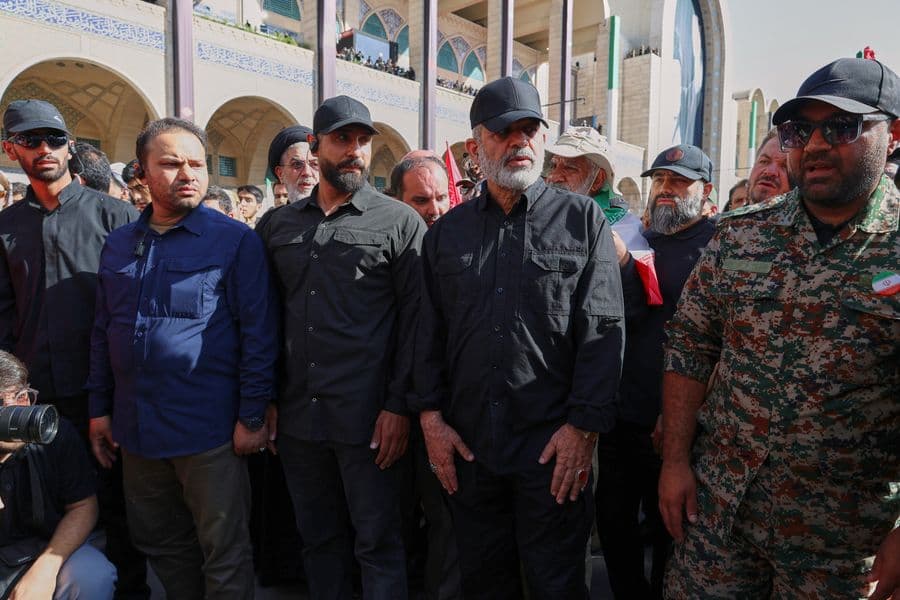
image: Iran's paramilitary Revolutionary Guard Gen. Ahmad Vahidi, center right, attend a prayer part of the dayslong funeral ceremonies for the slain Iranian Supreme Leader Ayatollah Ali Khamenei and members of his family at the Imam Khomeini Mosalla Grand Mosque in Tehran, Iran, Sunday, July 5, 2026.(Seyed Hamed Mousavi/ISNA via AP)

Innovation Alone Won’t Prepare the U.S. for the Future Battlefield
By Joshua Segal • RealClearDefense
The sUAS Tactical Trifecta
By Bryan T. Woody • RealClearDefense
The Revolutionary War: When Strategic Options Share the Same Weakness
By Henry Yep • RealClearDefense
The Houthis Are Testing the Limits of Collective Defense
By Saima Afzal • RealClearDefense
Radio Frequencies in the Intelligence Ecosystem
By Craig Brower • RealClearDefense

Who Shoots Down the Drone Over the Shipyard?
By John Ferrari & Dillon Prochnicki • RealClearDefense
Northrop Grumman Breaks Out the Big Guns at AUSA
By Daniel Terrill, Defense News
Army Pursuing Diverse Array of New Anti-Air Interceptors
By Trevithick, The WarZoneWho Shoots Down the Drone Over the Shipyard?
By John Ferrari & Dillon Prochnicki, RCD
F-35C Lands for the First Time on a Ford-Class Aircraft Carrier
By The Aviationist