
Iranian Cruise Missiles Also a Proliferation Threat
Last updated 05:29 PM EDT • Read time: 3m
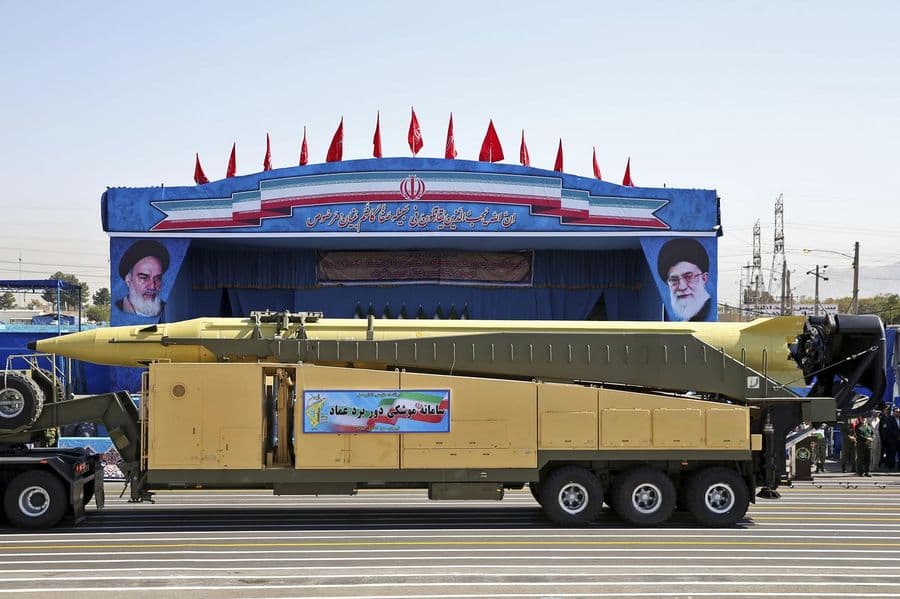
In its new Worldwide Threat Assessment for 2018, the U.S. intelligence community warns that Iran continues to “enable” attacks by Yemen’s Houthi rebels against America’s Persian Gulf partners. The new assessment highlights “an attempted 3 December cruise missile attack on an unfinished nuclear reactor in Abu Dhabi,” an important indication that the Iranian proliferation threat encompasses cruise missiles, not just ballistic ones.
Since the conclusion of the nuclear deal in July 2015, Iran has launched as many as 23 ballistic missiles, despite the prohibition of such activities by UN Security Council 2231. Iran also provided ballistic missiles to the Houthi rebels, who fired them at Saudi Arabia. Accordingly, the international community has focused on restraining Iran’s ballistic missile program. Yet the new threat assessment is a reminder that the U.S. and its allies must also pay close attention to other types of missiles.
The information in this assessment comprises the most high-level affirmation by the U.S. government of Iranian support for Yemen’s cruise missile capabilities. Iran’s own cruise missile arsenal is not nearly as diverse as its ballistic missile inventory, which is the Middle East’s largest. Moreover, only two of its cruise missile variants appear to be land-attack cruise missiles (LACMs), intended to strike ground targets.
The first is the air-launched Ya Ali LACM, which has a turbojet motor and can travel an estimated 700 kilometers (km). The second is the ground-launched Soumar LACM, which has a turbofan motor and allegedly can travel 2,500 km. The Soumar is apparently a substitute for the long-awaited Meshkat LACM, which Iranian officials had dubbed “the long-arm of the Armed Forces of the Islamic Republic of Iran.” Based on video provided by Arabic-language outlets, the cruise missile the Houthis attempted to fire at the United Arab Emirates (UAE) in December 2017 closely resembles the Soumar.
Iran first publicly displayed the Soumar in March 2015, hailing the missile as indigenously produced. However, the Soumar is likely a copy of the Russian air-launched Kh-55, six of which Iran imported from Ukraine in 2001. The Soumar features select design modifications to make it suitable for ground launch. However, both the Kh-55 and Soumar travel at subsonic speeds and can carry nuclear payloads.
In January 2017, Iran reportedly conducted its most recent test of the Soumar. The Houthi rebels’ reported cruise missile launch came just 11 months later. The UAE government denies that a cruise missile entered its airspace on the date of the alleged attack. This means either that the Soumar fell significantly short of its target, or that it flew below Emirati radar before landing.
As the Trump administration highlights Iran’s destabilizing activities in Yemen and across the Middle East, it ought not to forget about the newest vector of the Iranian threat – cruise missile proliferation – while searching for creative ways to offset it.
Behnam Ben Taleblu is a senior Iran analyst at the Foundation for Defense of Democracies.
Follow FDD on Twitter @FDD. FDD is a Washington-based, nonpartisan research institute focusing on national security and foreign policy.
This article appeared originally at Foundation for Defense of Democracies.

In Pursuit of Nuclear Abolition
By Peter Huessy • RealClearDefense
Innovation Alone Won’t Prepare the U.S. for the Future Battlefield
By Joshua Segal • RealClearDefense
The sUAS Tactical Trifecta
By Bryan T. Woody • RealClearDefense
The Revolutionary War: When Strategic Options Share the Same Weakness
By Henry Yep • RealClearDefense
The Houthis Are Testing the Limits of Collective Defense
By Saima Afzal • RealClearDefense

Who Shoots Down the Drone Over the Shipyard?
By John Ferrari & Dillon Prochnicki • RealClearDefense
Northrop Grumman Breaks Out the Big Guns at AUSA
By Daniel Terrill, Defense News
Army Pursuing Diverse Array of New Anti-Air Interceptors
By Trevithick, The WarZoneWho Shoots Down the Drone Over the Shipyard?
By John Ferrari & Dillon Prochnicki, RCD
F-35C Lands for the First Time on a Ford-Class Aircraft Carrier
By The Aviationist