
No Deal Is Better Than a Bad Deal on Iran
Last updated 06:39 AM EDT • Read time: 6m
On August 2, Senator John Kennedy put it plainly on Meet the Press. Asked what the U.S. should do after President Trump halted planned strikes on Iran, Kennedy said: “We only have three choices: escalate, retreat and come home, or maintain the status quo. I would maintain the status quo as long as I could.”
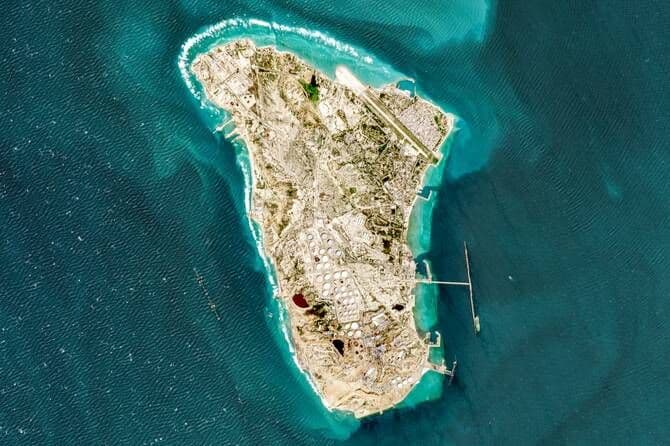
The President appears to have settled on the same option. He told Axios on August 9 that the United States is “low keying it,” only semi-negotiating while Iranian inflation does the work and has called the blockade a wall of steel. On August 10 he added that because Iran seeks compensation, he will demand the same. That is a choice for pressure over escalation and retreat. He applied the same logic at Kharg, striking military targets in March while sparing the loading infrastructure and threatening to destroy it if Iran interfered with Hormuz transit. This is a pivot, not a retreat: objectives unchanged, terms hardened, only the principal instrument moved—from ordnance to money. The President and Senator Kennedy are right.
The Hormuz transit framework has taken shape, but the terms for reopening have hardened. Iran and Oman have agreed coordinates for a corridor shifting traffic into Iranian waters, formalizing Iranian control rather than relinquishing it. Iran demands an end to the blockade, withdrawal of American forces, sanctions relief, frozen assets, reparations, and an end to action against its allies. Trump has reportedly considered ending the conflict without a nuclear agreement if the strait reopens and now claims total control of the strait. Iran says the proposed agreement makes it responsible for navigation guidance, traffic monitoring and maritime security, and bars American and Israeli vessels. The risk is no longer a bad bargain, but that Washington declares the operational objective achieved and lifts pressure while Iranian strategic threats remain unresolved.
Forty-seven years have produced no durable settlement, and the historical record shows a recurring pattern: Tehran uses negotiations to relieve pressure while preserving strategic capabilities. The June Islamabad Memorandum collapsed within weeks after restoring Iran’s financial capacity before Iran verifiably abandoned its core capabilities. The IRGC fired on commercial shipping weeks after signing it. On July 26, Supreme Leader Mojtaba Khamenei declared that “there remains no path forward except jihad and resistance.” On strategic issues, the American and Iranian positions do not meaningfully overlap. An agreement signed now risks reproducing the Islamabad structure—and repeating its failure.
Any durable agreement must answer five questions before Washington reduces pressure. Has Iran (a) verifiably dismantled its nuclear weapons program, (b) ceased proxy financing and attacks on neighboring states including Israel, (c) terminated its offensive missile and drone programs, (d) relinquished coercive control of the Strait of Hormuz, and (e) accepted rigorous verification mechanisms that confirm compliance?
Until Iran answers yes to each, the United States should maintain economic pressure on the IRGC’s revenue base, enforced with minimal but precise force. Agreements without verification and enforcement are not settlements; they are intermissions. But maintaining the status quo is not a passive choice; it requires a strategy. Months of air attack have not persuaded Tehran, and kinetics alone will not. Ground forces are neither practical nor necessary. What is required is a campaign built on economic pressure, with force in a supporting role.
The IRGC is Iran’s center of gravity, hard currency its critical requirement, and Kharg its critical vulnerability. Five instruments should be employed simultaneously to achieve these objectives:
- Precision strikes on Kharg Island’s loading equipment, denying exports without destroying the terminal or requiring an indefinite blockade, with the wider export system held as declared escalation;
- Economic Fury secondary sanctions closing the Chinese teapot refinery bypass;
- Demand-side pressure persuading China that Iranian crude is not in its interest;
- A graduated enforcement posture maintaining Hormuz pressure without indefinite blockade, with escort coordinated among Japan, South Korea, India and other Gulf-dependent importers; and
- Selective strikes on regenerating military capability.
No department can run all five. Coordinating them requires a Joint Interagency Task Force-Iran integrating Treasury, State, DoD, and the intelligence community.
The IRGC has behaved pragmatically when institutional survival was threatened. But the IRGC does not yet perceive that risk. On August 10, Khamenei formally confirmed Ahmad Vahidi as IRGC commander-in-chief with the rank of major general and instructed him to prepare for powerful offensive operations. Iran’s 2025-26 budget allocated roughly a third of oil-export revenue to the armed forces, paid in crude, while Reuters reports the Guard controls up to half of the oil trade itself. Four decades of sanctions fell on ordinary Iranians; the Guard worked around them. Closing Kharg falls on the Guard, whose assent any deal requires. The IRGC faces four possibilities. It can wait, betting Washington blinks first and a wrecked economy is survivable; meet verifiable compliance conditions and open Hormuz; face financial collapse as hard currency disappears; or face revolt as security forces go unpaid. Printed rials buy neither imports nor proxy networks. But an Iranian strategy of waiting is survival, not reconstitution: an economy starved of investment and hard currency cannot rebuild a missile industry or restore a proxy payroll at scale. The Wall Street Journal’s own reporting points the same way: underinvestment sustained long enough turns “dysfunction into ungovernability,” especially where strikes have damaged energy infrastructure. Khomeini drank the poisoned chalice in 1988 when resistance threatened the revolution. The current regime faces a similar dilemma: drink the chalice, or go broke.
Secretary Rubio should lead a permanent GCC-Israel air and missile defense architecture with AI-integrated early warning and pooled interceptors. Saudi Arabia’s decision to join U.S. strikes in Iraq suggests this is politically achievable. Any Iranian attack on Hormuz shipping or Gulf or Israeli territory should trigger automatic, publicly declared proportional strikes on IRGC assets. Deterrence requires certainty and immediacy. Washington should declare that it will never recognize Iranian closure or control of the strait.
Strategic patience demands political will and tolerance for Iranian pressure. Gasoline is well above last year’s price, with midterms three months away. Tehran is counting on that clock. But Washington does not need Iran to collapse; it needs to prevent survival from becoming regeneration. Preventing regeneration requires sustained denial, not waiting for collapse. That beats a settlement that restores what the campaign has degraded.
Iranian crude is commercially replaceable, and has been replaced. That weakens Iran’s oil leverage; its ability to disrupt Hormuz remains. The result may be that the strait stays contested for years while Iran’s capacity to contest it degrades faster than the world’s capacity to route around it. That requires no invasion and no Iranian consent, and the alternatives are worse: conceding control of the corridor permanently, or a ground war. No deal is better than a bad deal. Keep Iran in the box.
CAPT Lance B. Gordon (U.S. Navy, ret.) is a retired Navy intelligence officer, graduate of the Army War College and NYU School of Law, and former Partner/Principal at Ernst & Young LLP. He has written on the 2026 Iran campaign at RealClearDefense and Small Wars Journal.
The Unfinished Reform
By Mark W. Castillon • RealClearDefense
Winning the Data Advantage
By Turin Pollard • RealClearDefense
The Pentagon’s Quantum Race Needs a Warfighter’s Scorecard
By Burak Oktenli • RealClearDefense
The F/A-XX and the AIM-260 Reclaim the Perimeter
By Bruce Allen Lubbering • RealClearDefense
Iranian Cyber Operations
By Michael Groen • RealClearDefense
Winning the Data Advantage
By Turin Pollard • RealClearDefenseThe F/A-XX and the AIM-260 Reclaim the Perimeter
By Bruce Allen Lubbering • RealClearDefenseWinning the Data Advantage
By Turin Pollard, RealClearDefenseThe F/A-XX and the AIM-260 Reclaim the Perimeter
By Bruce Allen Lubbering, RCD
F-22 Pilot Directs CCA in Flight as ‘Airborne QB’
By Stephen Losey, Air & Space Forces