
Strategic Rupture and Deterrence: U.S. Policy Against Iran
Last updated 06:31 AM EDT • Read time: 15m
Introduction
This article analyzes how the United States has used deterrence by denial and strategic rupture to develop an overall strategy towards Iran since the 1979 revolution. It explores how U.S. policy has moved back-and-forth between coercive policies designed to keep Iran from developing a nuclear weapon and policies to limit Iran's ability to project power in the Middle East. It also demonstrates how the U.S. has operationalized deterrence by denial in its policy toward Iran and identifies areas where U.S. policy has experienced strategic ruptures. Finally, it provides implications for U.S.-Iran relations and broader Middle Eastern stability in the future.
For nearly half a century, the relationships between the United States and Iran have been shaped by intense strategic competition, distrust, and periodic conflict. Since the Iranian Revolution in 1979, Iran and the United States have utilized competitive methods to affect one another's behavior. Two analytic constructs are useful for examining this complex relationship: deterrence by denial and strategic rupture.
Deterrence by denial refers to the strategic process of preventing an adversary from achieving their goals by making those goals either impossible or unappealing to pursue. Strategic rupture refers to a disruption in the paradigmatic thinking about how states perceive and respond to threats. Examining U.S. policy using these two constructs allows for clarity regarding the interplay among military, economic, and diplomatic instruments that the U.S. uses to address Iran’s geopolitical ambitions in the region.
Deterrence Theory
As the basis of the U.S. policy toward adversaries like Iran, deterrence theory seeks to avoid unwanted actions by altering an opponent's cost-benefit calculus. Traditionally, there are two types of deterrence:
Deterrence by Denial:
The logic behind deterrence by denial which prevents the success of regional hegemonic ambitions is to create a situation where Iran (or any regional player) cannot effectively obtain a regional hegemony because it is too difficult and risky to do so. Unlike deterrents based on the threat of retaliation after aggression has occurred, deterrence by denial is focused on limiting the chance that aggression will be successful initially. The U.S., through its development of Israeli qualitative military superiority, integration of missile defense systems across the Gulf, increased naval presence in waterways, and construction of intelligence sharing relationships with regional players, seeks to build a defensive framework which limits Iran's ability to convert influence into control. Since Iran is unable to consistently acquire land, secure the maritime choke points, coerce neighboring countries, or reduce adversary defensive capabilities, there is little incentive to pursue overtly aggressive hegemonic expansion. Therefore, deterrence by denial is intended to make it difficult for Iran to calculate whether it is worthwhile to expand regionally.
Furthermore, deterrence by denial operates in the gray area. Much of Iran's regional strategy involves the use of proxies, political influence, and incremental expansion instead of open conquest. Through supporting local governance, improving partner country militaries, and establishing counter-proxy capabilities, the U.S. seeks to limit Iran's ability to establish structural dominance over the region. The goal is not to completely remove Iranian influence, but to ensure that Iranian influence does not become dominant and uncontested. Hence, deterrence by denial provides insight into why the U.S. places an emphasis on partnering defensively and developing capacity, rather than engaging in ongoing direct U.S. military action.
Deterrence by punishment:
Deterrence by punishment on the other hand explains the use of credible threats of retaliation in U.S. policy. Although denial makes it unlikely for aggression to succeed, punishment suggests that if aggression were to occur, severe consequences would result. These could include air strikes, economic sanctions, cyberattacks, etc. Retaliation-based deterrence implies that any significant disruption to the regional balance e.g., attacking U.S. personnel, targeting critical infrastructure, or accelerating destabilizing military efforts would bring about costs that would outweigh the benefits. The psychology and reputation of the leadership of Iran are targeted here: deterrence by punishment is intended to encourage Iranian leaders to believe that an escalation of conflict would lead to severe and unacceptable consequences.
Retaliation-based deterrence is especially relevant when denial cannot be made perfect. Missile attacks, proxy activities, and clandestine operations can rarely be completely stopped. For this reason, the U.S. maintains the capability to inflict retaliatory costs to reinforce credibility. For instance, the purpose of economic sanctions is to harm capabilities, but also to show that acts of revisionism carry systemic costs. In this way, punishment completes the gaps in defensive architectures created by denial.
Together, the logic of deterrence by denial and deterrence by punishment explain how the U.S. seeks to prevent a regional hegemon from emerging in the region without being engaged continuously in full scale war. Denial restricts Iran's ability to dominate; punishment suggests that severe consequences will follow if Iran attempts to breach those restrictions. Denial is both structural and prospective it builds the capacity of allies, creates defensive networks, and establishes a balance-of-power. Punishment is both reactive and coercive, it makes clear that any transgressions of the status quo will incur heavy penalties.
At a larger strategic level, denial shields the regional balance of power by empowering allies and increasing the hardness of their defenses, whereas punishment increases the credibility of the U.S. and deters escalation above previously established thresholds. The two mechanisms are mutually dependent: denial lowers the chances of a successful attack, and punishment makes any unsuccessful or limited attack costly. The two together provide a layered deterrence strategy to preserve the balance of power and prevent hegemonic consolidation in the Middle East.
Strategic Rupture
While strategic rupture is not a recognized concept in the classical literature on deterrence theory, it represents significant disruptions in paradigmatic thinking regarding how states perceive and respond to threats. In the context of U.S.-Iran relations, strategic ruptures occur when long-standing policy approaches are revisited, typically after some sort of crisis or change in leadership. Strategic ruptures can ultimately create new combinations of diplomacy, coercion, and force that redefine the strategic calculus of both parties.
Historical Context of U.S. Policy toward Iran:
Post-Revolutionary Period of Hostility
The 1979 Iranian Revolution marked a turning point in U.S.-Iran relations. The U.S. Embassy hostage crisis exacerbated the hostility between the U.S. and Iran, and Iran's support for anti-Western movements throughout the world further entrenched its status as an adversary of the West. Throughout this period, U.S. policy toward Iran has oscillated between containment, economic sanctions, and efforts to limit Iran's regional influence. During the Iran-Iraq War (1980-1988), U.S. forces primarily participated in the protection of shipping lanes from Iranian attacks, representing initial applications of the principles of deterrence by denial to shield allied and U.S. economic interests.
Nuclear Tensions and the "Axis of Evil"
During the George W. Bush administration, Iran was designated as a member of the "Axis of Evil," and nuclear proliferation was identified as the principal threat. This time frame was characterized by increased sanctions and diplomatic isolation coupled with the threat of force. The use of deterrence by denial in the U.S. approach was apparent in the efforts to prevent Tehran from obtaining the capabilities necessary to produce nuclear weapons by making success uncertain or unachievable. Additionally, the U.S. approach during this time included elements of deterrence by punishment, particularly the threat of military strikes.
U.S. Deterrence by Denial Against Iran:
Denial Conceptualization
Denial in the context of deterrence by denial involves convincing Tehran that its desired objectives — whether nuclear weapons or regional coercive influence — cannot be achieved. This is accomplished by developing robust defenses (missile shields, naval deployments) and maintaining persistent diplomatic pressure on Tehran.
Expert on Middle Eastern Security John Eisenstadt notes that the U.S. has increasingly utilized deterrence by denial to counteract Iranian activities specifically by making Iranian attacks less likely to succeed through air and missile defense systems. Furthermore, the U.S. maritime operations and regional security partnerships aim to signal to Tehran that Iranian efforts to disrupt shipping or threaten its allies will be thwarted. This posture is designed to discourage Tehran from taking escalatory actions by reducing the perceived probability of success.
Mechanisms of Denial in Practice
Military Presence and Defense Systems. The U.S. Fifth Fleet's naval presence in the Persian Gulf and deployment of missile defense systems in the region represent mechanisms of denial. By establishing a credible defensive network, the U.S. is able to reduce Iranian incentives to engage in direct confrontations.
Allied Cooperation: Cooperative efforts with regional partners, including Israel and GCC states, strengthen denial. Through integrated air defenses and intelligence sharing, these cooperative efforts undermine Iran's capabilities to execute offensive operations.
Economic Sanctions: While not a strictly military mechanism, sanctions operate as a form of denial by diminishing Iran's economic base and thereby limiting its access to resources necessary to expand its nuclear capabilities and conduct proxy operations. The maximum pressure campaign of recent years was designed to limit Iran's leverage in negotiations and reduce its ability to achieve its strategic objectives.
The alignment of US strategic vision or interests in the Region:
Prevention of Regional Hegemony
The U.S. empowerment of regional allies to prevent a hegemon from emerging in the Middle East can be viewed most clearly through the lens of structural realists. Great powers aim to survive in an anarchic world by preventing any one state from becoming powerful enough to threaten their existence. Therefore, the main goal of great powers is to prevent any state from rising to become a peer competitor, particularly in areas of the world with high strategic importance. The Middle East has always had strategic value because of its oil, the sea lanes that pass through it, and its proximity to Europe, Africa, and Asia. If a single state (like Iran) were able to dominate the entire region, it would likely gain the ability to control oil shipments, be able to use coercion against neighboring states, have the ability to project power beyond the region, and form alliances with other major powers like China and/or Russia. Therefore, supporting regional allies is a structural necessity to prevent any one country from gaining too much power so as to eventually threaten U.S. global primacy.
Off-Shore Balancing and Burden-Shifting
The logic behind this view is very close to what is often referred to as offshore balancing. Off-shore balancing refers to using regional actors to counter potential hegemons rather than having the U.S. take direct responsibility to occupy or dominate the region through permanent, large-scale deployments. Instead, the U.S. uses the military capabilities of regional allies (i.e., Israel and select Gulf states) to do the day-to-day balancing required to prevent a regional hegemon from forming. Through providing military assistance to these allies, Washington is able to shift the burden of defending the region away from itself and back onto local actors, while still maintaining the ability to quickly and decisively intervene should the regional balance of power collapse. Off-shore balancing reduces costs and political risk while allowing the U.S. to maintain its influence in the region. Additionally, it represents a strategic decision-making process that identifies local actors as having the greatest incentive to oppose a regional hegemon. Creating a network of allies, through joint arms acquisitions, intelligence sharing, and coordinated missile defense systems, creates a multi-faceted security architecture that makes it difficult for any single state (especially Iran) to transform influence into uncontested dominance.
Balance of Threat Theory and Deterrence by Denial
Additionally, the policy of using regional allies to counter potential hegemons can also be explained through balance of threat theory. Balance of threat theory argues that states are concerned not just with the raw power of other states, but also with the intentions and capabilities of those states. Iran's actions in the region, including the development of ballistic missiles, support for non-state armed groups, and attempts to increase its political influence in neighboring countries, create perceptions of revisionist intent among many states. In response to these perceptions of Iranian revisionist intent, the U.S. increases the military capabilities of regional allies to ensure that Iran does not have the capability to use these tools to establish regional hegemony. This represents an example of deterrence by denial, whereby limiting the material ability of Iran to achieve territorial, political, or military dominance, Washington is reducing the incentives for Iran to pursue aggressive and expansionist policies. The policy does not require regime change but instead requires the maintenance of a regional balance of power, in which no single state can impose its will unilaterally.
Global Grand Strategy and Order Preservation
Lastly, this policy is reflective of a broader global grand strategic commitment to maintaining a favorable international order. As the preeminent global power, the United States has traditionally attempted to prevent hostile states from establishing themselves as regional hegemons in critical industrial or resource rich areas of the world. Establishing a regional hegemon in the Middle East could disrupt global energy markets, jeopardize U.S. alliances, and potentially lead to the formation of an alliance between other major powers and the hegemon to challenge U.S. influence. Through supporting regional allies, the United States maintains a multipolar balance of power in the region, which prevents any one state from concentrating power, while at the same time, preserving U.S. strategic leverage. However, there are some drawbacks to this approach, such as creating security dilemmas for regional actors, encouraging proxy conflict, and creating a moral hazard among regional actors who assume U.S. backing. Despite these drawbacks, within the logic of great power competition and balance of power politics, supporting regional allies serves as a deliberate mechanism for preventing any regional hegemon from arising to challenge U.S. global dominance.
Limitations
While denial can mitigate the impact of specific actions, it has several limitations. Tehran has developed asymmetric strategies, including the use of proxy networks (Hezbollah, Houthi) and missile capabilities that make it difficult for the U.S. to deny Iranian objectives. Additionally, because denial focuses on the prevention of an adversary achieving a particular objective and does not necessarily impose costs on the adversary, an adversary can continue to pursue actions that do not immediately provoke the application of a retaliatory measure. Analysts suggest that without a credible threat of punishment, denial alone can enable an adversary to test limits and erode the red lines established by adversaries.
Strategic Ruptures in U.S. Policy Toward Iran:
The JCPOA and Diplomatic Engagement
One of the most significant strategic ruptures in U.S. policy toward Iran has been the implementation of the Joint Comprehensive Plan of Action (JCPOA) in 2015. Under the JCPOA, the Obama administration pursued a combination of diplomatic engagement and sanctions to restrict Iran's nuclear program. Although the JCPOA did not constitute solely a denial-based deterrent strategy, the agreement limited Iran's uranium enrichment and inspection capabilities by agreement, rather than solely through defensive postures. Thus, the JCPOA demonstrated how deterrence frameworks can become intertwined with incentive structures. Specifically, the U.S. created a calculus for Iran that emphasized the benefits of compliance, rather than the costs of non-compliance.
Withdrawal from the JCPOA
The Trump administration's withdrawal from the JCPOA in 2018 represented another rupture. The re-imposition of harsher sanctions ("maximum pressure") was designed to coerce Iran into accepting more stringent conditions than those established by the JCPOA. The withdrawal from the JCPOA recast the denial component of the U.S. strategy as part of a larger economic strategy.
Precision Strikes on Iranian Nuclear Facilities
On 21 June 2025, precision strikes on Iranian nuclear facilities (reported to include U.S. actions at Natanz, Fordow, and Esfahan) demonstrate the possibility that U.S. policy may be transitioning from denial to punishment. These strikes reflect a strategic rupture in U.S. policy in which the U.S. signals a willingness to utilize kinetic force to alter the decision-making calculus of Tehran. These strikes highlight the limitations of denial strategies and indicate a willingness to escalate when Tehran reaches certain thresholds of concern.
Challenges and Directions for U.S. Policy:
Blending Denial and Punishment
Many scholars and practitioners currently believe that a blended approach utilizing both denial and punishment will provide a stronger deterrent effect than either approach individually. A denial-only approach may incentivize Tehran to take risks and pursue objectives with little fear of retaliation. Conversely, a punishment-only approach risks creating an environment in which the U.S. and Iran are more likely to engage in conflict. An approach that balances denial and punishment e.g., by threatening to apply costs to key Iranian capabilities, while providing assurance of defensive coverage to its allies could increase the credibility of U.S. deterrence.
Communication and Credibility
For deterrence to be effective, both denial and punishment must be perceived as credible by an adversary. Therefore, the U.S. must clearly communicate its own redlines and boundaries to Tehran. Ambiguity can be exploited by an adversary and may lead to miscalculation. Clear signaling, robust defense deployments, and calibrated punitive threats all contribute to increasing the credibility of deterrence.
Dialogue and Diplomacy
Even in times of adversity, dialogue can complement deterrence. Diplomatic channels can reduce misunderstandings and provide a forum for clarification of intentions. Without communication, a defensive posture can be misunderstood and escalate tensions between adversaries.
Conclusion
Throughout the various phases of U.S. policy toward Iran, U.S. policy has evolved based on changing perceptions of threats and changing strategic priorities. Denial by deterrence has served as a core component i.e., attempting to prevent Iranian ambitions through defensive measures and alliances. However, the limitations of denial and the adaptable nature of Iran's security strategies have, at times, necessitated punitive components that have resulted in strategic ruptures in policy paradigms, such as the implementation and subsequent withdrawal from the JCPOA.
An examination of U.S. policy toward Iran using the theoretical constructs of denial by deterrence and strategic rupture provides a nuanced perspective on U.S. efforts to influence Tehran's behavior. Ultimately, a balanced approach that incorporates denial and punitive elements, supported by credible communication and diplomatic engagement, may provide the most enduring deterrent strategy. As global and regional dynamics continue to evolve, U.S. policy will need to continually assess and reassess its strategic tools and objectives.
Chick Edmond is a Political Scientist and Graduate Researcher in the International Studies program at Old Dominion University. His research focuses on Nuclear Deterrence Strategies, Geopolitics in Europe/Africa and the balance of power between NATO and Russia.
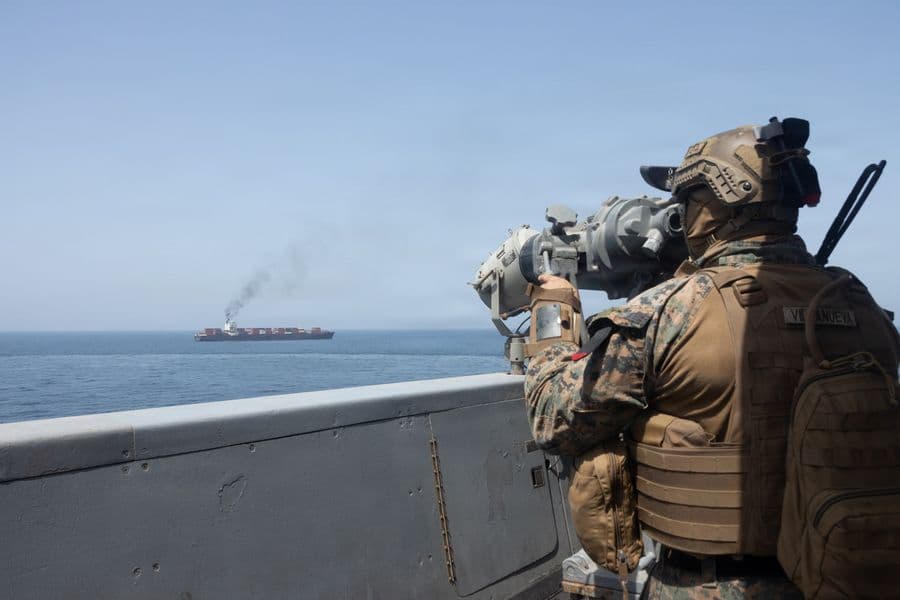
image: U.S. forces patrol the Arabian Sea near M/V Touska, April 20, 2026, after the Iranian-flagged vessel attempted to violate the U.S. naval blockade. (U.S. Navy photo)

Innovation Alone Won’t Prepare the U.S. for the Future Battlefield
By Joshua Segal • RealClearDefenseThe sUAS Tactical Trifecta
By Bryan T. Woody • RealClearDefense
The Revolutionary War: When Strategic Options Share the Same Weakness
By Henry Yep • RealClearDefense
The Houthis Are Testing the Limits of Collective Defense
By Saima Afzal • RealClearDefense
Radio Frequencies in the Intelligence Ecosystem
By Craig Brower • RealClearDefense