
Tehran Demands Access to $10 Billion of Frozen Iranian Assets As Reward for Negotiating
Last updated 06:17 PM EDT • Read time: 4m
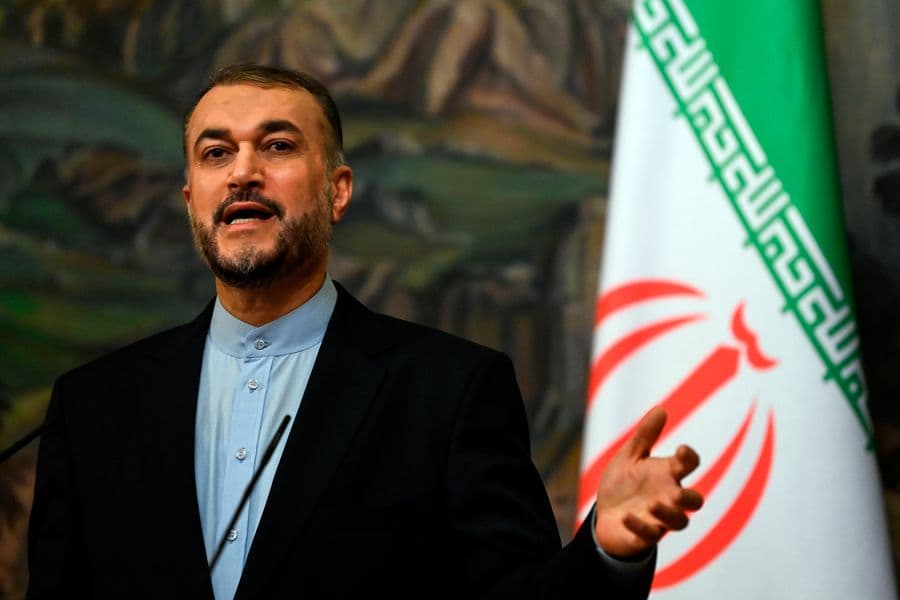
Iranian Foreign Minister Hossein Amirabdollahian said on Saturday that Washington should unfreeze $10 billion of Iranian assets as a goodwill gesture before Tehran resumes negotiations over compliance with the 2015 nuclear deal, formally known as the Joint Comprehensive Plan of Action (JCPOA). While the Biden administration’s subsequent rejection of this demand displayed a welcome measure of common sense, Washington remains eager to offer the Islamic Republic billions of dollars in sanctions relief in exchange for Tehran’s return to the flawed JCPOA.
Since Iranian President Ebrahim Raisi took office in August, his government has repeatedly claimed that it would come back to negotiations once it completed an internal review of Tehran’s nuclear policies. On September 21, Foreign Ministry spokesman Saeed Khatibzadeh said that talks “will resume soon and over the next few weeks.” On September 24, Amirabdollahian said Iran would re-enter negotiations “very soon,” but provided no date. The exact timetable remains unclear.
The delay constitutes an attempt by Tehran to boost its leverage and toy with the United States. The Islamic Republic is exploiting the current suspension of talks to advance its nuclear program without consequence, potentially reducing its breakout time — that is, the amount of time needed to produce enough weapons-grade uranium for one nuclear weapon — to as low as one month, according to arms control experts at the Institute for Science and International Security and the Foundation for Defense of Democracies.
Concurrently, Iran continues to stonewall the International Atomic Energy Agency’s investigation of undeclared nuclear materials found at several sites across the country. Yet the agency’s Board of Governors has failed to pass a resolution referring the Islamic Republic to the UN Security Council for countermeasures, apparently fearing that such a step would torpedo negotiations between Washington and Tehran.
“Iran will eventually return to the talks in Vienna,” a senior Iranian official told Reuters on condition of anonymity. “But we are in no rush to do so because time is on our side. Our nuclear advances further [sic] every day.” As a senior European diplomat put it, the Iranians “want to create a fait accompli on the ground — technical and nuclear — and preserve the possibility of a negotiation.”
Tehran’s negotiating strategy has paralyzed the Biden administration, effectively deterring Washington from punishing the clerical regime for its nuclear activities. Rather, Secretary of State Antony Blinken said on September 8 that America’s ability to rejoin the JCPOA “is not indefinite.” Special Representative for Iran Robert Malley commented on September 3 that America “can’t wait forever” but is “prepared to be patient.” Neither statement appears to have intimidated Tehran.
Given the possibility that America and Iran will ultimately resuscitate the JCPOA, other key stakeholders must intervene. U.S. governors and private attorneys, as well as Israel and the Gulf states, should use a combination of market and political deterrence to diminish the economic benefits to Tehran from an American return to the JCPOA. Some congressional Republicans have already signaled to the market — through legislation, resolutions, and open or personal letters — that when they take back power, they will reinstate sanctions and impose significant costs on anyone who has re-entered the Iranian market. Companies may thus enjoy only a few years of business opportunities before sanctions return.
U.S. governors can reinforce this market deterrence by expanding state laws to divest public pension funds from companies doing any business with the Islamic Republic. Private attorneys currently hold more than $50 billion in outstanding judgments against the clerical regime on behalf of victims of Iranian terrorism. They should seek to attach these judgments to transactions between international companies and Iranian entities.
These steps would help mitigate the deleterious effects of any revival of the JCPOA, denying Iran billions of dollars in cash that it would use to finance its malign activities.
Mark Dubowitz is the chief executive of the Foundation for Defense of Democracies (FDD), where Tzvi Kahn is a research fellow. Both contribute to FDD’s Iran Program and Center on Economic and Financial Power (CEFP). For more analysis from Mark, Tzvi, the Iran Program, and CEFP, please subscribe HERE. Follow Mark and Tzvi on Twitter @mdubowitz and @TzviKahn. Follow FDD on Twitter @FDD and @FDD_CEFP and @FDD_Iran. FDD is a Washington, DC-based, nonpartisan research institute focusing on national security and foreign policy.
This article appeared originally at Foundation for Defense of Democracies (FDD).

In Pursuit of Nuclear Abolition
By Peter Huessy • RealClearDefense
Innovation Alone Won’t Prepare the U.S. for the Future Battlefield
By Joshua Segal • RealClearDefense
The sUAS Tactical Trifecta
By Bryan T. Woody • RealClearDefense
The Revolutionary War: When Strategic Options Share the Same Weakness
By Henry Yep • RealClearDefense
The Houthis Are Testing the Limits of Collective Defense
By Saima Afzal • RealClearDefense

Who Shoots Down the Drone Over the Shipyard?
By John Ferrari & Dillon Prochnicki • RealClearDefense
Northrop Grumman Breaks Out the Big Guns at AUSA
By Daniel Terrill, Defense News
Army Pursuing Diverse Array of New Anti-Air Interceptors
By Trevithick, The WarZoneWho Shoots Down the Drone Over the Shipyard?
By John Ferrari & Dillon Prochnicki, RCD
F-35C Lands for the First Time on a Ford-Class Aircraft Carrier
By The Aviationist