
The Israeli Card
Last updated 06:55 AM EDT • Read time: 8m
In 1972, Chairman Mao Zedong hosted President Richard Nixon in Beijing to establish diplomatic relations. The visit ended China's isolation, ended the Sino-Soviet alliance, and freed America to focus on the Russian threat in Europe. More fatefully, the summit inaugurated a Sino-American dyad now steering the course of global affairs.
Ever since President Truman recognized Israel eleven minutes after its founding in 1948, America has been its staunchest ally. Nevertheless, as with China and the USSR in 1972, Israel and the United States are poised for a rupture with equally momentous consequences.
Israel in Isolation...
In the most recent Foreign Affairs, American scholar Marc Lynch succinctly summarized the primary goal of American policy in the Middle East since 1991—maintain regional primacy by sustaining a balance of power that favors Israel vis-à-vis friendly Arab regimes and contains adversaries and revisionist threats like Iraq, Iran, and Islamic extremists. Essential to sustaining this stability has been the declared intent to achieve peace between Israel and Palestine as well as military action against states and nonstate actors alike.
Unfortunately, the Israeli response to the Hamas terrorist attacks of October 2023 and the American-Israel war against Iran since February 2026 have constituted what Lynch characterized as the "one-two punch [marking the] end of the American Middle East."
In the aftermath, American foreign and domestic policy elites have begun questioning the once unassailable bipartisan consensus in support of Israel.
The former criticizes the United States for overlooking the entrapment risks inherent to the alliance. The latter accuses the United States of enabling genocide in Gaza.
At first, the opposition was confined to contrarian voices and university campuses. Nonetheless, favorable views of Israel have declined precipitously since then.
An April Pew survey revealed the percentage of Americans with very or somewhat favorable opinions of Israel had decreased from 55 to 37 since 2022. Very or somewhat unfavorable views increased from 42 to 60.
In July, a Pew survey showcased political and generational shifts. Among the four age cohorts surveyed, a majority of Republicans have favorable views of the Israeli people in every cohort except the youngest. On the Democratic side, only a majority in the oldest group held favorable views of Israel.
The disparity in the youngest cohort is substantial. The net favorability among Republicans is -13; among Democrats, it is -43.
Unsurprisingly, Israel has become a litmus test in Democratic Party primaries, and the most belligerent opponents have generally won. In New York, Michigan, Colorado, and Minnesota, stridently anti-Israel progressives have defeated incumbents and moderates who had been backed by millions of dollars in spending by pro-Israel groups.
On Capitol Hill, the Democratic conference has become increasingly hostile to Israel. In April, forty of forty-seven Democratic senators supported a failed measure to restrict the sale of military equipment to Israel. In July, a majority of Democratic House members voted for another unsuccessful measure to restrict aid to Israel (103 to 98 plus 10 abstentions).
As of Labor Day, Democrats are favored to win Congress in the upcoming midterm elections. Despite a decisive victory in 2024, President Donald Trump is polling very poorly, and a Republican presidential nominee has not won a majority of the popular vote since 2004.
An adversarial Congress would cancel the multi-billion-dollar assistance packages that ensure Israel's "qualitative military edge," block passage of (or repeal) legislation to deepen defense industrial linkages, or prevent the renewal of the ten-year memorandum of understanding.
On January 20, 2029, Israel could be confronted with a United States governed by a Democratic president and Congress whose members won by outbidding each other in their antagonism to it.
To whom would Israel turn?
...Will Inevitably Look East
In 1950, Israel was the seventeenth country to recognize Communist China—the first in the Middle East.
China belatedly established relations with Israel in 1992, with the latter becoming a major supplier of sophisticated military technology and then a trading partner.
From less than $2 billion in 2003, China-Israel trade has increased by over 1,000 percent to a peak of $21 billion in 2022. The Joint Committee for Innovation Cooperation, established in 2014, is the only senior-level government-to-government mechanism China maintains with a foreign country.
When President Biden told reporters in March 2023 that he would not be inviting Prime Minister Netanyahu to visit, the latter responded by announcing a visit with Xi Jinping.
Except, decades' worth of goodwill was another casualty of the Hamas terrorist attack of October 2023.
China has long espoused respect for sovereignty and non-interference in the internal affairs of other nations. Nonetheless, China decided to burnish its leadership of the Global South instead of remaining neutral.
China condemned Israeli operations in Gaza and declared its support for the Palestinian people. PRC actions included the substantive—support for Palestine before the Hague—and the slight—online Baidu maps removed Israel's name.
China's stance damaged its standing in Israel and, by April 2024, a survey revealed 54 percent of Israelis deemed it unfriendly or hostile.
But China is also pragmatic. In its bilateral relationships, China has applied a "Goldilocks logic" to its bilateral relationships—maximal economic and political benefits and minimal military obligations.
As of May 2025, China has established "partnerships" with 109 countries. The agreements are adorned with diplomatically auspicious terms like comprehensive, cooperative, coordinated, and strategic, but they are goal-driven, not threat-driven, and only entail modest commitments.
The comprehensive strategic partnership and twenty-five-year cooperation agreement with Iran has not translated into significant material support in its recent wars. In 2024, China's trade with Saudi Arabia and the United Arab Emirates amounted to $100 billion, dwarfing the $15 billion with Iran. (Even the vaunted "no limits" relationship with Russia has seen North Korea and Iran send more troops and weapons than China.)
China's priority in the Middle East is energy security and it has benefited from America’s aforementioned primacy in the region.
Indeed, China's most significant undertaking was a rare demonstration of "creative intervention"—the normalization of relations between Saudi Arabia and Iran in 2023. If not for Hamas, the natural corollaries to Saudi-Iran détente would have been presiding over the normalization of Saudi-Israeli relations and JCPOA 2.0. (China also opposes the Iranian nuclear weapons program.)
However, the bifurcation of economic interests and security responsibilities is increasingly untenable. Chinese stakes in the Middle East are enormous and are resulting in a technological lock-in for both sides.
China may tout itself as a Global South champion and proponent of multilateralism, but that is irrelevant to Middle East powers. Ruinous American interventions and the widening gap between Israeli and Arab military capabilities are very relevant, and regional stakeholders are looking for hedges.
But what incentive does China have?
Regional Stability for One
China would never extend Israel a security guarantee, but it is more capable of bringing about the security it desires in the region than the United States. China acknowledges Israel has "reasonable security concerns" and its influence over Iran is decisive—China could easily condition the aid Iran will need for reconstruction on a cessation of hostilities, overt and covert.
China has also been increasingly marginalized in the “technology triangle” with Israel and the United States. If China reined in Iran, Israel could reciprocate by restarting and expanding upon the technological linkages halted in response to American pressure.
Moreover, Israel possesses the military capabilities that would enhance China's ability to take Taiwan intact. Israel’s successful decapitation operations against Hezbollah, Hamas, and Iran are far more attractive than a risky and destructive amphibious invasion.
China will never persuade the Global South to embrace Israel or bring peace to Palestine, but the surveillance complex perfected in Xinjiang would be far more effective in pacifying Gaza than anything the West would condone. Middle East powers have long overlooked China's persecution of Muslim Uighurs and more than a few would quietly welcome the "stabilization" of the ungovernable territory.
Lastly, bringing stability to the Middle East will end the threat of rising energy costs undermining its export markets in Asia.
Global Momentum for Another
Ultimately, the immediate aftermath of the 1972 summit is compelling.
By playing the “China card”, the United States regained the initiative in the Cold War and undertook a triangular diplomacy that resulted in détente.
China is locked in a nascent cold war with the United States, and, in a single stroke, it could stabilize the Middle East while displacing the latter from a critical region.
Amid the demise of the American order in the Middle East, expect China to play the Israeli card.
R. Jordan Prescott is a private contractor working in defense and national security since 2002. He has been published in The American Conservative, The National Interest, Responsible Statecraft, Small Wars Journal, Modern War Institute, 19fortyfive, RealClearWorld, and RealClearDefense.
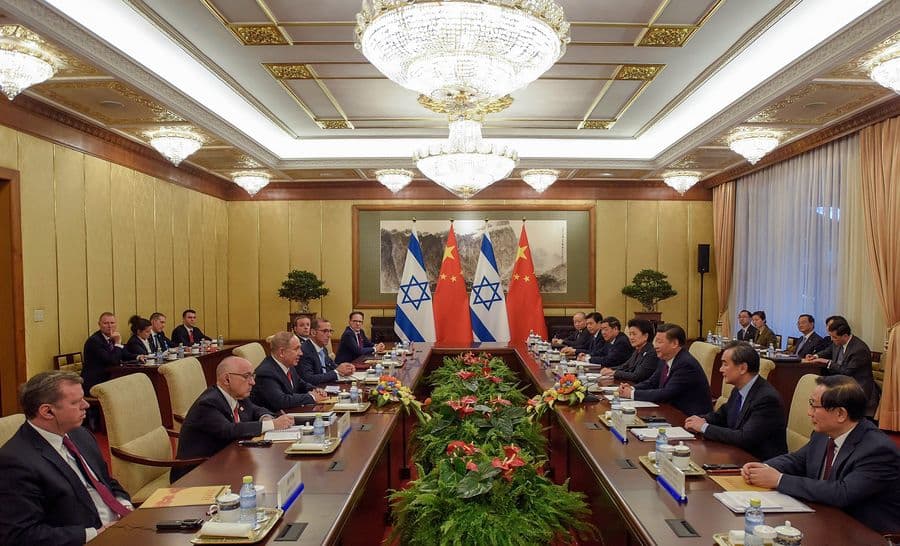
image: Israeli Prime Minister Benjamin Netanyahu, third left, and Chinese President Xi Jinping, third right, attend their meeting at Diaoyutai State Guesthouse Tuesday, March 21, 2017 in Beijing, China. (Etienne Oliveau/Pool Photo via AP)

Innovation Alone Won’t Prepare the U.S. for the Future Battlefield
By Joshua Segal • RealClearDefense
The sUAS Tactical Trifecta
By Bryan T. Woody • RealClearDefense
The Revolutionary War: When Strategic Options Share the Same Weakness
By Henry Yep • RealClearDefense
The Houthis Are Testing the Limits of Collective Defense
By Saima Afzal • RealClearDefense
Radio Frequencies in the Intelligence Ecosystem
By Craig Brower • RealClearDefense

Who Shoots Down the Drone Over the Shipyard?
By John Ferrari & Dillon Prochnicki • RealClearDefense
Northrop Grumman Breaks Out the Big Guns at AUSA
By Daniel Terrill, Defense News
Army Pursuing Diverse Array of New Anti-Air Interceptors
By Trevithick, The WarZoneWho Shoots Down the Drone Over the Shipyard?
By John Ferrari & Dillon Prochnicki, RCD
F-35C Lands for the First Time on a Ford-Class Aircraft Carrier
By The Aviationist