
The U.S. Can Easily Seize Iran's Strategic Islands
Last updated 06:29 AM EDT • Read time: 11m
Today, CENTCOM and the White House are at a flexion point. It is not clear that they will be able to bomb the fanatical Iranian regime into submission, while abandoning the effort to open the Straits of Hormuz is not a politically viable option. It does appear to the mathematically oriented that bombing combined with the blockade of Iranian ports cannot fail to collapse the already failing Iranian economy. The trouble is, that hasn’t happened, yet. The White House and CENTCOM need a stratagem that will rock Tehran and cause them to, “Drink from the Chalice of Poison,” and submit to Washington’s demands.
Some of us at The Dupuy Institute (TDI) believe that shove to the chalice might come in the form of taking several islands in the Persian Gulf. In 1987-88, the Iranians had several surveillance platforms that were highly problematic to U.S. Navy efforts to safely convoy neutral oil tankers out of the Gulf. Eventually, several were destroyed, but the Iranian islands were not touched – undoubtedly to maintain the idea that U.S. forces were neutral and would get involved only when U.S., or U.S.-protected assets were attacked. These small Iranian islands continued to be a thorn in the side of U.S. and its Gulf allies.
Today, these islands continue to serve as intelligence outposts to monitor Gulf shipping. Specifically, Abu Musa, Siri, and Greater and Lesser Tunb Islands have small or no garrisons and could be relatively easy to seize from Iran and put an end to this surveillance. Tehran and its IRGC would be partially blinded, and it would reduce their situational awareness in the Gulf, making it more difficult for them to target commercial shipping moving into the Strait of Hormuz.
More importantly, the seizure of these islands would be a decisive blow to Tehran’s psyche. Abu Musa, Greater and Lesser Tomb Islands were part of Sharjah — a predecessor emirate to the UAE — when the Shah had his forces seize them in 1971. Having taken and maintained them for so long, it would be a major humiliation to lose them. Siri’s provenance is different, but it is important to Tehran for oil production and taking the other islands doesn’t make much sense if Iran maintains control of Siri.
The key to this operation is that U.S. and GCC (Gulf Cooperation Council) forces have air and sea supremacy over and around these islands, cutting them off from support or reinforcement from the mainland. The small garrisons that were there before the beginning of hostilities are the only forces available to defend against invaders. From open-source satellite imagery and historical norms, we judge that these islands are defended by garrisons of between company and battalion size, at most.
TDI’s Wargaming & Combat Modelling team wargamed these prospective battles using a combination of Advance to Contact (ATC), a commercially available wargame, and confirmed by TDI’s TNDM model. ATC was used to calculate these engagements because it is accessible, available and reproducible.
We show that the military risk associated with a U.S. seizure of Iranian Islands is low, and the diplomatic pay-off is high. The U.S. currently has the 1st Brigade Combat Team (BCT) of the 82nd Airborne Division, comprising the three battalions (bn) of the 504th Infantry, deployed in Kuwait, along with the 82nd Combat Aviation Brigade (CAB). The U.S. Navy/Marine Corps team in the region consists of the bn-sized 11th Marine Expeditionary Unit (MEU) deployable from the USS Boxer (LHD-4), USS Portland (LPD-27), and USS Comstock (LSD-45). The UAE military includes a light infantry BDE, a Marine bn, a special operations bn, three El Quwaisat LSTs, and twenty landing craft (10 LCTs, 4 LCPs, and 5 LCMs), as well as 22 CH-47F and 44 UH-60L/M transport helicopters (IISS). The UAE is the U.S.’s most cooperative GCC ally in the Persian Gulf, and therefore most likely willing to assist in garrisoning duties post-engagement.
We expect the Iranians to have deployed the 34th IRGC Infantry Bde to reinforce the IRGC Marine and Basij militia island defenders, with a mixed bn on each of Kharg, Siri, Abu Musa, and Greater Tunb, a coy on Lesser Tunb and a platoon on Farsi Island.
82nd AB Div attacks are assisted by eight F-35A, eight AH-64 Apache, and two AC-130J on station every hour. The 11th MEU is supported by F-35B/C (from the flotilla and the CVN in the Arabian Sea), AH-1Z, and two AC-130J. The air threat from MANPADs and ZSU-23 AAA vs. the Osprey heli-lift is expected to be Moderate (2% loss rate), but with aerial suppression reduced to 0.5%.
We envision the operation to seize Iran’s coastal islands to occur in three phases. Phase 1 consists of the repositioning of forces into jump-off points. The 11th MEU flotilla will pass through the Straits and deploy 3nm south of Greater Tunb Island. From Al Jaber Air Force Base in Kuwait, 1/504 and 2/504 BNs of the 82nd Airborne relocate by C-17 to the UAE, with the CAB (Combat Aviation Brigade) ferrying to meet up with the assault forces. The distance of 1,000 km is covered in around five hours, with a refueling stop in Dhahran.
Phase 2 consists of the 1/504 bn lifted by the 82nd CAB to assault Siri. The 2/504 assaults Abu Musa, hitching a ride from the UAE’s Joint Aviation Bde, with the 82nd CAB providing liaison pilots to ensure the success of the combined operation. The 11 MEU amphibiously deploys two companies to Greater Tunb while one company air assaults Lesser Tunb. Suppression during the heliborne landings and subsequent close air support will be enabled by F-35A/B, F-18s and A-10Cs. UAE troops will be brought in quickly to deal with civilian inhabitants.
Simultaneously, two flights of heavy bombers will saturate Farsi Island with up to 500 500lb bombs, thoroughly razing the small island and its troublesome IRGC garrison to the ground. While that is happening, USAF stealth aircraft raid Kharg Island to destroy the three loading terminals, rendering the oil facility inoperable for months. To add insult to injury, heavy bombers could destroy the entire tank farm on the island, leaving them nothing to pump.
An important consideration of the occupation of the islands is their defensibility against Iranian drones. Abu Musa and Sirri are 75 and 67 km distant respectively from an Iranian coastal built-up area, putting them beyond the range of Iranian FPV drones, though they are certainly within range of MALE (medium altitude/long endurance) drones. MALE drones like the Shahed and Mohajer are a partial substitute for Tehran’s lack of airpower, though they constitute a lesser threat to the operation due to their relative scarcity and cost are more likely to be used against targets in the UAE. Greater and Lesser Tunb are both 36 km from Qeshem Island, potentially putting them within range of drones capable of fiber-optic guidance or enabled by signal repeaters. Either way, we must expect that the islands’ garrisons might include drones. The USMC is generally well-equipped to handle low-density attack, however, these defenses are only effective when safely ashore. ACVs transiting deep water to the shore would be highly vulnerable to FPVs carrying armor-piercing warheads, therefore, more must be done.
The USAF has a fair amount of experience taking down small drones with laser-guided APWKS rockets, and A-10C units have used this technique in the Strait. This operation will take place in darkness, so situational awareness must be at a peak to prevent leakers. Therefore, the USAF will put together Drone Hunter-Killer teams constituting one F-35A “Quarterback” and four A-10C “Killers.” At least one Hunter-Killer team will be on orbit over each island during the operation. The F-35 would use its exceptional sensor suite with 360⁰ view to catch pop-up threats and seamlessly hand the targets off to the A-10s, which would destroy the drones while the F-35 immediately drops GBU-39 small-diameter bombs on the launch sites. For 11 MEU’s islands, Marine or Navy F-35Bs or Cs could be substituted for USAF F-35As, and F-18Es for the A-10s, should that seem advisable to exploit the close relationship between Marine Ground Combat Elements (GCE) with their Air Combat Elements (ACE).
In Phase 3, 11 MEU is reconstituted aboard ship after the UAE relieves U.S. forces with an LST carrying a bn of light infantry to each of Abu Musa, Siri and the Greater and Lesser Tunbs, plus an Emirati engineer group. All of the islands possess airfields that can accommodate resupply by C-17.
The restoration of the islands to the UAE will undoubtedly produce goodwill for Washington, particularly since UAE troops participated, but in a relatively low-risk portion of the operation.
The results of the simulation of the combat in Phase 2 (hyperlinked in the following) demonstrate the quick subdual of Siri, Abu Musa, and Lesser Tunb in one hour, and three hours of fighting on Greater Tunb. The algorithm estimated that in total, the U.S. suffers a 2% loss on amphibious lift vehicles and 20 total combat casualties. The combat effects were the result of many variables, but the key advantages possessed by U.S. forces are their maneuver-producing pressure to inflict posture changes in the target Iranian forces, and not simply the superior firepower of U.S. units. Disadvantages to the U.S. are its detectable advance from the sea, its arrival by helicopter into “hot landing-zones” on small islands, the reduction of its firepower by night operations, typically the result of coordination friction, its lack of artillery, and the high motivation of IRGC Marines. Other U.S. advantages are principally the ability to guide accurate close air support to produce suppression, and combined arms, with the result being that most Iranian defenders are promptly overrun and surrender.
To reiterate, historically validated combat models have confirmed that the Gulf Islands could be taken in a few hours, and at minimal cost. This would be a huge blow to Tehran and a major boost to the UAE and other GCC allies, while severely damaging the IRGC surveillance and targeting of ships transiting the Strait of Hormuz. In just one night, Iran would be expelled from much of the Gulf, dealing them a devastating blow to their aspirations of pushing the U.S. out and replacing us with their own hegemony in the region.
William A. Sayers made his 30-year career in the Intelligence Community in Washington D.C. as a military analyst at DIA, CIA and the National Counterterrorism Center. He holds Master’s degrees from the Marine Corps Command & Staff College, the Marine Corps School of Advanced Warfighting (where he was their only civilian graduate through at least 2011) and the Marine Corps War College. He spent 2 years on active duty in the USAF and 3 years as a reserve intelligence officer in the Air Force Intelligence Service. Sayers has published articles on the air war over North Vietnam in Air Power History and twice in Vietnam magazine. He is currently the Principal Research Fellow and Director of Wargaming and Combat Simulations at The Dupuy Institute in Tyson’s Corner, Virginia.
Dr. Julian Spencer-Churchill is associate professor of international relations at Concordia University, and author of Militarization and War (2007) and of Strategic Nuclear Sharing (2014). He has published extensively on Pakistan security issues and arms control and completed research contracts at the Office of Treaty Verification at the Office of the Secretary of the Navy, and the then Ballistic Missile Defense Office (BMDO). He has also conducted fieldwork in Bangladesh, India, Indonesia, Egypt, and Taiwan, and is a consultant. He is a former Operations Officer, 3 Field Engineer Regiment, from the latter end of the Cold War to shortly after 9/11. He is currently collaborating with the Combat Modelling group at the Trevor Dupuy Institute.
The Central Intelligence Agency has reviewed this article and approved it for release to the public. This does not constitute endorsement of its content.
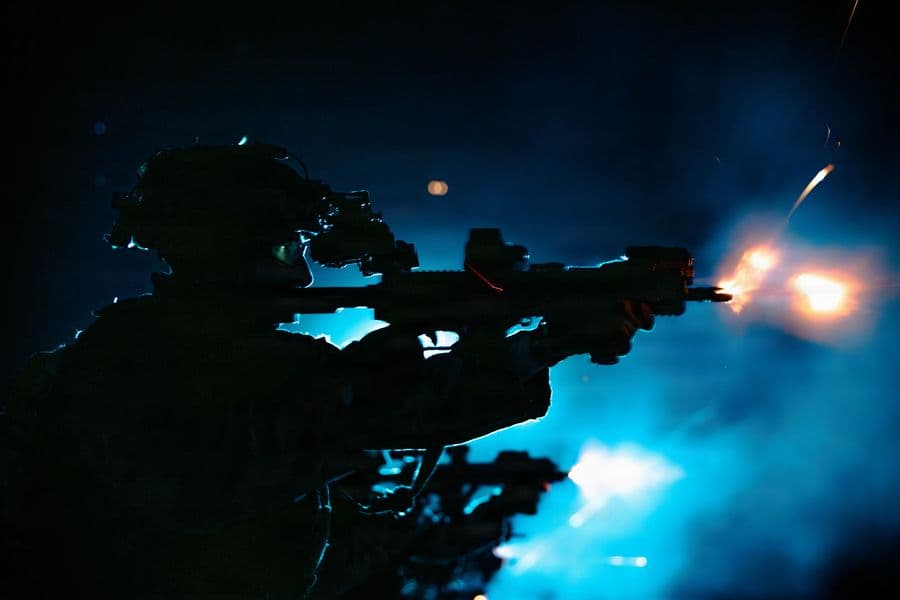
image: U.S. Marines with Maritime Raid Force, 31st Marine Expeditionary Unit, conduct routine training aboard the forward-deployed amphibious assault ship USS Tripoli (LHA 7) in the U.S. Central Command area of responsibility, April 12, 2026. The 31st MEU is deployed to support maritime security and stability in the U.S. Central Command area of responsibility. (U.S. Marine Corps photo)

In Pursuit of Nuclear Abolition
By Peter Huessy • RealClearDefense
Innovation Alone Won’t Prepare the U.S. for the Future Battlefield
By Joshua Segal • RealClearDefense
The sUAS Tactical Trifecta
By Bryan T. Woody • RealClearDefense
The Revolutionary War: When Strategic Options Share the Same Weakness
By Henry Yep • RealClearDefense
The Houthis Are Testing the Limits of Collective Defense
By Saima Afzal • RealClearDefense

Who Shoots Down the Drone Over the Shipyard?
By John Ferrari & Dillon Prochnicki • RealClearDefense
Northrop Grumman Breaks Out the Big Guns at AUSA
By Daniel Terrill, Defense News
Army Pursuing Diverse Array of New Anti-Air Interceptors
By Trevithick, The WarZoneWho Shoots Down the Drone Over the Shipyard?
By John Ferrari & Dillon Prochnicki, RCD
F-35C Lands for the First Time on a Ford-Class Aircraft Carrier
By The Aviationist