
The U.S. Has a Long History of Getting Iran Wrong
Last updated 07:45 PM EDT • Read time: 5m
On New Year’s Eve in 1977, U.S. president Jimmy Carter hailed Iran as ‘an island of stability in one of the more troubled regions of the world’, which he credited to Shah Mohammad Reza Pahlavi’s leadership and ‘the admiration and love which your people give to you.’ In his speech, Carter made no reference to Iran’s deep economic and social divisions and seemed unaware that the shah was widely reviled in his own country.
Within weeks, these divisions exploded into mass demonstrations, forcing the shah to flee the country a year later and paving the way for the Islamic cleric Ruhollah Khomeini to return from exile and establish the hardline theocracy that remains in power today.
Assessments by senior officials within the Carter administration were equally off the mark. The U.S. ambassador to Iran, William Sullivan, envisaged Khomeini returning as the spiritual leader of a new regime, but ‘shorn of any political power’. Just weeks after Pahlavi fled, America’s UN ambassador, Andrew Young, told journalists that Iran was too Westernised to become a fundamentalist Islamic state. He suggested that Khomeini would in time be hailed as ‘a saint’.
And when the U.S. press reviewed Khomeini’s aggressively anti-Western writings, the State Department rushed to his defence, suggesting that Iran’s clerics were turning towards moderation.
In King of Kings, Scott Anderson provides a detailed account of the ‘hubris, delusion and catastrophic miscalculation’ that permeated the United States’ relationship with Iran during the shah’s 38-year reign, culminating in a major foreign policy disaster for the U.S.. Anderson is a historian and novelist who has published widely on the Middle East, including an acclaimed biography of Lawrence of Arabia.
In 1941, Britain and the Soviet Union invaded Iran and replaced shah Reza Khan, whom they suspected of having Nazi sympathies, with his 21-year-old son crown prince Mohammad Reza, who was expected to be more compliant. Iran was strategically located as a military conduit, and the allied powers wanted to secure for themselves a steady flow of Iranian oil. In the 1950s, Britain’s key role in Iran was taken over by the U.S..
While today there are no formal ties between the two countries, in the 1970s, the U.S. had a major presence in Iran. This included a well-staffed embassy in Tehran, consulates in three major cities, one of the largest CIA stations in the world, thousands of military personnel to help arm Iran’s military, and a large corporate presence in the petroleum sector. With such an extensive information-gathering network, why was Washington so poorly informed?
According to Anderson, intelligence was screened, filtered and compartmentalised at several levels. Rather than gathering its own intelligence, the Central Intelligence Agency relied heavily on Iran’s own secret police, so it got a biased picture of the local situation from the outset.
Reports of social strife from a proactive and well-connected consul in Tabriz should have set off alarm bells. Instead, they were downplayed or dismissed by the embassy, which was intent on supporting the shah. When the consul reported an alleged mutiny plot at a local air force base, the ambassador threatened to destroy his career. And in Washington, State Department desk officers with little local knowledge tended to ignore bad news. Essentially, Washington heard what it wanted to hear.
The book offers many parallels with the current crisis. On the Iranian side, there were sharp divisions between the Westernised elite, the bureaucracy and the shah’s Imperial Guard on the one hand, and the military, the clerics and the rest of society on the other. In the U.S. administration, again, there was constant tension between the dovish secretary of state, Cyrus Vance, and hawkish national security adviser, Zbigniew Brzezinski. And when widespread strikes led to a collapse of Iran’s oil industry in late 1978, oil prices skyrocketed, triggering an international energy crisis.
Anderson provides a timely reminder not to underestimate the strategic skills of Iran’s leaders or the potential effect that events in Iran could have domestic politics in the U.S..
Once the shah had been ousted, Iranian students took U.S. embassy staff hostage and didn’t release them until 444 days later, right after the inauguration of Carter’s opponent Ronald Reagan. Khomeini seemed to be unaware of the hostage-taking at the outset but quickly put the situation to good use.
Anderson also sheds new light on allegations that Reagan’s team negotiated with Iran behind the scenes to delay the release of the hostages and gain political advantage. And there is little doubt that failed negotiations and a botched U.S. rescue mission undermined Carter’s public support and scuttled his chances of being re-elected.
Based on wide-ranging interviews and sources, Anderson provides a blow-by-blow account of the escalating crisis. If King of Kings has a shortcoming, it is the limited insight offered into the role of Iran’s Middle Eastern neighbours. However, in the current situation, the book’s focus on the relationship between Iran and the U.S. only enhances its relevance.
Robert Wihtol is an adjunct faculty member at the Asian Institute of Management and former Asian Development Bank country director for China and director general for East Asia.
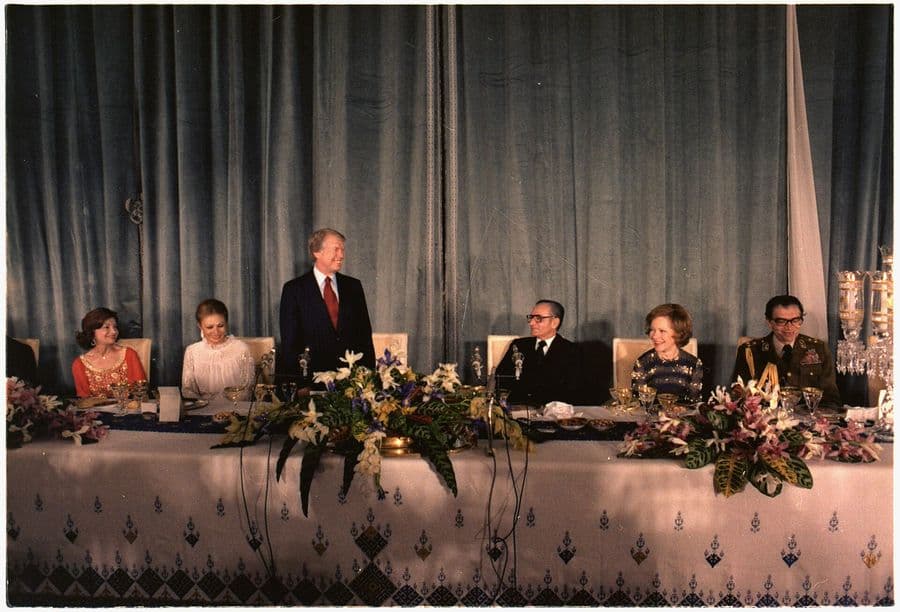
Image of Jimmy Carter with Mohammed Reza Pahlavi at the Niavaran Complex in Tehran, Iran, December 1977: U.S. National Archives and Records Administration/Wikimedia Commons.
AI contributed no ideas to this article – Robert Wihtol.
This article appeared originally at The Strategist (ASPI).

In Pursuit of Nuclear Abolition
By Peter Huessy • RealClearDefense
Innovation Alone Won’t Prepare the U.S. for the Future Battlefield
By Joshua Segal • RealClearDefense
The sUAS Tactical Trifecta
By Bryan T. Woody • RealClearDefense
The Revolutionary War: When Strategic Options Share the Same Weakness
By Henry Yep • RealClearDefense
The Houthis Are Testing the Limits of Collective Defense
By Saima Afzal • RealClearDefense

Who Shoots Down the Drone Over the Shipyard?
By John Ferrari & Dillon Prochnicki • RealClearDefense
Northrop Grumman Breaks Out the Big Guns at AUSA
By Daniel Terrill, Defense News
Army Pursuing Diverse Array of New Anti-Air Interceptors
By Trevithick, The WarZoneWho Shoots Down the Drone Over the Shipyard?
By John Ferrari & Dillon Prochnicki, RCD
F-35C Lands for the First Time on a Ford-Class Aircraft Carrier
By The Aviationist