
The Video Got the Headlines. The Bank Got Cut Off.
Last updated 06:59 AM EDT • Read time: 7m
What the second month of the economic campaign against Iran actually did — and what Moscow does when it has no paperwork left
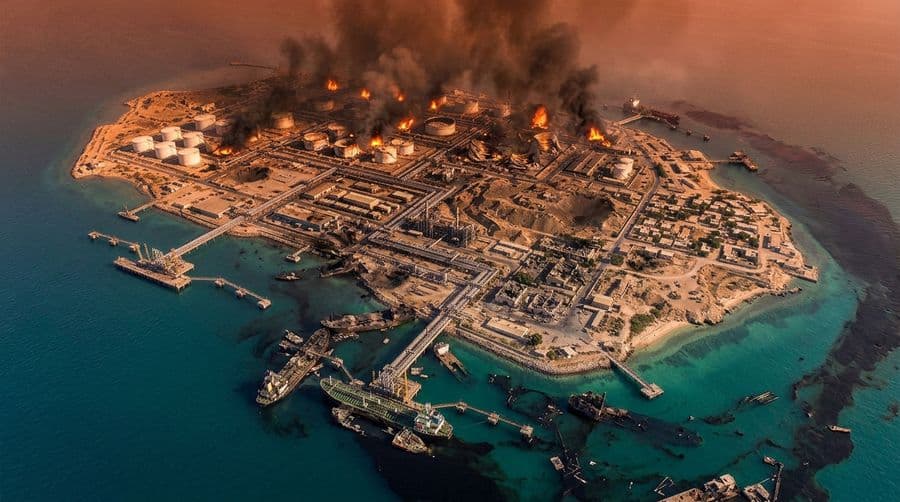
On August 30, the president of the United States posted a video of Kharg Island under attack, captioned "Kharg Island being blown to smithereens!!!" The footage was generated by artificial intelligence. Within a day it had collected more than fifteen thousand likes and been reposted almost four thousand times.
The following morning, he wrote that Iran was officially a failed nation, that it had no navy, no air force, and no currency, and that its leadership was in total disarray.
Twenty-four hours earlier, on August 29, the Treasury Department had cut the United Arab Emirates branch of Banque Misr — one of Egypt's largest banks — out of the dollar-based financial system. The same action sanctioned the Dubai branch manager of Iran's Bank Melli and a Hong Kong shell company that the Office of Foreign Assets Control says helped a sanctioned Iranian exchange house launder money.
The video was covered. The designation, largely, was not.
I wrote in these pages that the instruments deciding who can afford to sail through Hormuz were published in London in a few lines of contract language nobody outside marine insurance bothered to read. The month since has produced a cleaner example, and it did not involve a strait at all.
What Actually Happened in the Third Week of August
On the evening of August 18, residents of Dubai received a missile threat alert. The Emirati defense ministry later said two ballistic missiles had been fired from Iran at maritime traffic. Tehran denied responsibility.
Within hours, the Emirati foreign ministry announced that all trade, commercial exchange and financial transactions with Iran had been halted until further notice. The statement did not mention the missiles. It cited escalations undermining regional and international peace and security.
Iran International reported that the halt came a day after a telephone call between the American president and Sheikh Mohamed bin Zayed.
On August 25, asked about the sequence, Treasury Secretary Scott Bessent said the Emirati suspension was not a coincidence, and that he expected a broad array of countries to follow.
Consider what that decision closed.
The Emirates had been Iran's largest trading partner. Roughly seventy percent of Iran's fuel oil exports in 2025 — of some 256,000 barrels a day — went there. But the bilateral figure understates it. Dubai was Iran's re-export hub: European and Asian goods that could not be sold to Tehran directly entered through Emirati traders. It was also the center for the exchange houses and intermediaries that moved Iranian money across borders after Iran lost access to most of the international banking system.
A Tehran-based consultant told Bloomberg that an Emirati embargo could prove more damaging to Iran's economy than American and European sanctions.
No American warship was involved. No strike was flown. One phone call, and a third country closed the door itself.
The Campaign Now Has a Tempo
Bessent told Reuters that new secondary designations should be expected weekly, and that the campaign would begin with banks. He said the next step could be cutting a financial institution off from the dollar system entirely.
He put it to the world's finance ministers in one sentence: you are either with us or with the Iranians.
That is worth reading slowly. It is not a threat of force. It is a threat of paperwork, delivered to central bankers, with a schedule attached.
And it is being enforced on the timetable he described. Banque Misr's Emirati branch was severed nine days after the Emirati trade halt. Bank Melli's Dubai manager was designated the same day. A Hong Kong front company followed.
Each of these is a document. Together they are a campaign.
The Target Has Confirmed the Result
The most persuasive evidence that this works did not come from Washington.
Iran's president, Masoud Pezeshkian, said this week that if power has to be cut, it should be cut to government ministries rather than to industrial plants. He said the government was considering consolidating its operations and closing some state buildings over the winter so that the electricity saved could go to production.
A government proposing to shut its own offices to keep factories running is not describing a diplomatic dispute. It is describing an economy that has stopped being able to do two things at once.
That admission is worth more than any American assessment, because it comes from the other side of the ledger.
What Moscow Does When the Paperwork Is Gone
There is a second half to this, and it runs in the opposite direction.
The United States is applying leverage to Iran because it still has leverage to apply. Dollar clearing, insurance markets, correspondent banking, port access — these are instruments Washington controls or can influence, and they work without a shot.
Russia has been losing exactly those instruments since 2022. The pipeline leverage over Europe is largely spent. The banking channels are narrowed. The markets that once made Moscow indispensable have found other suppliers.
In an assessment published on August 31, The Economist reported that Western intelligence services now believe Russia may strike European factories producing equipment for Ukraine's military, while considering direct military confrontation with NATO unlikely. The Russian defense ministry has already announced preparations for large-scale attacks on Ukraine's energy infrastructure.
Moscow's remaining registers were all visible in a single week. On August 31, the Russian foreign ministry published an article by Sergei Lavrov calling NATO's exercises in the far north aggressive and warning that the risk of incidents leading to armed confrontation is rising. The day before, NATO officials had said they saw no imminent threat of attack.
Declaration is the cheapest instrument left. It is also the one nobody is buying.
Set those two campaigns side by side.
One power is buying compliance with contracts, designations, and clearing access. The other has lost the ability to do that, and is substituting sabotage and explosives for the leverage it no longer holds.
This is not a moral comparison. It is a structural one, and it has a practical implication. Coercion through paperwork is available only to states that own the paper. When a state loses that ownership, it does not become less coercive. It becomes more physical.
I watched that transition once from the receiving end. In the years before 2008, Russian pressure on Georgia arrived as customs regimes, wine and water bans, energy interruptions and border closures that were always technical and never political. When those instruments stopped producing results, the pressure did not stop. It changed form, and in August 2008 it arrived in tanks.
Anyone who assumes that a Russia running out of economic tools will therefore behave more cautiously has the sequence backwards.
What Washington Should Take From This
Three things follow, and none of them requires new money.
First, the Iranian campaign is working through institutions the American government does not command. Emirati ministries, Egyptian banks, Hong Kong registrars, Lloyd's underwriters. Each is deciding independently, and the aggregate can drift. I argued before that this needs a single interagency body reading sanctions designations, insurance capacity, corridor commitments, and financial flows as one system. The events of the past month strengthen that case rather than weakening it.
Second, the publicity and the effect are diverging, and that has a cost. When a generated video draws fifteen thousand endorsements and a bank severance draws almost none, the public record of this campaign becomes the noise rather than the result. Adversaries who read only the announcements will misjudge American intentions. So will allies. So, eventually, will American voters.
Third, the same instruments that are squeezing Tehran are the instruments Moscow no longer has — and that asymmetry is a forecast, not a comfort. The European infrastructure warnings in this month's intelligence reporting are what the loss of economic leverage looks like on the other end.
The president can post a video of an island being destroyed. He cannot post a bank back into the dollar system.
One of those two things happened, and it was not the video.
Emzari Gelashvili is a former senior official in Georgia's state security, defense, and interior ministries, with a career in counterintelligence focused on Russian and Iranian operations. He served in the Georgian Parliament from 2008 to 2012, representing Kareli, on the administrative boundary with the Russian-occupied territories. His work has appeared in Newsweek, The Hill, the Washington Examiner, RealClearDefense and RealClearWorld.

In Pursuit of Nuclear Abolition
By Peter Huessy • RealClearDefense
Innovation Alone Won’t Prepare the U.S. for the Future Battlefield
By Joshua Segal • RealClearDefense
The sUAS Tactical Trifecta
By Bryan T. Woody • RealClearDefense
The Revolutionary War: When Strategic Options Share the Same Weakness
By Henry Yep • RealClearDefense
The Houthis Are Testing the Limits of Collective Defense
By Saima Afzal • RealClearDefense

Who Shoots Down the Drone Over the Shipyard?
By John Ferrari & Dillon Prochnicki • RealClearDefense
Northrop Grumman Breaks Out the Big Guns at AUSA
By Daniel Terrill, Defense News
Army Pursuing Diverse Array of New Anti-Air Interceptors
By Trevithick, The WarZoneWho Shoots Down the Drone Over the Shipyard?
By John Ferrari & Dillon Prochnicki, RCD
F-35C Lands for the First Time on a Ford-Class Aircraft Carrier
By The Aviationist