
Trump's 'Guardian of Hormuz'
Last updated 06:18 AM EDT • Read time: 11m
Trump’s 'Guardian of Hormuz' Distracts From His Goal of a 'Good and Proper' Deal
On July 13, President Trump demanded the United States be "reimbursed, at the rate of 20% on all cargo shipped" to serve as the "Guardian of the Hormuz Strait" which directly distracts from transforming a flawed preliminary memorandum into a “good and proper” final agreement that the president demanded. By treating an international security mission as a toll collection mechanism, this rhetoric inadvertently legitimizes the illicit transit taxes Washington has spent months condemning. It validates Iranian Foreign Minister Abbas Araghchi’s mocking counter-claim that "whoever provides secure and safe passage... should be compensated for this service." This dangerous precedent effectively invites friends and foes alike to levy arbitrary tariffs across hundreds of vital global waterways, severely undermining the president's own best strategic negotiation leverage. Far from breaking the underlying deadlock, this tariff dispute complicates his primary national security mission. On July 10, Trump stated that while the United States agreed to continue "talks," he made clear "in no uncertain terms, that the Cease Fire is OVER!" Negotiations since June 17 have achieved little. As Tehran continues its provocations, talks will remain stop-and-go until August 16, unless extended by mutual agreement. Meanwhile, Washington must navigate two looming crises:
- Will the United States slide back into a full-scale regional war that will be even bloodier and more economically disruptive than before?
- Even if negotiations survive, will they yield a final agreement that is just as bad as the preliminary Memorandum of Understanding (MOU)—or worse, one that allows Iran to institutionalize permanent control and extract toll fees over the Strait?
To rescue the United States from these two crises, Washington cannot simply rely on the reactive, tit-for-tat strategy used since the war began on February 28. Indeed, as U.S. and Iranian forces trade heavy strikes across the Gulf, UN Spokesperson Stephane Dujarric openly pleaded at a news conference on July 9, "Look, this tit-for-tat needs to stop," warning that this back-and-forth conflict is only driving further regional destabilization. Instead of de-escalating, President Trump has repeatedly doubled down on his public warnings, threatening a massive, scorched-earth attack designed to force Tehran's compliance. Yet, even if the United States were to follow through on his no-holds-barred attacks, as well as rapidly seize physical control of the Strait of Hormuz to reopen oil traffic, the domestic and international blowback would be catastrophic. The American public and Western allies remain deeply averse to a full-scale military campaign due to the severe humanitarian suffering it would inflict, even on an adversary.
By exploiting this widespread democratic reluctance to cause massive destruction—such as Trump’s July 8 warning: “In one day, we could take down all of Iran’s bridges,” as well as their power plants—Tehran confidently gambles that Trump’s rhetoric is ultimately an empty threat. Especially with the midterms approaching, voters would not forgive a president who so flagrantly violates their moral conscience. Because an empty threat cannot force Hormuz open, Trump's only other option is to accept a lousy preliminary deal in exchange for reopening the Strait, hoping to convert that bad deal into a good one during the final negotiations. Unfortunately, if this reactive strategy remains unchanged, the final agreement will, at best, mirror the flawed preliminary one.
If Washington wants to return the Strait of Hormuz to its traditional form—always open and free to international traffic—and transform a flawed preliminary deal into a “good and proper” final agreement that President Trump demanded, it cannot rely on empty threats or reactive strikes. Instead, the administration must pivot to a high-leverage strategy built on three mutually reinforcing elements.
First, Trump must plainly explain to domestic and international audiences how inadequate Iran’s concessions are, while directly answering serious public misunderstandings regarding past and future U.S. actions. Had he established this public clarity earlier, he would have secured far greater support at home and abroad. Second, he must deploy high-leverage maritime options—such as utilizing air-launched sea mines to block Iranian oil exports—creating an asymmetric deterrent that forces compliance but can be deactivated once a peaceful settlement is reached. Third, he must establish an open, transparent negotiation protocol to expose unreasonable Iranian demands for the world to judge.
To execute this first element of public education on Iran and U.S. key positions in the MOU, the administration must calmly dismantle Tehran’s public relations campaign. Iran has attempted to frame its opening moves in the final negotiations as cooperative, but its primary focus remains a long-term trap to secure permanent control over global shipping lanes. Major reporting, including analysis by the Wall Street Journal, has highlighted how Tehran is attempting to turn the waterway into a political toll booth. Specifically, Point 5 of the preliminary MOU stipulates a toll-free window for “60 days only,” a tight timeline that Iran is already using as the legal groundwork to impose a disruptive transit fee on global shipping the moment that window expires. The administration must aggressively expose this bad intent, letting the public plainly see that any final agreement recognizing Iranian administrative control over the Strait would allow Tehran to close the waterway at will—the exact opposite of the traditional, always open and free form Washington demands.
To fully execute this first element, public education must expand from maritime security to the critical nuclear dimension. The United States, by contrast, is fully justified in its first critical demand: holding a firm line against domestic election-day timelines and political distractions to ensure any final nuclear agreement permanently prevents a surprise breakout. On May 27, President Trump declared that he did not “care about the midterms,,” signaling to Tehran that he will not rush into a weak deal for short-term political expediency. Now that final negotiations are underway, the administration must maintain this high ground by reemphasizing to both domestic critics and Iranian negotiators that securing a structurally sound, fair agreement takes priority over any domestic election-day timeline.
At the same time, the administration must counter the opposition's primary argument that military force was unnecessary because the 2015 Joint Comprehensive Plan of Action (JCPOA) was working—a narrative bolstered by former President Obama’s mid-June 2026 interviews claiming the war achieved nothing diplomacy couldn't secure. To dismantle this, Trump must articulate that while the JCPOA merely delayed a nuclear crisis, long-term security requires more than an outdated fix. He must remind the public that Iran could attain nuclear weapon capability “in a matter of months, not years”—a timeline warned of by nuclear nonproliferation experts Gregory Jones and Henry Sokolski in Foreign Policy (October 10, 2024)—which can arrive without timely warning to stop it. It is why Trump executed Operation Midnight Hammer in June 2025, to severely damage Iran’s key nuclear facilities at Fordow, Natanz, and Isfahan.
Of the 14 points in the preliminary memorandum, only Point 8 addresses this critical nuclear commitment, stating that Iran "reaffirms that it shall not procure or develop nuclear weapons." Yet, this language is practically a carbon copy of—or even weaker than—the 2015 JCPOA preamble, which famously declared: "Iran reaffirms that under no circumstances will Iran ever seek, develop or acquire any nuclear weapons." By locking this empty pledge in the preliminary MOU, Tehran outmaneuvered the administration into resurrecting the exact same toothless framework the U.S. previously abandoned. Under the preliminary MOU, Iran secures a massive win-win: establishing the groundwork to finalize administrative control over the Strait and continuing nuclear weapon development under the guise of a peaceful civilian program.
Exposing this trap through public education is an essential first step, but clarity alone will not change Tehran's calculus. To break Iran's maritime leverage over global shipping and strip Tehran of its nuclear breakout potential, Washington must immediately pair this public exposure with the strategy's remaining two elements: asymmetric reprisal to target Iran's oil exports and its economy—executing a high-leverage retaliation that matches the maritime and economic nature of their disruption but cripples their maritime commerce and their economy at a far higher level—and a transparent negotiation protocol that forces them to defend—or, failing that, to abandon—their untenable position to the world.
To implement this second element, the Trump administration must enhance its naval blockade, which has already substantially reduced Iran’s seaborne exports. Crucially, Washington must prevent Iran from using an illicit, oil-smuggling "shadow fleet" that now numbers around 1,500 ships according to TankerTrackers.com to circumvent the blockade. If Tehran threatens to close Hormuz or attacks commercial vessels, the U.S. must immediately reinforce the blockade and turn back or seize tankers transporting Iranian oil. Should Iran strike the energy infrastructure of U.S.-friendly Arab Gulf states, the U.S. military must retaliate directly against Iranian oil facilities. Long before putting boots on the ground, Washington should deploy a progressive bombing campaign against Kharg Island to penalize further escalation—striking loading piers as an initial warning, and expanding to storage tanks if aggression continues.
If Iran attempts to fully blockade Hormuz and scare commercial tankers from entering, Washington should deploy a highly targeted, air-launched sea-mine blockade to sever Iran's oil exports from hubs like Kharg Island. Crucially, these modern, Quickstrike naval mines can be tightly controlled because they are programmed with a precise, automated shelf-life. Once negotiations succeed, the U.S. military does not need to risk long and dangerous minesweeping missions; instead, these precision assets are designed to safely self-neutralize or self-destruct after a pre-set timeline, rendering the transit lanes harmless. Providing these distinct responses demonstrates that U.S. retaliation is justifiable because it directly mirrors the nature of Iran’s own maritime blockades and global economic disruptions. At the same time, executing these tailored responses fulfills the high-leverage framework: it maintains strict asymmetry by mirroring the maritime and economic theater of Iran’s own aggression, but establishes an overwhelming deterrent by inflicting far more systemic damage than the regime can absorb. Ultimately, this dual-track leverage forces the regime to realize that its best strategy is to abandon physical confrontation and participate in the final negotiations in good faith, returning both sides to peace without allowing unmitigated escalation.
Under the third element, whenever the Iranian team makes a demand, the Trump administration should ask for a corresponding concession to expose any imbalance between what Tehran demands and what it is willing to concede, leaving it for the world to judge. A good example is Tehran's demand for $300 billion in reconstruction funding from neighboring Gulf states as compensation for U.S. and Israeli military attacks. This demand provides an excellent opportunity for the Trump team to transparently expose Tehran's hypocrisy. By demanding hundreds of billions while offering no meaningful concessions on its own nuclear weapons program, Iran inadvertently demonstrates to both the deeply polarized American public and Washington’s skeptical international allies why the United States was justified in executing preemptive self-defense by bombing Iran’s nuclear facilities. Indeed, as of June 2025, Iran could produce and deliver nuclear weapons before being detected and stopped. As its stockpile of 440 kg of 60% enriched uranium could be further enriched to make 11 nuclear bombs, historical Hiroshima data indicates such an arsenal could inflict upwards of 1 million fatalities. Therefore, the threat of an imminent nuclear breakout is why the U.S. responded with force, and Tehran cannot demand billions from Gulf states to rebuild from a conflict sparked by its own illicit nuclear ambitions. Moreover, these Gulf states can determine whether donating this sum to Iran is better than using it to protect their own energy infrastructure with effective defense systems rapidly becoming available.
In sum, this three-element strategy addresses the twin crises facing Washington: sliding back into a war with Iran and getting a bad deal in the final agreement. By keeping the public informed, deterring Iran with high-leverage maritime countermeasures, and maintaining a transparent and fair negotiation protocol, the administration can execute asymmetric retaliations without putting boots on the ground. This framework provides an overwhelming deterrent that the American public and our allies believe are justified and can fully support—crippling Iran’s oil exports and its economy far more than it hurts us. Ultimately, this decisive leverage will convince Tehran to abandon physical confrontation and collaboratively participate in the final negotiations, securing a fair, lasting, and “good and proper” final agreement that avoids a "Guardian of Hormuz" toll fee—an idea that validates Iran's widely hated scheme to charge ships for using a natural international passage that the world has legally guaranteed to be completely free.
Brian G. Chow is an independent policy analyst with more than 190 publications on national security issues. He holds a Ph.D. in physics from Case Western Reserve University and an MBA with distinction and a Ph.D. in finance from the University of Michigan. He can be reached on X at @briangchow.
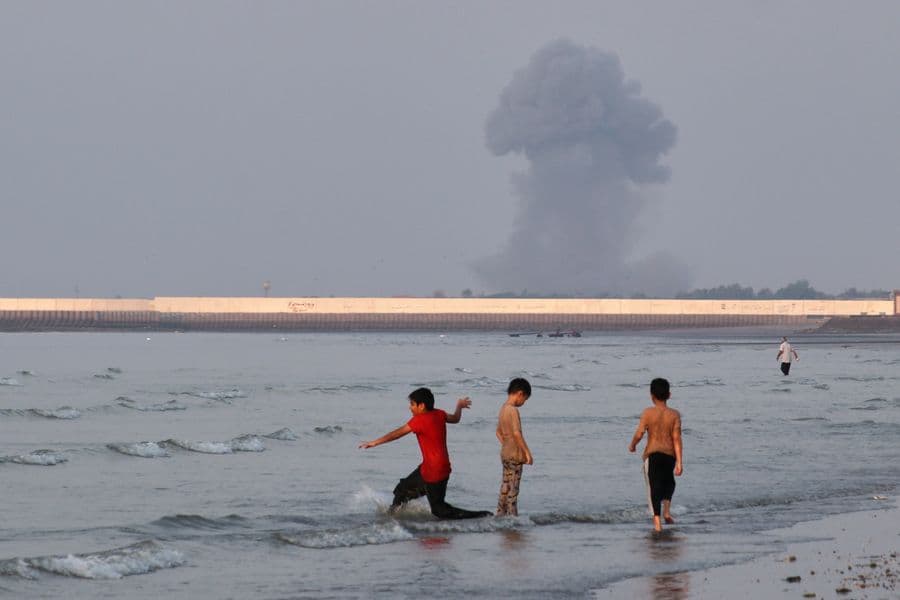
image: Three boys play in the shallow waters of the Strait of Hormuz, as a plume of smoke rises from an explosion in the background, off Bandar Abbas, Iran, Monday, July 13, 2026. (Razieh Poudat/ISNA via AP)

In Pursuit of Nuclear Abolition
By Peter Huessy • RealClearDefense
Innovation Alone Won’t Prepare the U.S. for the Future Battlefield
By Joshua Segal • RealClearDefense
The sUAS Tactical Trifecta
By Bryan T. Woody • RealClearDefense
The Revolutionary War: When Strategic Options Share the Same Weakness
By Henry Yep • RealClearDefense
The Houthis Are Testing the Limits of Collective Defense
By Saima Afzal • RealClearDefense

Who Shoots Down the Drone Over the Shipyard?
By John Ferrari & Dillon Prochnicki • RealClearDefense
Northrop Grumman Breaks Out the Big Guns at AUSA
By Daniel Terrill, Defense News
Army Pursuing Diverse Array of New Anti-Air Interceptors
By Trevithick, The WarZoneWho Shoots Down the Drone Over the Shipyard?
By John Ferrari & Dillon Prochnicki, RCD
F-35C Lands for the First Time on a Ford-Class Aircraft Carrier
By The Aviationist