
U.S. Strike Iranian-Backed Militia in Iraq After Troops Injured in Drone Attack
Last updated 06:46 AM EST • Read time: 4m
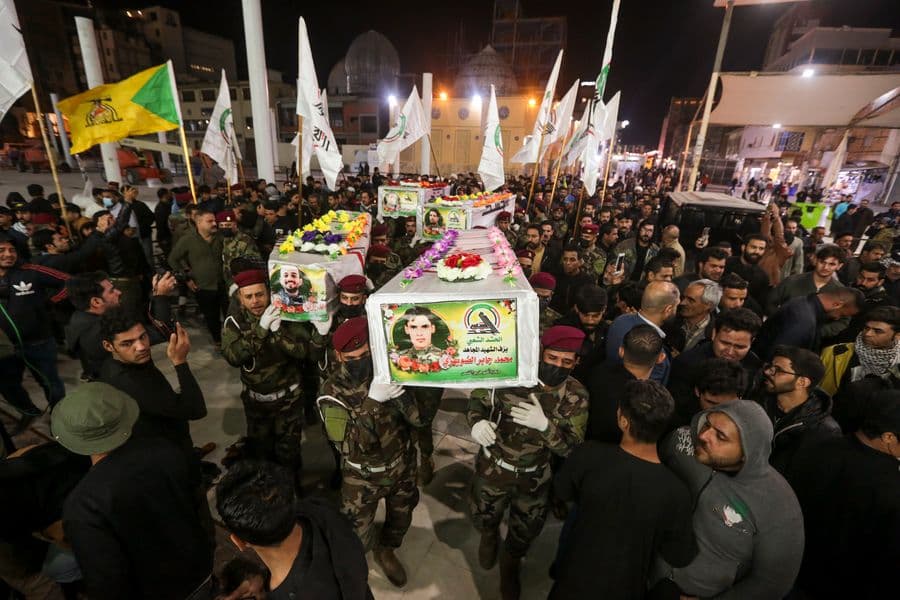
Iraqis attend the funeral of the Kataib Hezbollah members in Najaf, Iraq, Wednesday, Nov 22, 2023. Kataib Hezbollah fighters were killed in the U.S. airstrikes in response to attacks against U.S. forces at Al-Asad Air Base earlier this week. (AP Photo/Anmar Khalil)
President Joe Biden ordered the U.S. military to carry out retaliatory airstrikes against Iranian-backed militia groups after three U.S. servicemembers were injured in a drone attack in northern Iraq.
National Security Council spokeswoman Adrienne Watson said one of the U.S. troops suffered critical injuries in the attack that occurred earlier Monday. The Iranian-backed militia Kataib Hezbollah and affiliated groups, under an umbrella of Iranian-backed militants, claimed credit for the attack that utilized a one-way attack drone
Biden, who is spending Christmas at the presidential retreat at Camp David, Maryland, was alerted about the attack by White House national security adviser Jake Sullivan shortly after it occurred on Monday and ordered the Pentagon and his top national security aides to prepare response options to the attack on an air base used by American troops in Erbil.
Sullivan consulted with Defense Secretary Lloyd Austin. Biden’s deputy national security adviser, Jon Finer, was with the president at Camp David and convened top aides to review options, according to a U.S. official, who was not authorized to comment publicly and requested anonymity.
Within hours, Biden convened his national security team for a call in which Austin and Gen. CQ Brown, the chairman of the Joint Chiefs of Staff, briefed Biden on the response options. Biden opted to target three locations used by Kataib Hezbollah and affiliated groups, the official said.
The U.S. strikes were carried out at about 4:45 a.m. on Tuesday in Iraq, less than 13 hours after the U.S. personnel were attacked. According to U.S. Central Command, the retaliatory strikes on the three sites, “destroyed the targeted facilities and likely killed a number of Kataib Hezbollah militants.”
“The President places no higher priority than the protection of American personnel serving in harm’s way,” Watson said. “The United States will act at a time and in a manner of our choosing should these attacks continue.”
The latest attack on U.S. troops follows months of escalating threats and actions against American forces in the region since the Oct. 7 Hamas attack on Israel that sparked the devastating war in Gaza.
The dangerous back-and-forth strikes have escalated since Iranian-backed militant groups under the umbrella group called the Islamic Resistance in Iraq and Syria began striking U.S. facilities Oct. 17, the date that a blast at a hospital in Gaza killed hundreds. Iranian-backed militias have carried out dozens of attacks on U.S. bases in Iraq and Syria since the start of the Israel-Hamas war more than two months ago.
Last month, U.S. fighter jets struck a Kataib Hezbollah operations center and command and control node, following a short-range ballistic missile attack on U.S. forces at Al-Assad Air Base in western Iraq. Iranian-backed militias also carried out a drone attack at the same air base in October, causing minor injuries.
The U.S. has also blamed Iran, which has funded and trained Hamas, for attacks by Yemen’s Houthi militants against commercial and military vessels through a critical shipping choke point in the Red Sea.
The Biden administration has sought to prevent the Israel-Hamas war from spiraling into a wider regional conflict that either opens up new fronts of Israeli fighting or that draws the U.S. in directly. The administration’s measured response — where not every attempt on American troops has been met with a counterattack — has drawn criticism from Republicans.
The U.S. has thousands of troops in Iraq training Iraqi forces and combating remnants of the Islamic State group, and hundreds in Syria, mostly on the counter-IS mission. They have come under dozens of attacks, though as yet none fatal, since the war began on Oct. 7, with the U.S. attributing responsibility to Iran-backed groups.
“While we do not seek to escalate conflict in the region, we are committed and fully prepared to take further necessary measures to protect our people and our facilities,” Austin said in a statement.
Copyright 2023 The Associated Press. All Rights Reserved.

In Pursuit of Nuclear Abolition
By Peter Huessy • RealClearDefense
Innovation Alone Won’t Prepare the U.S. for the Future Battlefield
By Joshua Segal • RealClearDefense
The sUAS Tactical Trifecta
By Bryan T. Woody • RealClearDefense
The Revolutionary War: When Strategic Options Share the Same Weakness
By Henry Yep • RealClearDefense
The Houthis Are Testing the Limits of Collective Defense
By Saima Afzal • RealClearDefense

Who Shoots Down the Drone Over the Shipyard?
By John Ferrari & Dillon Prochnicki • RealClearDefense
Northrop Grumman Breaks Out the Big Guns at AUSA
By Daniel Terrill, Defense News
Army Pursuing Diverse Array of New Anti-Air Interceptors
By Trevithick, The WarZoneWho Shoots Down the Drone Over the Shipyard?
By John Ferrari & Dillon Prochnicki, RCD
F-35C Lands for the First Time on a Ford-Class Aircraft Carrier
By The Aviationist