
What the Iran-KSA Normalization Means for US and Middle East Security
Last updated 01:00 AM EDT • Read time: 9m
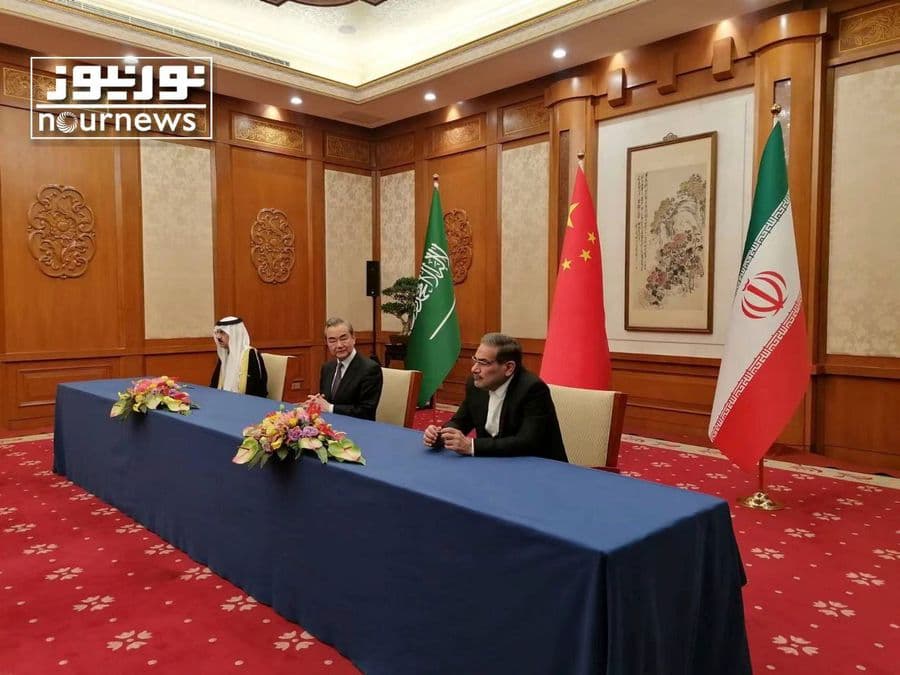
Reactions to the deal to restore diplomatic relations between Iran and Saudi Arabia have largely focused on how China, Iran’s collaborator and the broker/guarantor, is displacing the U.S. in the Middle East. Saudi Arabia is after all the U.S.’ oldest ally in the region and is now putting its trust in China to intervene if Iran breaks its non-interference commitments. This may sound appealing to some Americans, but the cost will be increasing irrelevance in any major deal, decision, or development in an area vital to America’s national security. From energy and extremism to nuclear proliferation, we cannot disengage and expect to escape consequences. The failures of successive administrations to judiciously exercise American influence and power, especially to defend our allies and other interests, undermines credibility, breeds contempt, and invites challenges.
The U.S. has been losing leverage throughout the region for a long time. The initial opening for Russia and China came about circa the war in Iraq, specifically when the George W. Bush administration pledged itself to imposing democracy. This was anathema to the Gulf monarchies. Despite Bush’s strong relations with the Saudis, Riyadh viewed the U.S. policy of interfering in internal affairs of the Middle Eastern states and pushing for “grassroots” movements as something that could only end badly, even for friends. Indeed, this policy delivered disastrous results in Iraq and Gaza, and was an early harbinger of the Arab Spring.
While 20 years ago China was more open to foreign influences and not yet as strong militarily, it already prioritized preparing cadres of Arabist diplomats and espoused the model of political non-interference. During this same time, the U.S. foreign policy establishment ignored distress signs from its most important Arab ally. President Obama’s 2009 speech in Cairo and subsequent policies were perceived as direct threats. The first unambiguous sign of wanning influence was in 2012, when King Abdullah asked the U.S. to withdraw its military base due to popular dissatisfaction with U.S. interventionism, and the U.S. relocated to the Al Udeid base in Qatar.
Obama’s policy centered on shifting the regional balance of power to Iran. He even froze weapons sales to Saudis, some of the best U.S. customers. Meanwhile, Saudi Arabia began to diversify its petroleum customer base and its economy overall. Saudi-led OPEC sought to serve the rapidly growing China and Southeast Asian markets. China became one of KSA’s top oil partners. Crown Prince Mohammed bin Salman's trip to the United States in 2018 was focused on adding strategic depth to the U.S.-Saudi relationship through cooperation on education, scientific research, defense, and in other areas. However, the U.S. handling of the Jamal Khashoggi campaign and lack of vision sabotaged such efforts.
The Trump administration is perceived to have been tougher on Iran and China than its predecessor, but the record is mixed. Jared Kushner embraced China; Donald Trump himself, in his previous life, was happy to do business with China and the Muslim Brotherhood-oriented branch of the Saudi royal family—Alwaleed bin Talal, who was a donor to the International Institute of Islamic Thought, Adnan Khashoggi, the arms dealer and uncle of Brotherhood member and friend of Osama bin Ladin, Jamal Khashoggi, and other associates in those circles.
The Trump administration, far from limiting Islamist lobbying influence, allowed Muslim Brotherhood organizations to receive unprecedented levels of funding from the U.S. government. Trump gave-in to pro-Brotherhood voices inside the State Department and intelligence community, rejecting the idea of designating the Brotherhood as a terrorist organization. He further failed to curtail the Qatar and Muslim Brotherhood media campaign against the Saudi Crown Prince, whose appointment represented KSA’s best attempt to-date to confront extremism in all its forms. No one benefited more from the simulated outrage over Khashoggi’s death than the Muslim Brotherhood and authoritarian regimes.
Russia went out its way to show its disinterest in this affair; China, too, played to the Saudi popular sentiment, which resented what it perceived as a witch hunt. While outwardly Trump appeared to be pro-Saudi, his presidency empowered the elements of the Saudi establishment that favored peace deals with the Houthis in Yemen and their backers, the Khomeinists in Iran. Moreover, when Iran attacked ARAMCO in September 2020, the U.S. signaled to the international community to keep mum on the real source of the attack and took no action. This sent a chilling message to the Saudis that the U.S. was determined to minimize its presence in the Middle East even at the cost of credibility as the regional security guarantor.
The Biden administration merely accelerated events already in motion. The Old Guard and pro-Brotherhood elements in Saudi Arabia were looking for an excuse to shift to China and have succeeded in reorienting many projects intended by the Crown Prince to advance U.S.- and EU-KSA relations. Even NEOM is increasingly “Made in China.” U.S. contractors and consultants who bailed at the peak of the Khashoggi affair may have had only themselves to blame, but President Biden’s personal attacks on the Crown Prince served as an excuse for the Old Guard to chase more openly after the China, a preferred partner given its corruption and dismissal of human rights look at China’s horrific treatment of its own people in Hong Kong or the Uyghur Muslims).
Another consideration was undermining the rapid rise of the Crown Prince and his pro-Israel policies. Under the Biden administration that dynamic shifted backwards very rapidly; a recent critique of comments by an Israeli official by the Saudi Foreign Ministry described him as an “Israeli occupation official”.
While it is easy to blame Biden for alienating the Saudis and empowering Iran with the administration’s fixation on the nuclear deal, the Saudis had their own reasons for embracing the China-brokered rapprochement. With the struggle for power between the Old Guard and the reformists, the former are seeking to settle the conflict in Yemen by handing over the country to the Houthis. However, such a deal is impossible without Iran’s blessing—and Iran has no reason to cave on its goals to weaken Saudi Arabia without a major concession. The peace deal, which opens Iran’s doors to Saudi markets and to a greater role inside OPEC+, provides such a concession.
It is no coincidence that the Saudi FM visited Moscow the day before the normalization agreement announcement. Russia and Iran are part of a tripartite gas cartel with Qatar, and share common interests in the oil market, particularly after Russia sanctions. Moscow and Tehran also have a growing defense relationship while Saudis have a fair share of American weapons. As this author has been warning for years, Russia has been exploiting every opportunity to divide KSA and the U.S.. It just so happens that Qatar and the Old Guard members of the Saudi Royal Family are significant investors in Russian energy markets. Iran and Russia are members of China’s new anti-NATO bloc, the Shanghai Cooperation Organization.
Already, in 2018, the Old Guard put an end to a successful Al Hudaydah offensive by then-Defense Minister Mohammed bin Salman. Ideologically closer to Khomeinists and their proxies than to liberals and reformists, the Houthis even have a history of Brotherhood faction support from their fight against Egyptian communists during the Cold War. The security impact of the peace deal with the Houthis would be devastating. Iran would likely agree to freeze the attacks of its proxies on Saudis, instead focusing the offensive on the Southern Yemenis and unleashing an even deadlier civil war in Yemen. The Southerners would be left without air support to face Houthi-led Northerners equipped with sophisticated Iranian weapons.
There is mounting evidence indicating that the Houthis are gearing up for an offensive. Moreover, the Houthis would likely move to attack Israeli targets independently or in concert with Iran’s “Axis of Resistance”: Hezbollah, Islamic Jihad, Hamas, IRGC, and Iraqi militias. The threat of a combined, encirclement attack on Israel may deter Jerusalem from taking any serious action against Iran going nuclear.
With one fifth of the global oil and gas trade passing through the Strait of Hormuz, Houthis would have their hands untied to disrupt the freedom of navigation, further encumbering American ships in the vicinity. These developments would provide the Saudis with only a short-lived respite.
Access to Saudi markets would strengthen Iran’s economic situation, providing more funding for terrorism, but Iran’s ultimate goal is regional dominance through religion by replacing Saudis as the Custodian of Two Holy Mosques. Normalization would pave the way for Iranian intelligence to incite violence in the Shia-dominated East and encourage jihadist groups.
Although progress with the Saudis is likely to be very slow, Tehran is by far the stronger negotiator. Moreover, China’s backing invites Beijing’s far greater investment and entrenchment in both countries, with the possibility of building naval bases and pushing its surveillance state model even farther – with more security apparatchiks around to disrupt U.S. intelligence efforts and military operations in the region. China’s rise in the region could transform UAE and even Saudi into vassal states over time; Hong Kongs with natural resources.
Economic and cultural activity in Saudi Arabia is geared towards the United States as entire generations have grown up accustomed to U.S. markets and influence. However, the Biden administration’s ideological fixation to excise the Crown Prince from public life, to appease China to support climate change cooperation, and to draw Iran back into some version of the nuclear deal is proving disastrous. Washington has empowered the anti-reformist, antisemitic, and anti-American political factions in KSA and pushed a critical ally into the embrace of U.S. adversaries. U.S. officials did not learn from a similar turn by the UAE in 2022 and have now encouraged the view that pivoting to Iran and China will be met with tacit approval, if not an invitation to the White House.
Irina Tsukerman is a national security lawyer, geopolitical analyst, and President of Scarab Rising, Inc., a media and security strategic advisory. She has written and commented extensively on defense and security issues, Russia, China, U.S. foreign policy, and information warfare.

In Pursuit of Nuclear Abolition
By Peter Huessy • RealClearDefense
Innovation Alone Won’t Prepare the U.S. for the Future Battlefield
By Joshua Segal • RealClearDefense
The sUAS Tactical Trifecta
By Bryan T. Woody • RealClearDefense
The Revolutionary War: When Strategic Options Share the Same Weakness
By Henry Yep • RealClearDefense
The Houthis Are Testing the Limits of Collective Defense
By Saima Afzal • RealClearDefense

Who Shoots Down the Drone Over the Shipyard?
By John Ferrari & Dillon Prochnicki • RealClearDefense
Northrop Grumman Breaks Out the Big Guns at AUSA
By Daniel Terrill, Defense News
Army Pursuing Diverse Array of New Anti-Air Interceptors
By Trevithick, The WarZoneWho Shoots Down the Drone Over the Shipyard?
By John Ferrari & Dillon Prochnicki, RCD
F-35C Lands for the First Time on a Ford-Class Aircraft Carrier
By The Aviationist