
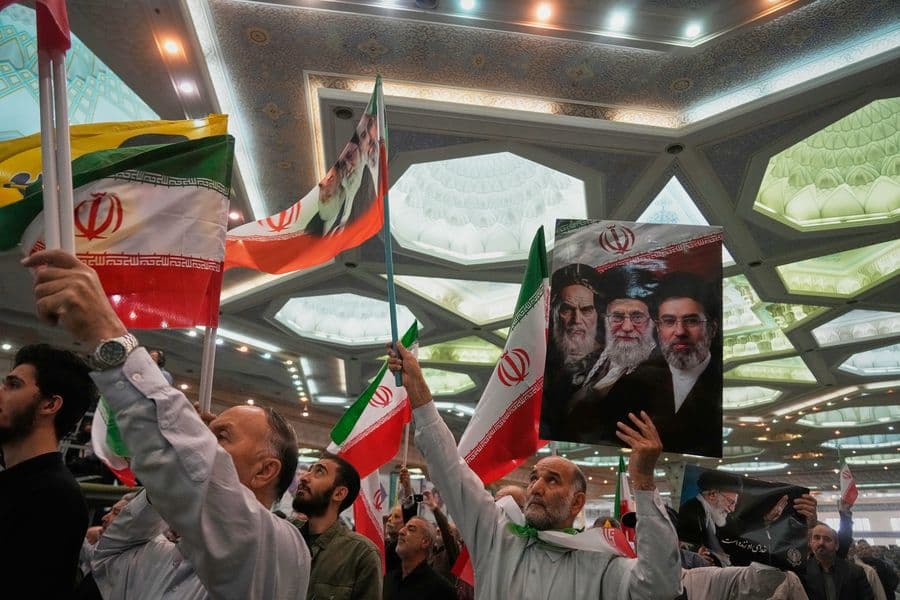
Why Liberal Democracies Should Defeat Totalitarian Iran
Last updated 06:37 AM EDT • Read time: 11m
When the Peoples Republic of China was admitted into the WTO in 2001, the world (wishfully) stopped reminding itself of a social science fact: totalitarian regimes cannot reform; they do not evolve into liberal democratic states; they spiral into greater totalitarianism until they lash out or implode. They are incompatible with modernity.
The liberal democracies of NATO, Australia, New Zealand, the Republic of Korea, and Japan share common national security viewpoints not because of realism (‘big powers inevitably clash’) but because they share the same political values of all liberal democracies, which guarantee the rights of man and recognize natural law. These principles are irreconcilable with totalitarian states.
Four states – China, Russia, Iran, and North Korea – commit figuratively 99 percent of the world’s insecurity. Totalitarian states inevitably and dialectically agitate against alleged foreign threats to justify repression at home. This is the communist (totalitarian) playbook and a social science reality that has existed for 100 years. These states will never stop threatening neighbors unless and until their leadership dies or is replaced. And such transitions are always uncertain, unstable, and messy.
We have forgotten the relevance – the primacy – of polity in international relations. We compete with these states -- not because they are large but because they are totalitarian. They struggle in a zero-sum relationship with Western democracies.
- The defense of Ukraine is the defense against the now totalitarian regime of Russia.
- The defense of Taiwan is the defense against the totalitarian regime of the Peoples Republic of China.
- The defense of Israel is the defense against the totalitarian regime of Iran.
- The defense of the Republic of Korea, Australia, New Zealand, and Japan is the defense against the totalitarian regimes of the Peoples Republic of China and North Korea.
The defense of the United States is the defense against all these totalitarian regimes, most immediately from Iran, which has killed thousands of Americans, thousands of innocents throughout the Middle East, dozens of citizens worldwide, tens of thousands internally, and attempted to build nuclear weapons and intercontinental ballistic missiles. The regime has even executed dozens and arrested thousands since the war for Iran’s liberation began over a month ago. Iran is the opposite of all that liberal democracy stands for and defends. The regime will never moderate. Totalitarian regimes never do.
The end of the Iranian regime is a message to all totalitarian states:
- President Trump has demonstrated his willingness to defend democratic goals against an implacably hostile, utterly dishonest, faux-religious, and utterly totalitarian state of Iran. That is a strong signal to all totalitarian states. President Trump's willingness to use force demonstrates that the United States is no paper tiger.
- President Trump has demonstrated the superiority of American technology, which has proved that the United States can defeat numerically superior forces. The United States military has also proven that it is (at least now) comprehending the evolution of warfare better than most states -- certainly more than Russia has, which is slowly losing its war with the smaller state of Ukraine. And China has not fought a war in decades and cannot know for certain if its planners are keeping pace with technology or not. (Add to this the fact that Chairman Xi has purged over 100 generals and lieutenant generals since 2022 – 46 in the last 12 months alone; China seems far from ready to invade Taiwan.)
- President Trump has already changed the regime in Iran and ‘negotiates’ with remnants of Iran’s totalitarian state with a US gun pressed against Teheran’s head. The only question that remains is whether the remnants will agree to step aside for a new, more-democratic state or whether they prefer to be killed by US and Israel forces over the next 12 months. Of course, once the internet is restored, it is not clear whether the Iranian people will allow any member of the former regime to survive. (If they were smart, the former regime members would flee to Oman or Qatar in exchange for some US and Israeli pledge to allow them to live.)
- Many Americans are simply unfamiliar with President Trump’s strategy of regime change in slow motion – criticizing him for either not attempting to occupy Iran or for starting conflict without, they say, finishing the job. Trump seems uninterested in regime change via occupation, yet his critics attempt to claim he is repeating the Iraq and Afghanistan War or complain that gas prices have risen pointlessly. Critics ought to look at Venezuela and Cuba for similar examples of what historian Victor Davis Hanson calls Trump’s ‘vise’-strategy: holding a state firmly in place until change is hammered out of the old regime over time.
- Totalitarians historically never moderate; there is no case where a totalitarian regime peacefully agreed to moderate into a liberal democratic state. Trump’s approach may be the first of its kind if it works, but we should expect the leadership of the Islamic Revolutionary Guard Corps to resist moderation to its bitter end.
- The regime change mission in Iran demonstrates that the concept of ‘imminence’ in the age of nuclear weapons, cyber space, and ballistic missiles must be moved much further to the ‘left.’ Claims that Iran posed no ‘imminent threat’ is like saying the United States posed no existential threat to Japan until the atomic bomb was flown to Tinian Island. This is an untenable argument. States that pledge the destruction of another state and pursue weapons of mass destruction are immediate and imminent threats.
- The cost of liberation may indeed be high. Thirty thousand French were killed by Allied forces in and during the invasion of France to push the Nazis out of France -- about the total number of Americans who died in the Korean War. One to three million German civilians were killed in World War II -- 500,000 from Allied bombing alone. The cost of liberation from totalitarianism is high. Iranians are likely willing to pay this price.
It is disturbing to a percentage of Americans that US allies and friends are not contributing to the defeat of the dictatorship of Iran. Allied passivity suggests that these states do not share the relevance of governance and the defense of liberal democracy. (How do Germany and Japan today not understand this?) It suggests that such allies and friends have narrow concepts of self-defense or assume little physical or political risk in the defense of their state. This is national security parochialism that is unseemly and difficult for many Americans to understand.
Worse, by not participating in the war against the totalitarian regime of Iran, US allies provided the remnant Iranian regime an information operation to play against the United States: ‘your own allies consider the US intervention wrong, foolish, and costly.’ Iran now amplifies allied and US audiences that criticize the Trump Administration for its intervention, which might not have emerged had US allies acted in support of the intervention.
To suggest that Iran is not NATO’s or Japan’s fight is to suggest that the defeat of totalitarianism is not recognized as a self-defense value to these states. It suggests that these states view American servicemen as mere mercenaries for their specific state only and not equals in their mutual defense. That would be an unsettling message to Americans who perceive totalitarian regimes as a common enemy to liberal democracy.
Further still, the liberation of 92 million Iranians is hardly a small matter. If successful, it will be the greatest geo-strategic improvement in the world since the collapse of the Soviet Union.
Specific complaints about the Iran war sound shallow, insincere, and indifferent to the suffering of the Iranian people:
“The US is using up many weapons!” Yes, US stockpiles have been depleted, and these weapons will be replaced with next generation weapons.
“The Iran conflict distracts the United States from other world threats; PRC Chairman Xi may think this is the time to move on Taiwan.” Not really, since the war sends the most powerful deterrent imaginable: President Trump will act if provoked and US technology is superior.
“The United States is fighting Iran because Israel asked it to.” States have interests, not friends. The defeat of the totalitarian regime of Iran deters all totalitarian adventurism and advances the national security of all liberal democracies. Secondarily, the defeat of Iran should permit a reconciliation with Israel, leading to the end of decades of Middle East conflict, terrorism, instability, and economic backwardness – all in the interests and self-defense of the United States and its liberal democratic allies. Israel and Iran had a strategic alliance from 1941-1979 and cooperated on security and intelligence; Iran used to export oil to Israel. (Did anyone claim President Obama acted against Muammar Gaddafi because the Europeans asked him to?)
“Oil prices are up and this will help Russia.” First, it is morally grotesque to suggest that paying more for gas for a year is not worth the liberation of 92 million Iranians or for peace in the Middle East. And Ukrainian forces are making sure Russia will not be able to benefit from the temporary rise of gas prices as they attack Russian refineries and harass shipping. Simply because gas prices are rising, the democrats who oppose everything President Trump does and isolationists in Trump’s party work to keep the Iranian regime alive and disparage a Jacksonian move by the President to improve US and global security immeasurably.
“A year ago, Trump said he is not interested in upsetting the international order.” Totalitarian regimes upset the international order; liberal democracies are the status quo powers. Iran upset the international order by enriching uranium to 60 percent this year, fielding thousands of ballistic missiles, and preparing to build nuclear weapons. Once fascist states, German, and Japan are firmly part of the rules-based international order. Iran violates Western principles at will. Trump is protecting and restoring the international order by eliminating the greatest threat to that order. President Franklin D. Roosevelt publicly pledged to keep the United States out of the European conflict as late as October 1940, months after France fell to the Nazis, when he assured Americans that our ‘boys are not going to be sent to any foreign wars.’ He aligned with strong, isolationist sentiment and signed several neutrality acts. Should he be condemned for entering the war in Europe against the Nazi regime in 1941, just one year later?
“Japan cannot act because of Article Nine of its Constitution.” Japan is not a pacificist state; pacifists take no action in their defense. No government that defends its people can be pacifist. No state can renounce the right to self-defense. Japan has recognized such a right since 1955 – a year after adopting its postwar constitution. Shooting down a drone attacking a Japanese warship or an oil tanker is not an act of war; it is an unambiguous act of self-defense. Successive postwar Japanese governments have been reluctant to act in Japan’s self-defense but have consistently renounced pacifism and acknowledged Japan’s right to self-defense. And if Japan feels more vulnerable in Asia now because it believes the United States is distracted in Iran, then such a sense of insecurity only reveals how interconnected the world is, how important it is for Japan to act in its own self-defense, and how the defeat of one totalitarian regime is a strong deterrent to others. The United States stations more US troops in Japan – 50,000 – than in any other state in the world, stations thousands more in the region, visits Japanese ports with its warships, provides a nuclear umbrella, and maintains a joint defense agreement with Japan. The US commitment to the defense of Japan is self-evident and strong.
We have lost our understanding of the preeminence of polity. The type of state rule is supremely important; theocracies are incompatible with modernity. Totalitarian states exist in a zero-sum competition with all liberal democracies.
James Van de Velde, Ph.D., is a Professor at the US National Defense University. The views expressed in this article are those of the author and do not reflect the official policy or position of the US National Defense University, the US Department of War, or the U. S. Government.

Iranian Cyber Operations
By Michael Groen • RealClearDefense
Reflecting on an Epic Horse Campaign in the Mountains of Afghanistan
By Brian Glyn Williams • RealClearDefense
The Godfather of American Foreign Policy Realism Speaks to Today’s World
By Francis P. Sempa • RealClearDefense
In Pursuit of Nuclear Abolition
By Peter Huessy • RealClearDefense
Innovation Alone Won’t Prepare the U.S. for the Future Battlefield
By Joshua Segal • RealClearDefense

Navy Civilianizes Six Former Flag Billets, Reduces Six to Captains
By Mongilio, USNI N.
Raytheon's $8B Contract for Strategic Comms Terminal Modernization
By M+A El
America’s Maritime Moment Will Not Wait
By CDR Salamander
Armor Up?
By Marine Corps Compass Points
Who Shoots Down the Drone Over the Shipyard?
By John Ferrari & Dillon Prochnicki • RealClearDefense