
Let's Stop Using the Term 'Non-Traditional' About Security Threats
Last updated 04:48 PM EDT • Read time: 4m
As a former naval officer and current student of maritime affairs, I have long been infuriated by the blanket use of the term ‘non-traditional’ to describe security threats external to those directly generated by the conflicting interests of nation-states.
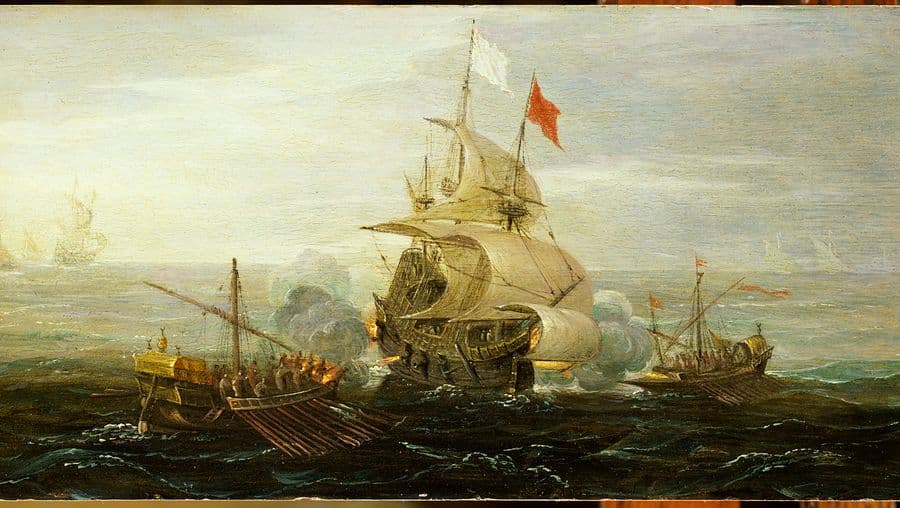
In the maritime domain, piracy, smuggling, slave trading and illegal fishing are just a few of the threats to which the ‘non-traditional’ label has been attached. The pundits would know better if they gave the slightest thought to history.
In humanity’s use of the sea, it’s difficult to decide which activity should be counted as seafarers’ ‘second oldest profession’, but piracy and smuggling probably vie for the prize. Illegal fishing follows not far behind. It’s no coincidence that the Fishery Protection Squadron is the oldest formed squadron of Britain’s Royal Navy. Or that the international pennant to distinguish vessels on fishery protection duties dates back nearly 140 years.
Natural disasters and the mechanisms to respond to them are another example. Those interested in understanding how humanitarian assistance can be coordinated by rival great powers and their navies would do well to study the interventions that followed the Messina earthquake in Sicily. It occurred 112 years ago.
The latest misapplication of the term—to pandemics—is perhaps the most egregious example. Pandemics are indeed occasional, even rare, but the idea that they are ‘non-traditional’ is ludicrous. Such disasters for civilisations can be traced back to the beginning of recorded history. Even in the early Christian era, the Antonine Plague of the second century, the Plague of Justinian in the sixth century and that of Emmaeus in the seventh all had profound social, economic and political and thus strategic effects. The Black Death of the 14th century and the Great Plague of London in the 17th are just two more examples.
There are good reasons why this unthinking application of jargon must stop. First, ‘non-traditional’ implies something new. Adopting the label too often means that the historical record is not consulted, the voice of experience is ignored, and the mistakes of the past are all too often repeated.
As in the case of pandemics, it also contributes to our neglecting threats that are recurrent but rare. We discount the need to prepare for them because we pay too little attention to their catastrophic effects, which we have never studied. The belated rush to examine the experience of the Spanish influenza pandemic of 1918–19 is a case in point.
Next, it implicitly minimises the importance of such threats for countries and communities—particularly the smallest nation-states, which have always had them at the forefront of their security concerns. This dynamic is particularly apparent amongst the Pacific island countries. They have reason to be impatient with those preoccupied with nation-state rivalries at the expense of what the islands perceive to be existential threats.
The label also makes it more difficult to identify what really is new in the forms of emerging threats—and new in the shape of the customary ones. Transnational crime is hardly an innovation; it is criminal methods that are evolving. To give another example, the effect of climate change on natural disasters is a major cause for concern. Just what will more severe and frequent weather events mean for us? What needs to change in our preparations as well as in the mechanics of any humanitarian response? These are difficult questions but treating such subjects as something wholly new will lead at best to the reinvention of many wheels—and, most likely, to a failure to achieve the most effective change and adaptation.
I have suggested elsewhere that what most military services need is less tradition and more history. In this matter, what many analysts of contemporary affairs need is less ‘non-tradition’ and more history. It might help them see through the glass, less darkly.
James Goldrick served as a rear admiral in the Royal Australian Navy, has published widely on naval issues and now has appointments at UNSW Canberra, the ANU Strategic and Defence Studies Centre and ANCORS (Australian National Centre for Ocean Resources and Security).
This article appeared originally at The Strategist (ASPI).

The First Test of Peace Lies in Ukraine's Borderlands
By Dennis T. Cosgrove • RealClearDefense
The VFW’s Gambling Addiction Victimizes Veterans
By Jack Yoest • RealClearDefense
Superintelligence Exposes a Gap in the Law of Delegated Authority
By Sue Ghosh Stricklett • RealClearDefense
When the Network Goes Dark, Who Controls the Battlefield?
By Jonathan K. Corrado • RealClearDefense
We Cannot Build Tomorrow's Weapons With Yesterday's Alloys
By Joseph F. Krause • RealClearDefense
When the Network Goes Dark, Who Controls the Battlefield?
By Jonathan K. Corrado • RealClearDefense
Air Force Should Buy 250 Blended-Wing Tankers, as 2027 Demo Looms
By A&SF Mag.
Long Deployments to Be Navy Standard For Next Couple Years
By Mongilio, USNI NewsWhen the Network Goes Dark, Who Controls the Battlefield?
By Jonathan Corrado, RCD
Marines Deploy Neros Archer Drone in Live Fire Exercise for First Time
By USNI News