
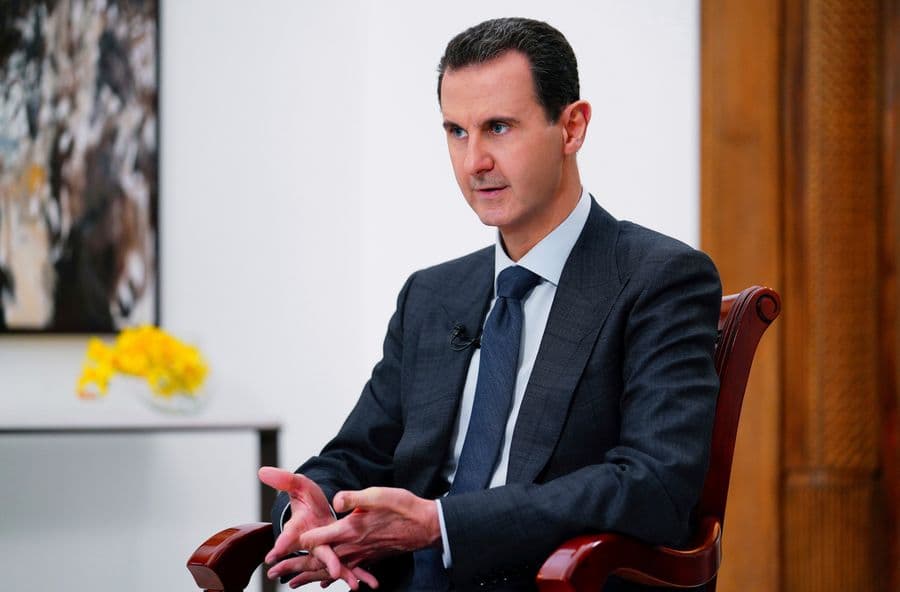
Syria Placement on WHO Executive Board an Embarrassment for All
Last updated 02:54 AM EDT • Read time: 6m
On Saturday, Hend Zaza, the youngest Olympian at the Tokyo Games, lost her first-round match in women’s singles table tennis. Besides the incredible distinction at age 12 of being the fifth youngest ever to compete in the Olympic Games, there is a more unenviable reality about this capable and talented young lady. She was born, reared, and trained to become an Olympian in Syria, a country in the midst of civil war made longer every day by a ruthless dictator, Bashar al-Assad. Since the brutal civil war began in 2011, public estimates total the number of Syrian deaths resulting from regime attacks at over 600,000.
The reality is that countless young boys and girls in Syria never had the chance to try and realize their dreams like Hend Zaza because of the Assad regime and its Russian and Iranian benefactors the possibility that other young talented Syrian girls and boys can realize their dreams like Hend Zaza is demonstrably diminished. Hundreds of young boys and girls have had their lasts breaths taken from them, some burned or asphyxiated to death by exploding chemical filled barrel bombs, others by missile and artillery strikes, and still others through utter starvation as Assad has prevented the flow of even basic food items.
While the world community, except Putin and a few others, oppose the Assad regime’s actions, there has been an utter failure to bring total and collective international pressure to bear. In fact, there is essentially tacit approval in the halls of our international organizations, even those whose stated purpose is maintaining international peace and security. And there has been little leadership from the United States under three Presidents.
Case in point, on May 28th Syria was elected to the World Health Organization’s Executive Board, the governing organization responsible for the implementation of decisions and policies of the WHO’s Health Assembly. Syria’s representative on the board will be Dr. Hassan Muhammed al-Ghabbash, an individual under sanction by the European Union. Perhaps the Assad regime could not find a less controversial doctor to serve as a representative because they are torturing and killing them.
According to the World Health Organization's homepage, the nation state run international organization is “dedicated to the well-being of all people and guided by science, the World Health Organization leads and champions global efforts to give everyone, everywhere, an equal chance to live a healthy life. WHO is the United Nations agency that connects nations, partners, and people to promote health, keep the world safe and serve the vulnerable…” Let us revisit these commendable and necessary pursuits in a bit.
Unfortunately, for peace loving people around the world, President Bashar al-Assad was sworn in earlier this month for his fourth term, seven more years of untold abuse and disregard for international norms and law. With the luxury of diplomatic, economic, and military support from a couple of the world’s most destabilizing forces, Russia and Iran, it appears unlikely that Assad’s conduct will change. The international community remains stuck on what to do to change Assad’s current behavior. This decision, or lack of action, at the WHO perfectly, pitifully captures this dilemma.
We all know that the Assad regime has used chemical weapons to commit many atrocities against innocent Syrians—most of them well documented. These attacks have been thoroughly examined by United Nations investigators such as the UN Organization for the Prohibition of Chemical Weapons (OPCW) Joint Investigative Mechanism, which attributed responsibility for a 2017 sarin gas attack in Khan Shaykhun, killing over 100 individuals, children and infants included. Then, in April 2020, the OPCW Investigation and Identification team, another UN mechanism set up in 2018, issued its first report determining that the Syrian Air Force used banned chemical weapons when they attacked the town of Al-Lataminah.
There are three immediately troubling issues relative to this decision to admit Syria to the WHO Executive Board. First, the fact that the Eastern Mediterranean Region would nominate such a destructive force to the WHO’s leadership board raises questions about how serious they view Assad’s atrocities and violations of international law and order.
The second concern is that the United Nations exercised zero oversight by allowing its traditional procedural process to continue, thereby allowing a country like Syria to attain a seat on the board. Obviously, the Eastern Mediterranean Region could have nominated another country. Similarly, the World Health Assembly’s General Committee could have challenged the appointment of Syria and held a formal vote. They did not, which allowed election of Syria by consensus of the committee. Equally troubling is the fact that the United States was a member of the WHA’s General Committee and remained silent during the process, only expressing “grave concerns” after the result was made public.
The third troubling issue is the continued regression of the WHO. Specifically, the perception that the organization prefers the influence of destabilizing forces like Russia, China, and now Syria to dictate decisions, public statements, and actions. Lack of action by the WHO early in the COVID-19 pandemic resulted in the flow of misleading information about the likelihood of human-to-human transmission. Accepting the lack of forthrightness from the People’s Republic of China and then refusing to push for more transparency over the last 20 months demonstrates poor judgment, rudderless leadership, and endangered the well-being of world citizens they seek to protect.
Broadly speaking, the world must focus on reforming our international organizations. Allowing deceitful, murderous regimes a seat in decision-making bodies of our influential international organizations only diminishes an organization's credibility while simultaneously condoning bad or illegal behavior. Specifically, regarding Syria, they should be immediately removed from the WHO Executive Board, replaced by a country that values human life and subscribes to WHO’s mission of working to give “everyone, everywhere a chance to live a healthy life.” Rewarding countries who flagrantly disregard international norms will only perpetuate the behavior in the offending country and conceivably others. End the embarrassment and act now to remove them.
David F. Lasseter is the former Deputy Assistant Secretary of Defense for Countering Weapons of Mass Destruction. He is the Founding Partner at Horizons Global Solutions as well as a Visiting Fellow at the National Security Institute.

Putin, Plague, and America’s Biodefense Gap
By Ryan Kane • RealClearDefense
From Hormuz to the South China Sea: Defending Freedom of Navigation in Contested Waters
By David F. Lasseter • RealClearDefense
Checklist for Modern Conflict Readiness
By Sergey E. Ivashchenko • RealClearDefense
AUTOWARCOM Is Heading for a Command-and-Control Collision
By Michael Carvelli • RealClearDefense
The Unfinished Reform
By Mark W. Castillon • RealClearDefense
From Hormuz to the South China Sea: Defending Freedom of Navigation in Contested Waters
By David F. Lasseter • RealClearDefense
National Guard Soldier Shot While Breaking Up Fight in Washington D.C.
By Military.com
‘No Marine Fights Alone’
By Gidget Fuentes, USNI News
Sea Services Weigh How to Embrace Autonomous, Attritable Tech
By Reeves, NatDef
Lockheed Delivers C-130J to Become Navy’s TACAMO Plane
By Stephen Losey, A&SF