
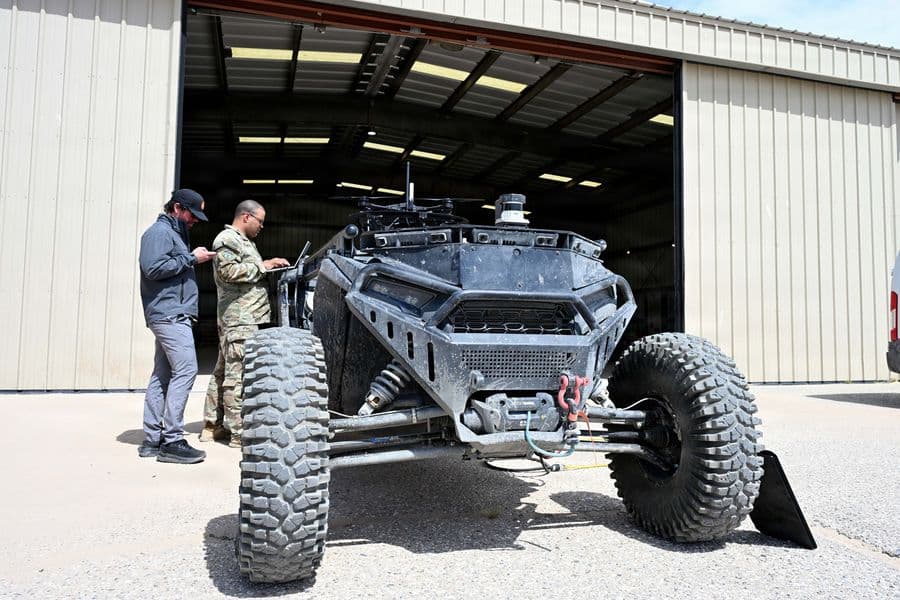
Chief Warrant Officer 2 Zackary Cowher, Cyber Capabilities Developer Technician for Multi-Domain Command - Europe, uploads configuration files to an autonomous land-based vehicle equipped with a tethered UAS quadcopter during Arcane Thunder 26 at Fort Irwin, California, April 18, 2026. Arcane Thunder 26 is a U.S. Army Europe and Africa-directed, Multi-Domain Command – Europe led exercise conducted with NATO Allies and partners across the United States and Europe. The exercise trains multi-domain capabilities by integrating cyber, space, electronic warfare, and conventional forces to strengthen interoperability and enhance NATO’s ability to deter aggression and defend the Euro-Atlantic region. (U.S. Army)
AUTOWARCOM Is Heading for a Command-and-Control Collision
Last updated 05:16 AM EDT • Read time: 5m
On September 30, Secretary Hegseth announced the formation of the Autonomous Warfare Command (AUTOWARCOM), with October 1, 2027, as the target date for establishing the new four-star functional combatant command. The Project Agincourt memo gives the effort its purpose: define the joint force’s needs, integrate forces provided by the services, and test materiel. Key design choices, including authorities, funding, personnel, and headquarters structure, require further decisions.
Future choices will shape whether AUTOWARCOM speeds the adoption of autonomous systems or if it will add another layer between service members and the capabilities they need. Recent conflicts show why faster adaptation is critical to maintaining a relative advantage. The histories of other defense organizations show why a new command needs clear responsibilities from the start.
Wars Reveal the Pressure
Russia’s war against Ukraine displays how quickly low-cost drones and countermeasures can change battlefield tactics. Ukraine has expanded drone production at a rapid pace. Russia has increased its use of jet-powered drones, which can challenge existing detection and interception systems. Both sides keep adapting their equipment and methods to gain an advantage.
The 2020 Armenia-Azerbaijan conflict offers an earlier lesson. Azerbaijan used armed drones to exploit Armenia’s limited air defenses and strike ground forces and equipment. The conflict showed how an opponent can use drones to expose weaknesses in air defense and force protection. It also showed the limits of drawing broad conclusions from one war: outcomes depend on the full mix of forces, tactics, and defenses.
The United States faces drone threats in the Middle East, the homeland, and other theaters. U.S. forces in the Middle East face Iranian drones and missiles during Operation Epic Fury. The campaign also puts pressure on air-defense inventories and tests how quickly the United States can adapt. These threats create an operational case for joint priorities in autonomy, counter-drone systems, testing, and force integration.
Taken together, these conflicts show that battlefield innovation moves quickly. Acquisition, training, and force-generation systems must keep pace. AUTOWARCOM may help close that gap, but the command’s design will determine whether it can.
Precedents Teach Hard Lessons
The Department of Defense has faced similar organizational challenges before. U.S. Special Operations Command (SOCOM) offers a useful precedent. Congress established SOCOM in 1987 after operational failures, including the failed Operation Eagle Claw. Congress gave SOCOM dedicated authorities and funding to support special operations forces.
SOCOM’s model also required a defined relationship with the services. Under Title 10, U.S.-based active and reserve special operations forces are assigned to SOCOM unless the Secretary of Defense directs otherwise. SOCOM has authority to train assigned forces, while the services retain responsibilities for personnel and other service functions. Congress and the Department refined SOCOM’s funding authorities over time. AUTOWARCOM should learn from this division of duties: its authority should match the forces and missions assigned to it.
U.S. Cyber Command (CYBERCOM) provides another comparison. The command grew from the Department’s effort to address challenges in network operations. Its history and later analysis of its funding describe how its budget and authorities developed over time. Critics have also questioned the command’s effectiveness. These sources point to another significant lesson: Congress and the Department should explain how funding, authority, and measurable outcomes will support AUTOWARCOM’s mission.
Army Futures Command (AFC) offers a service-level example. The Army created AFC to shape future force requirements and modernization. Its experience exposed tensions between new command structures and established acquisition processes. In 2025, the Army merged AFC with Training and Doctrine Command to form the Transformation and Training Command. Reorganization alone does not prove that AFC failed, but its history shows that leaders may reshape a command when its role overlaps with existing institutions.
AUTOWARCOM needs the authority that matches its mission, funding that supports its responsibilities, and clear boundaries with the services. The Department of Defense and AUTOWARCOM’s planners should resolve those choices before the command begins operating. Congress can press for answers now, while the Department shapes the command’s charter and resources.
Congress and DOD Must Act
Congress should ask which authorities the Department plans to give AUTOWARCOM, and which will remain with the services. Lawmakers should also ask which budget lines will fund the command, who will prepare its program objective memorandum, and which civilian official will oversee its work. These choices will show whether AUTOWARCOM can direct joint priorities while preserving service responsibility for building and sustaining forces.
The Army has recently announced the Futures and Autonomous Systems Command (FASCOM). Its creation makes coordination with AUTOWARCOM an immediate design issue. The two commands need distinct responsibilities for requirements, acquisition, testing, and fielding. Without clear boundaries, the Army and AUTOWARCOM may compete for authority or direct investment toward different priorities. This will surely extend to the other services as they react to the creation of AUTOWARCOM.
The Department should define AUTOWARCOM’s mission, decision rights, funding, and relationship with the services before building its headquarters. It should assign named officials to each major responsibility, limit the initial portfolio, and set measures for fielding speed, interoperability, operational testing, and adoption by the services. Providing AUTOWARCOM with a clear mission and defined authority will help the joint force adapt. Without those, the command risks reproducing the gaps that it was created to close.
Michael Carvelli is the co-founder and managing partner of Attain Leadership Solutions, a consulting firm that helps organizations turn strategy into execution, strengthen teams, and improve organizational performance. His work draws on experience leading complex organizations and planning operations in demanding environments. He is completing his Army career as an engineer officer and organizational leader.
The views expressed are his and do not represent those of the U.S. Army, the Department of Defense, or any part of the U.S. government.

Putin, Plague, and America’s Biodefense Gap
By Ryan Kane • RealClearDefense
From Hormuz to the South China Sea: Defending Freedom of Navigation in Contested Waters
By David F. Lasseter • RealClearDefense
Checklist for Modern Conflict Readiness
By Sergey E. Ivashchenko • RealClearDefense
AUTOWARCOM Is Heading for a Command-and-Control Collision
By Michael Carvelli • RealClearDefense
The Unfinished Reform
By Mark W. Castillon • RealClearDefense
From Hormuz to the South China Sea: Defending Freedom of Navigation in Contested Waters
By David F. Lasseter • RealClearDefense
National Guard Soldier Shot While Breaking Up Fight in Washington D.C.
By Military.com
‘No Marine Fights Alone’
By Gidget Fuentes, USNI News
Sea Services Weigh How to Embrace Autonomous, Attritable Tech
By Reeves, NatDef
Lockheed Delivers C-130J to Become Navy’s TACAMO Plane
By Stephen Losey, A&SF