
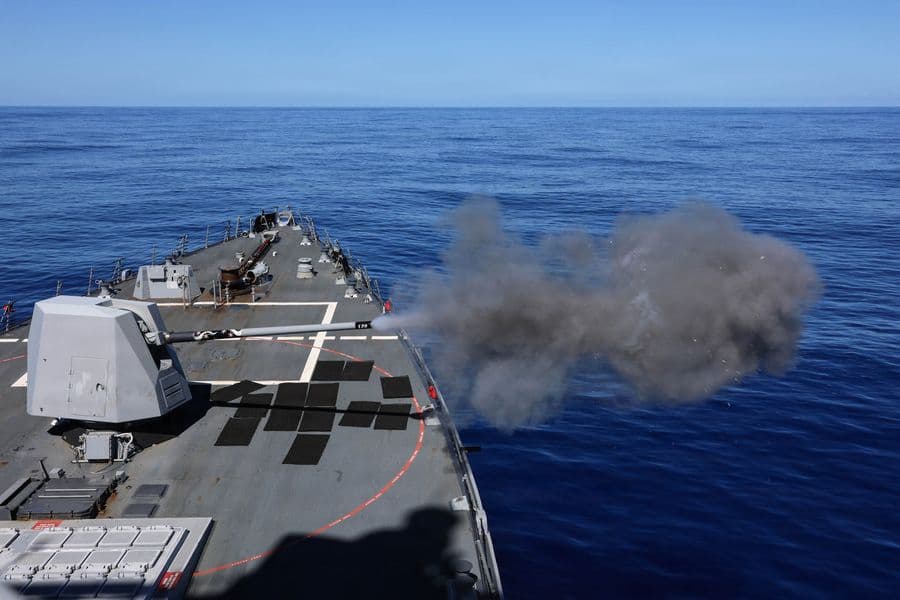
PACIFIC OCEAN (Sept. 11, 2026) Arleigh Burke-class guided-missile destroyer USS Carl M. Levin (DDG 120), fires the Mark 45 5-inch gun during a live fire training exercise in the Pacific Ocean, Sept. 11, 2026. An integral part of U.S. Pacific Fleet, U.S. 3rd Fleet operates naval forces in the Indo-Pacific and provides the realistic, relevant training necessary to execute the U.S. Navy’s role across the full spectrum of military operations. U.S. 3rd Fleet works together with our allies and partners to advance freedom of navigation, the rule of law, and other principals that underpin security for the Indo-Pacific region. (U.S. Navy photo by Mass Communication Specialist 2nd Class Isabelle Dial)
From Hormuz to the South China Sea: Defending Freedom of Navigation in Contested Waters
Last updated 05:44 AM EDT • Read time: 5m
For centuries, the freedom of the seas principle has sustained the world economy and nations. It has served as an indispensable pillar of international stability, maritime security, and global commerce. The ability of commercial shipping vessels, naval fleets, and fishing boats to navigate international waters unhindered is not a diplomatic luxury—it is the bedrock of international order. Yet today, these foundational rights face unprecedented threats across critical maritime chokepoints, from the Middle East to the Indo-Pacific.
Nowhere is the threat more acute than the months-long conflict in the Strait of Hormuz. Over the course of the last seven months Iran has conducted systematic harassment, unlawful boarding, and illegal seizures of commercial tankers—alongside drone strikes and coercive threats against merchant shipping. All are flagrant violations of international law.
In response to these aggressive actions, the U.S. has itself implemented what some critics might call a limit on navigation through its naval blockade. A distinction is that the U.S. Navy has been continuously escorting commercial vessels through the Strait for many weeks which directly enables freedom of navigation.
Under the United Nations Convention on the Law of the Sea (UNCLOS) and customary international law, the Strait of Hormuz is an international strait wherein all ships, including commercial vessels, enjoy the continuous and expeditious right of unimpeded transit. Tehran’s aggressions breach the law of the sea, destabilize global energy markets, and are a direct threat to civilian mariners. Unlawful interference with transit passage in vital chokepoints cannot be tolerated as a normalized strategic lever.
Simultaneously, in the Indo-Pacific, Beijing continues its systematic assault on maritime freedoms. China’s sweeping, illegal maritime claims in the South China Sea—invalidated by the 2016 Permanent Court of Arbitration ruling—have meant unsafe intercepts of aircraft, dangerous water-cannon attacks on supply vessels, and the militarization of artificial features.
These unlawful actions curb freedom of navigation and overflight while disrupting the legitimate rights of regional nations—such as the Philippines, Vietnam, and Malaysia—to access their own Exclusive Economic Zones. Chinese maritime militia and fishing fleets that are illegal, unreported, and unregulated relentlessly bully regional nations out of their traditional fishing grounds. In the East China Sea, Beijing’s persistent incursions around the Japanese-administered Senkaku Islands further demonstrate a calculated effort to undermine established norms and coerce neighboring sovereign states.
Defending the high seas requires more than rhetorical condemnation; it demands visible, coordinated, and persistent sea power. The U.S. Department of State, using diplomatic communications, and the Department of War through U.S. Navy Freedom of Navigation Operations (FONOPs) can lead a renewed diplomatic and military effort to uphold global freedom of movement via a three-pronged approach.
First, enforce the universally accepted tenets of the UNCLOS and international customs. Second, hold rogue state actors accountable through both diplomatic and more coercive actions. Third, operationalize robust, multilateral freedom of navigation coalitions led by the United States.
The legal architecture governing global waters is clear. UNCLOS codifies the navigational rights, maritime boundaries, and sovereign obligations of nation states. Crucially, international law dictates that treaty signatories are obligated to refrain from acts that would defeat the treaty’s object and purpose. This binds them to its legal requirements even prior to or in the absence of full ratification.
Although the United States has not formally ratified UNCLOS, America adheres to the treaty and vigorously upholds its tenets through its actions, diplomacy, and maritime operations. To enhance its support for UNCLOS, Washington can deepen operational coordination with key allies and partners—specifically the United Kingdom, Australia, Japan, and, possibly, India. Building upon existing frameworks like the Quad and AUKUS, these nations should execute regular, multilateral FONOPs and joint maritime patrols in contested and high-risk waters. By conducting its global operations strictly within the bounds of UNCLOS rules, Washington demonstrates that navigational rights are universal, non-negotiable standards rather than opportunistic privileges.
The first iteration of this should be a standing multinational escort mission for Hormuz. President Trump is correct to prod NATO and international allies to assist with or even lead these efforts.
Combined FONOPs send an unmistakable signal of unified resolve in three ways. First, they demonstrate to aggressive actors like Iran and China that unlawful maritime restrictions will be actively challenged by a coalition of capable maritime powers. Second, they safeguard vital commercial shipping lanes and protect regional fishing rights essential to global supply chains and local livelihoods. Third, they operationally reject illegal maritime claims, preventing them from solidifying into accepted customary practice through acquiescence.
Freedom of navigation is not self-sustaining; it requires constant attention. If maritime nations allow aggressive states to rewrite the rules of the ocean through coercion and illegal claims, global commerce, food security, and international peace will suffer immeasurably. By holding signatories accountable to UNCLOS, upholding customary law, and spearheading combined freedom of navigation operations alongside our vital allies, the United States can ensure that the world's oceans remain free, open, and secure for generations to come.
David F. Lasseter is the former Deputy Assistant Secretary for Policy and the Founder of Horizons Global Solutions.

Putin, Plague, and America’s Biodefense Gap
By Ryan Kane • RealClearDefense
From Hormuz to the South China Sea: Defending Freedom of Navigation in Contested Waters
By David F. Lasseter • RealClearDefense
Checklist for Modern Conflict Readiness
By Sergey E. Ivashchenko • RealClearDefense
AUTOWARCOM Is Heading for a Command-and-Control Collision
By Michael Carvelli • RealClearDefense
The Unfinished Reform
By Mark W. Castillon • RealClearDefense
From Hormuz to the South China Sea: Defending Freedom of Navigation in Contested Waters
By David F. Lasseter • RealClearDefense
National Guard Soldier Shot While Breaking Up Fight in Washington D.C.
By Military.com
‘No Marine Fights Alone’
By Gidget Fuentes, USNI News
Sea Services Weigh How to Embrace Autonomous, Attritable Tech
By Reeves, NatDef
Lockheed Delivers C-130J to Become Navy’s TACAMO Plane
By Stephen Losey, A&SF