
Water and the Syrian Civil War
Last updated 06:17 AM EST • Read time: 9m
Control of water, especially in an era of increasing water insecurity, is becoming an ever more significant force in global geopolitics. This is particularly true in the Levant, where the World Resources Institute (WRI) has identified Syria, Israel, Jordan, Lebanon, and the Palestinian territories as among the twenty-five regions in the world most threatened by water insecurity.
Syria provides a stark example. Between 2006 and 2010, the country experienced one of its worst droughts in history. This drought caused widespread crop failures (50%) and livestock losses (60%), leading to the near collapse of the agricultural economy. The crisis forced millions of the 7.2 million internally displaced people to abandon rural areas in search of better conditions. This mass rural-to-urban migration overwhelmed city infrastructure, resulting in food and water shortages. Combined with an inadequate response to the crisis and a violent crackdown by the Assad regime, these conditions led to widespread social unrest. This unrest was further fueled by the example of the "Arab Spring," eventually igniting a full-scale civil war.
In 2011, the Syrian uprising began with peaceful protests against President Bashar al-Assad's regime. These protests, initially confined to the southern city of Daraa, quickly escalated into an armed insurrection as the government responded with violent repression. As violence spread, the Assad regime resorted to brutal tactics in an effort to defeat the opposition, one of the earliest being the targeting of water infrastructure. While initially localized to Daraa, this tactic presaged the later use of water as a strategic weapon in the conflict.
As the war progressed, opposition forces adopted similar tactics, targeting vital infrastructure to weaken the Syrian government's control over key areas. Rebel groups sought to disrupt the regime’s hold on Damascus by attacking critical infrastructure, including water supply systems. In 2012, rebels targeted water pipelines, pumping stations, and treatment facilities around the capital. Their goal was to hinder the government’s ability to govern and exert pressure on the civilian population by depriving them of basic services and access to necessities like water. These attacks marked a shift in the conflict, with both sides increasingly viewing water as an instrument of war.
The government's strategy of targeting opposition-held areas continued into 2013, exemplified by the siege of Eastern Ghouta, a suburb of Damascus and a stronghold for rebel forces. The government employed siege tactics aimed at starving both the opposition and the civilian population. One notable action was the cutting off of the Barada River, a primary water source for the region. By depriving civilians of access to water, the Syrian government sought to destroy the population's morale and force the rebels to surrender.
Aleppo, Syria’s largest city, endured some of the most intense weaponization of water during the conflict. In 2014, Syrian government forces deliberately targeted the Al-Khafseh water treatment plant, which served over two million people. In 2016, the government escalated its attacks by targeting Aleppo’s remaining functional water plants, including the Suleiman al-Halabi water treatment facility, worsening the already dire humanitarian crisis. In 2019, Syrian rebels, backed by Türkiye, also attacked the Al-Mansoura water station.
Homs, Syria’s third-largest city and an industrial hub, also faced water supply disruptions early in the war as it became an epicenter of anti-government protests. In 2013, the city’s water supply was intentionally polluted, with both the government and rebel factions potentially responsible for the contamination. As is common in civil wars, civilians were tragically caught in the middle of these offensive actions.
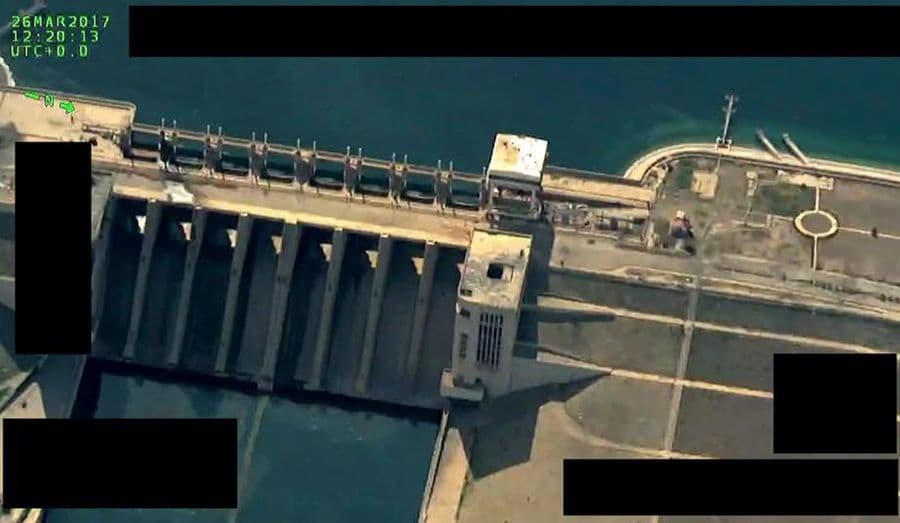
By 2014, ISIS (the Islamic State) had emerged as a dominant force in Syria, seizing large portions of territory. The group’s control over the Euphrates River and its dams, such as the Tabqa Dam (Syria’s largest) and Tishrin Dam, made water a crucial element in the conflict. These dams were vital not only for water supply but also for power generation, making them strategic assets. ISIS used its control over these resources to manipulate water flow, threatening to release contaminated water or flood surrounding areas.
Idlib, located in the northwest of Syria, played a significant role in the later stages of the Syrian Civil War. After years of conflict, it became the last major stronghold of rebel and Islamist groups, including factions like Hay’at Tahrir al-Sham (HTS), the group that played the key role in toppling the Assad regime, and which currently controls the capital, Damascus. Following multiple ceasefires and failed peace efforts, Idlib’s strategic position made it a flashpoint for clashes between Syrian government forces, backed by Russia, and rebel factions. In 2017, the Syrian regime, with Russian air support, launched a series of offensives aimed at reclaiming the province. The United States also employed air power during the war, but generally to degrade ISIS in the north.
The Euphrates River, by far the largest in Syria, and its associated infrastructure continued to play a central role in the war. The battle for control of Raqqa, ISIS’s central base of operations, centered around the Euphrates Dam, which became a key strategic point in 2017. Syrian Democratic Forces (SDF), a Kurdish group backed by the U.S.-led coalition, advanced to liberate the city. The SDF played a major role in the defeat of ISIS and its ongoing containment of the group’s remnants.
As the war progressed, Türkiye became a major player in the conflict, particularly in the northeastern regions controlled by Kurdish forces, notably the Syrian Democratic Forces (SDF). Türkiye views the SDF as an extension of the YPG (People's Defense Units) and the PKK (Kurdistan Workers' Party), the latter of which Türkiye has designated as a terrorist organization with which it has been in conflict for decades. As part of its military operations, Türkiye targeted strategic points such as the Alouk Water Station, a critical water source for northeastern Syria. Turkish-backed forces seized control of the station, depriving large numbers of civilians in Kurdish areas of water and fueling tensions with the Kurdish forces.
As a result of the Syrian Civil War, 50% of Syria’s water infrastructure—water treatment plants, pumping stations, reservoirs, and pipelines—has been damaged or destroyed. This has led to a dramatic reduction in potable water, with availability dropping by up to 40% since the conflict began in 2011. Millions of Syrians are now without reliable access to clean water, contributing to outbreaks of cholera. Additionally, an estimated 50% of Syria’s agricultural irrigation infrastructure has been destroyed or rendered inoperable. Seventy percent of freshwater demand is used in agricultural production. Prior to the Civil War, Syria was a net exporter of agricultural products, but this is no longer the case. As a result, the population faces not only water insecurity but also food insecurity.
Syria is also affected by competing claims on shared waterways. Syria shares a border with Türkiye, Iraq, Jordan, Israel, and Lebanon. Of these, competing claims with Türkiye and Israel are most salient. Syria frequently claims that it receives inadequate downstream water from the Euphrates due to Türkiye’s systems of dams, most notably the Atatürk Dam. Ironically, Türkiye points to Syria’s claim to 90% of the water from the Orontes River to the east, which flows in the opposite direction, into Türkiye. Water also flows on the Tigris, which skirts the border of Syria between Türkiye and Iraq.
Most significant are the competing claims over the Golan Heights, which Israel captured from Syria in the Six-Day War in 1967. The Golan Heights had constituted a significant portion of Syria's water resources. The Golan Heights are valuable militarily for their high elevation on Israel's northern border and for controlling the headwaters of the Jordan River Basin and Lake Tiberias. The Banias, Hasbani, and Yarmouk rivers, all part of the Jordan River watershed, flow through Syria, its border, or the disputed Golan Heights. The Jordan River Basin is critical as a water source for Israel and Jordan. While the Jordan River flows along the border between the West Bank and Jordan, Israel controls the western bank of the West Bank, curtailing access to the river for Palestinians living there.
In December 2024, the Assad regime finally collapsed. The question now is whether the Civil War is indeed over or whether it is entering a new phase. HTS (Hay'at Tahrir al-Sham), the successor to the Al-Nusra Front, an Islamist group formerly associated with al-Qaeda, is positioning itself to fill the vacuum created by the fall of Bashar al-Assad, though the power dynamics in the country are anything but settled. Multiple competing actors control different parts of the country and, by extension, the water resources in those areas. One such group is the Kurdish-led Syrian Democratic Forces (SDF), which controls parts of northeastern Syria, including vital infrastructure like the Tabqa Dam on the Euphrates. One of the primary objectives of neighboring Türkiye is to prevent the formation of a strong Kurdish-led region along its border. Türkiye is unlikely to hesitate in using its system of dams, such as the Atatürk Dam, to restrict the flow of Euphrates waters downstream into Syria as leverage.
Syria serves as a case study for the future. The MIT Global Change Outlook forecasts that the number of people living in water-stressed environments will increase from 4.5 billion to 5.8 billion by 2050. The causes of water scarcity are manifold: aquifer mismanagement, poor infrastructure, deforestation, urbanization, pollution, increased agricultural production, industrialization, war, and population growth. Despite stabilization or declines forecast for much of the world, global population growth is not projected to peak until 2080, driven primarily by a doubling in Africa and increases in South Asia—regions experiencing water stress. Sixty percent of global freshwater is shared across transborder water sources: 286 river basins and 592 aquifers. This situation requires high levels of cooperation but also creates conditions for dispute and armed conflict.
David W. Wise is a retired businessman who writes frequently about public policy. He is a graduate of The Fletcher School of Law and Diplomacy, Tufts University.
Trump's Disrupt First, Negotiate Second: Greenland in Focus
By Meda Parameswara Reddy • RealClearDefense
In Seeking Peace With Beijing, Taipei Is an Asset, Not a Burden
By Alexandru Filip • RealClearDefense
Strike First: Israel's Inevitable Doctrine for the Iranian Axis
By Lance Gordon • RealClearDefense
It’s Not President Trump but Thomas Friedman Who Should Be Ashamed
By Francis P. Sempa • RealClearDefense
Putin, Plague, and America’s Biodefense Gap
By Ryan Kane • RealClearDefense
U.S. and Japan Begin Naval Exercises Near Taiwan
By Mari Yamaguchi • Associated PressU.S. and Japan Begin Naval Exercises Near Taiwan
By Mari Yamaguchi, AP
U.S. Navy, Gecko Robotics Surge AI Maintenance Contract
By Ceder, Simkins, Navy T.
Ghost Shark XL-AUV Payload Bay Seen For First Time
By Thomas Newdick, The WarZone
Dakota Meyer Tapped As Barracks Task Force Senior Advisor
By C. Stassis, MC Times