
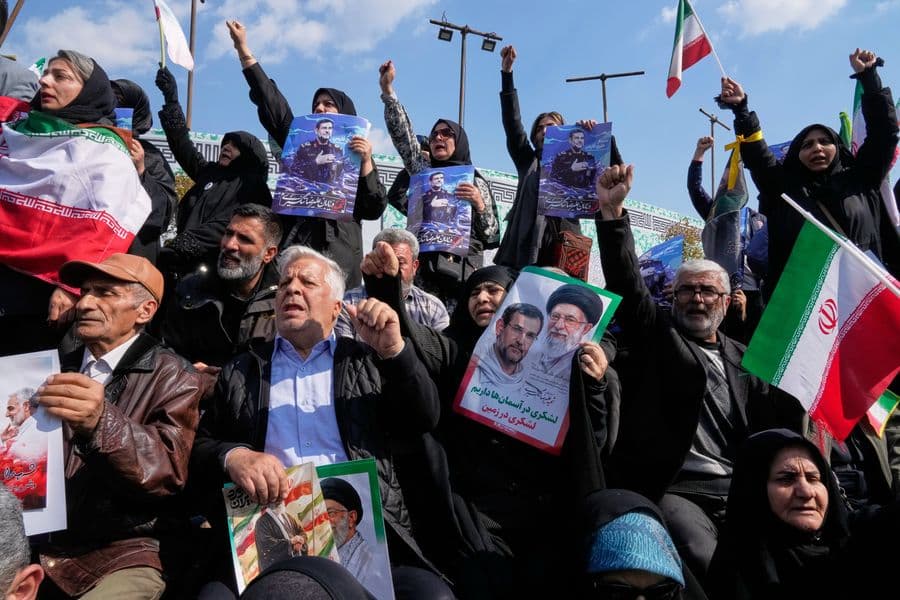
Mourners gather during a funeral procession for Alireza Tangsiri, head of Iran's Islamic Revolutionary Guard Corps Navy, and others killed in Israeli strikes in late March, in Tehran, Iran, Wednesday, April 1, 2026. (AP Photo/Vahid Salemi)
Strike First: Israel's Inevitable Doctrine for the Iranian Axis
Last updated 06:28 AM EDT • Read time: 10m
Introduction
On October 7, 2023, Hamas carried out the deadliest day for Jews since the Holocaust, with some 1,200 people killed, most of them civilians brutally murdered, and 251 taken hostage. Israel held the attack plan more than a year in advance, and three months before the attack a veteran signals-intelligence analyst warned that Hamas was rehearsing it. Both were dismissed under the conception that Hamas was deterred, a failure the Israel Defense Forces' own investigations later confirmed. The response came in fragments, and it was heroic in them, from an all-female tank crew to reservists who drove south. Three years later, no state commission has been convened.
Israel has no strategic depth and cannot trade space for time. Captured documents show Sinwar sought Iran's and Hezbollah's participation in a broader fight. Neither committed to the full-scale offensive he sought. The margin was the adversary's hesitation, not Israeli warning.
October 7 was a failure of execution, as critics argue, but also a failure of doctrine. Israel's intelligence architecture was built to detect a change in intent, against an adversary whose intent never changed. Events have since forced Israel into a doctrine of prevention and preemption triggered by capability rather than intent. Dan Schueftan of the University of Haifa has named the shift preventive violence. Brig. Gen. (res.) Itai Shapira, writing in RealClearDefense, calls it ultra-prevention and concludes that Israel needs a new security doctrine. This article proposes the rule to bound it, which it calls capability-triggered preemption, a strike-first rule covering prevention and preemption. Against the Iranian axis, Israel should treat the enemy's goal of destroying it as fixed, watch capability instead of guessing intent, and strike when that capability nears the point at which an attack could no longer be stopped, while testing regularly whether that goal has changed.
Why the Axis Will Not Make Peace
The doctrine applies only to the Iranian axis, the Islamic Republic organized around the Islamic Revolutionary Guard Corps (IRGC), together with Hamas, Hezbollah, the Iraqi Shia militias and the Houthis. Israel's confrontation states abandoned the goal of destroying it only after recognizing that it could not be achieved. Egypt made peace after 1973 and recovered the Sinai, once Sadat concluded that war could not destroy Israel. Jordan followed in 1994. Syria opened a security dialogue only after a change of leadership, and Lebanon moved only after Hezbollah was badly degraded. Neither has made peace. Two conditions explain these cases. The belief that Israel can be destroyed must break, and a leadership must exist that can turn that recognition into settlement. The Iranian axis meets neither.
Gaza shows why. Israel largely dismantled Hamas as an organized army, and President Trump's intervention brought the hostages home. Yet Hamas remains armed and still holds sway where Israeli forces are absent. Capability was denied. Intent did not change.
Iran's regime is as resilient. It absorbed the killing of its Supreme Leader and its IRGC commander and named successors to both within nine days. Neither the 38-day joint campaign of 2026 nor the Islamabad memorandum changed its aims. Absent an internal transformation of the Islamic Republic, containment is the only presently plausible strategy, and Israel's doctrine must work indefinitely.
The Intelligence Inversion
The inversion changes the decision rule. Intent becomes a tested planning assumption, and capability becomes the gate for action. U.S. joint doctrine requires intelligence to predict adversary intentions. The 2013 edition of Joint Publication 2-0 tells analysts to accept the risk of doing so. For a force with strategic depth, that risk may be recoverable. For Israel, it may not be. Israel paid heavily for that error in 1973 and catastrophically in 2023.
Intent is also the most deceivable variable. Sinwar spent years persuading Israel that Hamas wanted quiet while the evidence of capability sat in plain view. In the terms of Richards Heuer, the CIA's leading teacher of analysis, the conception weighed evidence by how well it confirmed deterrence, not by its power to disconfirm it.
The commander instead assumes that the axis's goal of destroying Israel will not change and plans on that basis. U.S. joint planning doctrine calls this a planning assumption, a condition accepted as true in the absence of proof. Intelligence then tracks capability on two clocks. The long clock measures production and reconstitution, from missile plants to enrichment, and triggers prevention, which strikes a capability before any attack is imminent. The short clock measures readiness to attack, from dispersing launchers to fueled missiles, and triggers preemption, which strikes an attack about to happen.
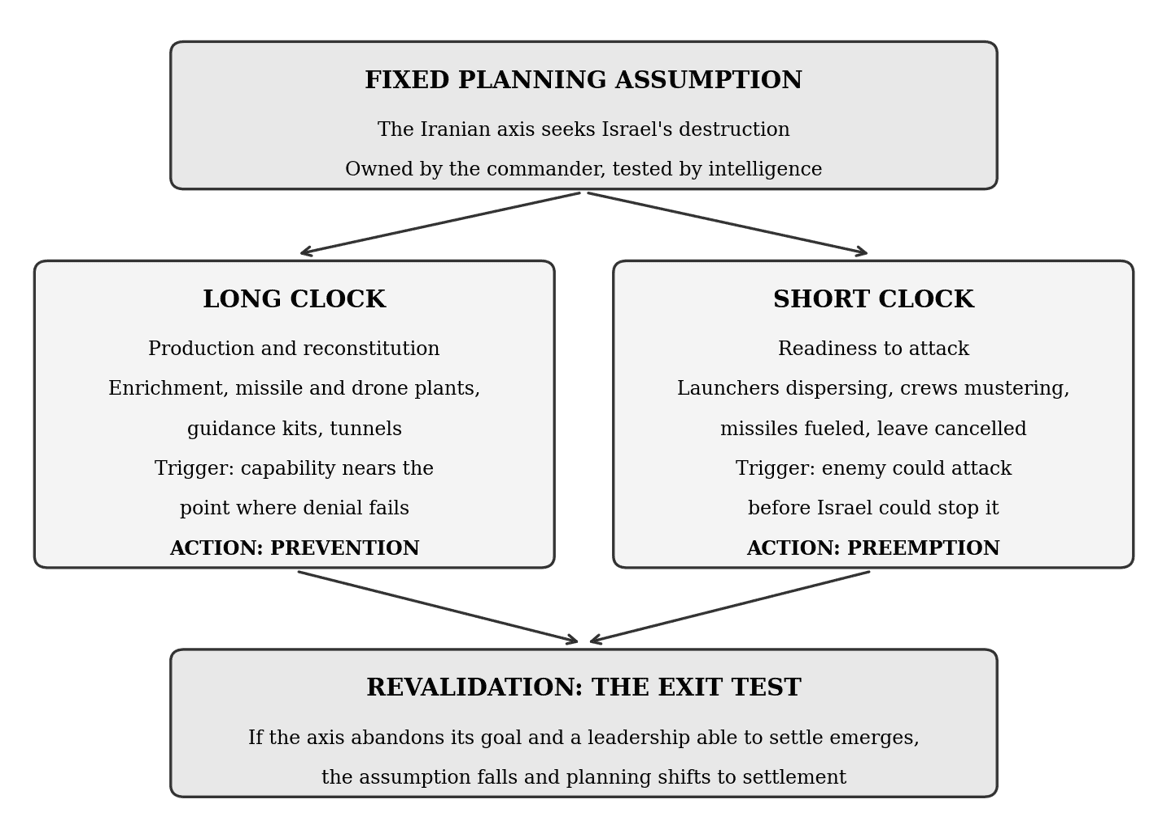
Capability-triggered preemption: one fixed assumption, two clocks, one exit test.
Lance Gordon
The same doctrine's model requirement asks, "Will the enemy attack within the next 72 hours?" It answers with readiness indicators. The indicators measure capability. The question asks about intent. This doctrine keeps the indicators and changes the question. It asks whether the enemy could attack before Israel could deny the attack. Traditional warning assesses readiness and prospective hostile action. This doctrine makes the time remaining to deny an attack the controlling decision variable.
The rule is this. Against an enemy whose goal of destroying Israel is treated as fixed, Israel may strike when that enemy's capability, on assessed evidence, crosses the point at which it could attack before Israel could stop it, without first proving that it has decided to attack. Capability alone is not the trigger, and the rule authorizes rather than requires action. A fixed goal is not a decision to attack.
Consider how the rule would work against Hezbollah's precision missiles. On the long clock, analysts track guidance kits reaching Lebanon and rockets converted each month. The threshold might be the inventory that could saturate Israel's defenses in one salvo. When analysts project that Hezbollah will cross it sooner than Israel could destroy the conversion sites, the commander may strike the sites, not the launchers, after notifying U.S. Central Command (CENTCOM) within the notice window. On the short clock, they watch for dispersing launchers and mustering crews. If those appear and Israel could not intercept what follows, the commander may preempt.
An assumption never re-examined becomes a blind spot, as the Agranat Commission found after 1973. The two conditions for peace (recognition that Israel cannot be destroyed and a leadership able to turn that recognition into settlement) become standing intelligence requirements, reported on a fixed schedule, challenged by red teams and assigned to analysts kept apart from daily targeting. If both turn, the assumption falls and planning shifts to settlement. The purpose is not to replace an optimistic conception with a pessimistic one, but to keep either from becoming immune to contrary evidence.
What the Doctrine Requires
In U.S. Joint Publication 5-0 terms, the center of gravity of Iran's regional network is the IRGC. Its nuclear program, missiles, proxies and ability to close the straits share a common critical requirement, oil and petrochemical revenue. The doctrine therefore targets the export chain and the production base alongside the fielded force, applying an economic compellence model, and measures success by how fast the enemy reconstitutes.
The rule scales effort to the threat. Iran's nuclear program sits on the long clock, where breakout time measures its approach to the threshold, so enrichment and weaponization sites warrant the earliest and most intensive effort. Rockets and drones, which defenses can absorb and the enemy can replace, warrant strikes on design and manufacturing rather than an endless hunt for launchers.
Israel will act alone only when a threshold has been crossed, the denial window will close before coordination can, and the action lies within its own means. Prevention, unlike preemption, rests on contested legal ground, and each strike remains governed by the law of armed conflict. Meeting the threshold is a strategic test, not legal authority. Strikes can also rally a population behind its rulers, drive rebuilding deeper underground and draw in outside patrons. If operations build the enemy's capability, cohesion or outside support faster than they destroy its weapons, prevention has become counterproductive and the effort must change.
Ofer Shelah of Israel's Institute for National Security Studies warns that preventing every capability becomes perpetual war that Israel's economy and reserves cannot sustain. Dmitry Adamsky of Reichman University identifies a "culminating point of deterrence," beyond which more coercion provokes escalation and stimulates the adversary's dangerous innovation. The answer to both critics is the discipline of the rule itself. Strike only at an assessed denial threshold, measure the strategic effects, and change course when prevention becomes counterproductive.
What It Means for Washington
For Washington, the doctrine poses a decision, not a compliment. An ally striking often, from Lebanon to Yemen, will keep Washington managing crises unless the thresholds are understood in advance. Shaping the threshold is a staff product. Israeli capability indicators would be incorporated into priority intelligence requirements shared with CENTCOM, each tied to a decision point and a window measured in hours. When a threshold is crossed, Washington can back the strike, attach conditions to the American weapons Israel would use, or hold Israel back and accept that the enemy rebuilds. The 2026 campaign left strategic inventory shortfalls, so each choice has a cost. Energy is the sharpest seam, since strikes on Iran's export chain raise the prices Vice President Vance has called "goal number one."
The doctrine is already being tested. On October 18, Prime Minister Netanyahu published a security doctrine prioritizing preemptive strikes and declared Israel prepared to act against Iran without American support. The announcement specifies neither a capability threshold nor an exit test. Netanyahu has also called a strike before Israel's October 27 election "not convenient," and President Trump has ruled out strikes before the November 3 midterms. Neither deferral stops the clocks. If Iran or its proxies move to strike Israel or American forces, the short clock, not the electoral calendar, will set the timing.
Washington has its own stake. To Iran, as Ambassador Mike Huckabee put it, Israel is "maybe the appetizer, but we're the entree." Washington should help shape the doctrine. CENTCOM and Israel should make the threshold framework a standing arrangement. The Joint Staff should review the prediction principle for adversaries whose intent is declared and fixed. The next security assistance agreement should fund co-production of interceptors and munitions.
Conclusion
Four Israeli strategists frame this problem. Schueftan explained why Israel must strike first. Shapira showed that Israel already strikes first, and Netanyahu has now formally embraced the principle, but neither supplies a governing rule. Shelah and Adamsky warned that unbounded applications of force risk exhausting Israel and strengthening its enemies. Capability-triggered preemption answers all four. It sets a threshold for action, scales the effort to the threat, and names the evidence that would end it. Strike first, for as long as the enemy seeks to kill you. The doctrine's task is to know, continuously, whether it still does, and when it will be able to.
CAPT Lance B. Gordon (U.S. Navy, ret.) is a retired Navy intelligence officer, graduate of the Army War College and NYU School of Law, and former Partner/Principal at Ernst & Young LLP. He has written on the 2026 Iran campaign at RealClearDefense and Small Wars Journal.

Trump's Disrupt First, Negotiate Second: Greenland in Focus
By Meda Parameswara Reddy • RealClearDefense
In Seeking Peace With Beijing, Taipei Is an Asset, Not a Burden
By Alexandru Filip • RealClearDefense
Strike First: Israel's Inevitable Doctrine for the Iranian Axis
By Lance Gordon • RealClearDefense
It’s Not President Trump but Thomas Friedman Who Should Be Ashamed
By Francis P. Sempa • RealClearDefense
Putin, Plague, and America’s Biodefense Gap
By Ryan Kane • RealClearDefense
U.S. and Japan Begin Naval Exercises Near Taiwan
By Mari Yamaguchi • Associated PressU.S. and Japan Begin Naval Exercises Near Taiwan
By Mari Yamaguchi, AP
U.S. Navy, Gecko Robotics Surge AI Maintenance Contract
By Ceder, Simkins, Navy T.
Ghost Shark XL-AUV Payload Bay Seen For First Time
By Thomas Newdick, The WarZone
Dakota Meyer Tapped As Barracks Task Force Senior Advisor
By C. Stassis, MC Times