
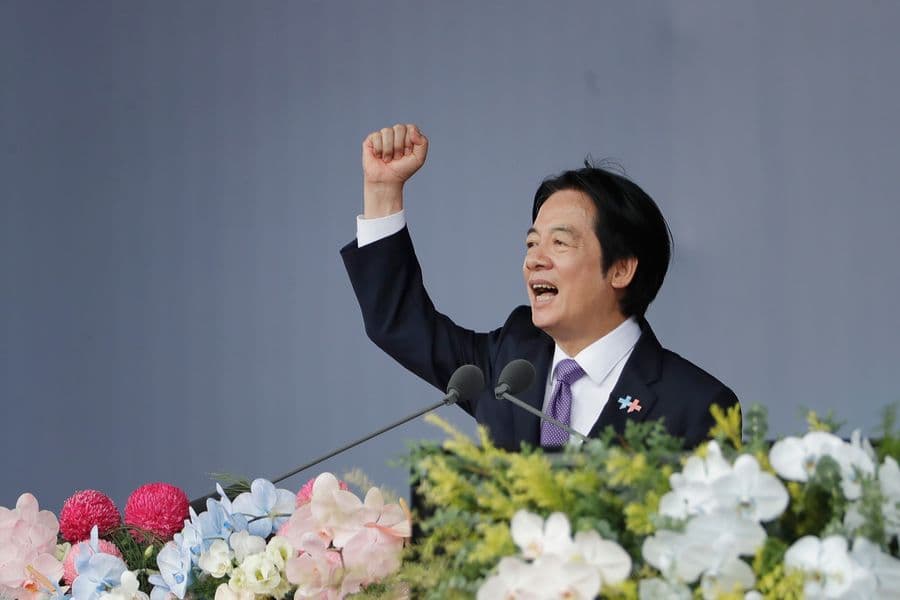
Taiwanese President Lai Ching-te cheers during National Day celebrations in front of the Presidential Building in Taipei, Taiwan, Saturday, Oct. 10, 2026. (AP Photo/Chiang Ying-ying)
In Seeking Peace With Beijing, Taipei Is an Asset, Not a Burden
Last updated 06:29 AM EDT • Read time: 5m
On October 10, in his Republic of China National Day address, Taiwanese President Lai Ching-te made his country’s position clear: “Taiwan cherishes peace, but we will not give up our freedom. We are open to exchanges but will not accept subordination.” As evidenced by Taiwan’s recent arms build-up, in direct response to Beijing’s aggression, the conventional wisdom which has come to regard Taiwan’s security situation as being partially bound by the resolve of Western states is flawed. A better explanation is rooted in understanding the managerial role Taipei plays against the internal dynamics of the Chinese Communist Party (CCP), which incentivize external aggression. Despite not being formally recognized as a sovereign state, the Republic of China is a full member of 45 intergovernmental organizations and holds a further 30 positions which range from observer roles to non-member participant status. Taipei’s consistent assertion of its national interests, of its right to self-determination, and its participation within international frameworks make it a source of moral legitimacy for its democratic allies, in stark contrast to Beijing's revisionism.
In the context of cross-Strait security, declarations made in Washington or Brussels, while reassuring, are not the most effective tool of support for Taiwan, as the People's Republic of China (PRC) either ignores the messaging or responds by reasserting the “One-China Principle”. While democracies almost uniformly perceive the PRC's view of Taiwan as an affront to the values of self-determination, Beijing does not. This is because it sincerely believes in the strength of its “reunification” narrative, due to its domestic legitimation. To counter this, Western support should not solely seek to confront Beijing; it should also seek to validate and moralize Taiwan's position as a self-governing democracy which seeks to safeguard its own national interest.
Domestically, the central party has become increasingly repressive of personal rights and freedoms and has sought to exert greater social control. Most importantly, China has continued to make bellicose claims on the “reunification” of Taiwan and continues to threaten regional allies. Beijing's cross-Strait pressure campaign does not appear to be the result of extreme confidence, rooted in China's unprecedented military growth, or due to international legitimation of the CCP's goals. It is the result of an authoritarian regime looking to shift domestic attention towards foreign policy objectives, as a result of its slowing economy.
For Taipei, its historical willingness to seek agreement or even détente with Beijing signaled its good faith to an international audience. The internal discourse within democratic societies forces them to constantly reassess their own position and values, making them prone to agreements. By contrast, authoritarians who stake their legitimacy on a set of key issues face a profound reputational risk in abandoning these objectives. That is where the difference is most stark; if Beijing renounced its goal of “unification”, Taipei, while understandably skeptical, would likely respond in kind to any overtures aimed at repairing the deteriorating security condition and reestablishing cordial relations. Domestically, however, such a statement would destroy the Chinese Communist Party's legitimacy. Taipei's skillful management of cross-Strait issues through an internal discourse on deterring Beijing, and its consistent signaling of good faith to the global community, demonstrates a level of diplomatic statecraft that its Western allies could learn from.
Western states and their Pacific allies must continue to maintain deterrence in the Indo-Pacific, primarily by seeking to deny China the ability to establish a foothold within the island chains and threatening to impose a high cost on aggression. However, the risks of a security dilemma are acute, specifically because the CCP continues to advertise that “outside forces” pose a credible risk to its objectives. This is evidenced by Xi Jinping's 2023 comments to the president of the European Commission, Ursula von der Leyen, where he indicated a belief that Washington was “goading” him into invading Taiwan.
Staunchly supporting democratic allies is important. But the most effective support for Taiwan is in allowing its democratic process to define its national policy. This reduces the risk of reinforcing internal CCP narratives rooted in Beijing's self-fulfilling security assumptions, which portray the West as imposing upon Taipei. Thus, democracies must maintain their composure, continue to trust that Taipei's internal discourse will yield positive security developments, and recognize that China's rhetoric aims to address primarily domestic audiences. To that extent, not all threats from Beijing should elicit reactions, especially when they are either credibly below or outrageously over the deterrence threshold.
As democracies look for different paths towards engagement with China, they should recognize the outsized role that Taipei can play in legitimizing their own positions. Today, the Chinese Communist Party is constrained by the tension between greater economic liberalization and its societal effects. On its end, the West can never afford to yield on Taiwan's right to self-determination. It is because of Taiwan’s defiant stance that Western states are able to approach Beijing from a position of strength and confidence, as the value of this association provides a measure of moralizing legitimation to commonly held democratic values. To that point, any change to the ambiguous nature of the “One China Policy” should be made with the consent of Taiwan, as it alone can have the internal debate on what this means and whether it is ready to accept the risks tied to Beijing's reaction. This means trusting that the democracy of an ally makes it stronger, not weaker. Regardless of what Taiwan decides, the West must continue to deter aggression and support Taipei's legitimacy on the world stage.
Alexandru Filip is a Research Fellow with the Dupuy Institute, based out of Tysons Corner, Virginia. His research focus is strategic and security studies, with a current emphasis on China's military development. He has published pieces on capability analysis and policy recommendations in venues such as RealClearDefense, The Diplomat, The Center for International Maritime Security, The Center for Maritime Strategy, The National Interest, and Merion West.
The views expressed in this piece are the sole opinions of the author and do not necessarily reflect those of The Dupuy Institute.

Trump's Disrupt First, Negotiate Second: Greenland in Focus
By Meda Parameswara Reddy • RealClearDefense
In Seeking Peace With Beijing, Taipei Is an Asset, Not a Burden
By Alexandru Filip • RealClearDefense
Strike First: Israel's Inevitable Doctrine for the Iranian Axis
By Lance Gordon • RealClearDefense
It’s Not President Trump but Thomas Friedman Who Should Be Ashamed
By Francis P. Sempa • RealClearDefense
Putin, Plague, and America’s Biodefense Gap
By Ryan Kane • RealClearDefense
U.S. and Japan Begin Naval Exercises Near Taiwan
By Mari Yamaguchi • Associated PressU.S. and Japan Begin Naval Exercises Near Taiwan
By Mari Yamaguchi, AP
U.S. Navy, Gecko Robotics Surge AI Maintenance Contract
By Ceder, Simkins, Navy T.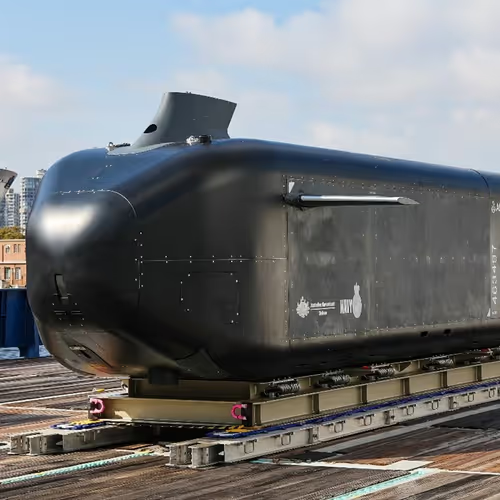
Ghost Shark XL-AUV Payload Bay Seen For First Time
By Thomas Newdick, The WarZone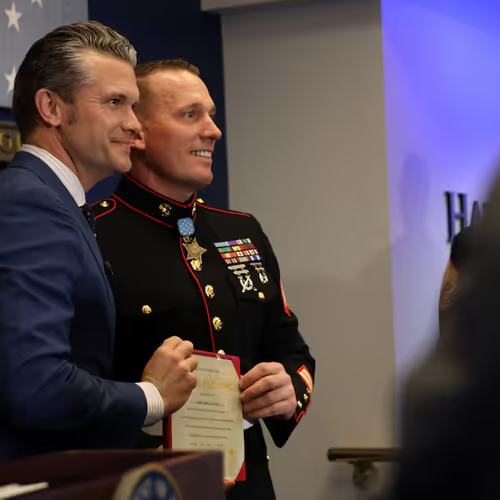
Dakota Meyer Tapped As Barracks Task Force Senior Advisor
By C. Stassis, MC Times