
Drawing the Right Lessons From D-Day
Last updated 05:00 PM EDT • Read time: 15m
This week marked the 75th anniversary of D-Day, rightly commemorated as the largest seaborne invasion and most expansive combined sea-air-land operation in the history of kinetic conflict. Given advancements in the technology of combat and evolving geopolitical developments, it is likely that the magnitude and complexity of this invasion will never be equaled in the annals of human warfare, though it will forever be studied for its lessons in military and naval logistics and strategy.
The memorialization of D-Day has conferred upon June 6th a special place in American history and even pop culture and has generated a veritable cottage industry of books, articles and films. Little wonder then that this week the chattering class hordes from big U.S. media outlets descended upon France, joining the politicians to offer their fevered intonations of what the day was all about – and, more importantly to them, what it means now. Self-anointed experts from Hollywood and the Beltway/Manhattan ruling class such as Joe Scarborough of MSNBC have filed reports all week as to how we should think of D-Day while echoing the pronouncement of historian Stephen Ambrose that D-Day was the climactic battle of World War II.
To be sure, as President Trump pointed out in his Normandy remarks, the sacrifices of the dead and maimed 75 years ago are worthy of a reverent respect, but for anyone willing to do even a modicum of historical study, "climactic battle" is a patently errant descriptor in light of Stalingrad, Kursk, or the destruction of Japanese naval power at Leyte Gulf. To say it differently, had D-Day not even occurred, and instead, the western allies attacked through Italy and the Balkans as the British war leader and prime minister Winston Churchill preferred, the war would still have been won, and perhaps to better advantage for the western allies.
So what, then, are we to make of D-Day? In this solemn week of remembrance for American war-dead and the sacrifices of all involved, it’s past time to move beyond the trite banalities of the likes of Tom Brokaw and Martha MacCallum, and enunciate the real lessons of D-Day, thinking anew about its reverberations for the 21st century. It’s an important event to reflect upon, but not for the reasons expressed by the Beltway elite, as shown below.
The Breadth and Scope of Operations on June 6, 1944
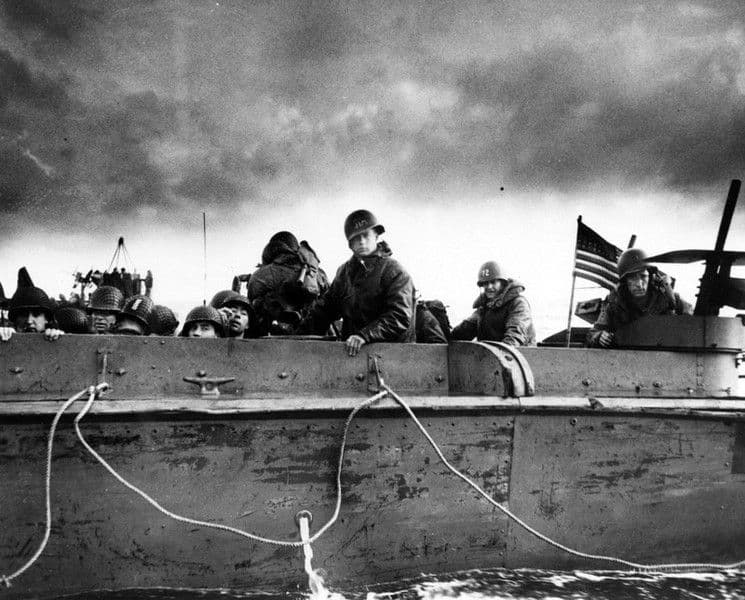
While British and Canadian forces played essential parts in the Normandy landings, and troops from Australia, Belgium, Czechoslovakia, France, Greece, the Netherlands, New Zealand, Norway, and Poland also took part, it was primarily an American-led undertaking in terms of manpower, material, and funding. It was indeed a gargantuan operation: 11,590 allied aircraft flew 14,674 sorties on D-Day, of which 127 planes were lost. The sea-going armada was comprised of 1,213 combat ships, 4,126 landing craft, 736 support ships, and 864 merchant vessels. By the end of June 11 (D+5), 326,547 troops, 54,186 vehicles and 104,428 tons of supplies had come ashore.
Shortly after midnight on June 6, some 2,395 aircraft and 867 gliders delivered two airborne divisions totaling 24,000 paratroops and glider-borne assets, dropping them into points along the targeted battlefront, coordinating where able with French Resistance fighters who worked to incapacitate the phone system, rail lines, and otherwise disrupt the anticipated German counter-attack and advance of reserves. By the end of D-Day, 156,000 allied troops were dug in across a 50-mile front along the French coastline that was not consolidated for a week.
For the allies, it began the more massive Battle of Normandy that entailed some 209,000 casualties in all, with 53,000 killed in action; more than 9,000 Americans are buried at the Normandy American Cemetery and Memorial at Colleville-Sur-Mer. On that first day alone there were approximately 10,000 allied casualties and over 4,400 killed (of which at least 2,500 were Americans), while a flotilla of sixty U.S. Coast Guard cutters, operating farther from American shores than ever before, plucked over 1,400 troops from the sea off of all five landing beaches.
Naval losses were lighter than anticipated but included Norwegian and U.S. Navy destroyers, and one U.S. sub chaser along with several landing craft. While German casualties were fewer than the allies and many aspects of the operation went wrong, thus leading to a delayed breakout (e.g., the strategic hub of Caen, just 15 miles inland due south from the Normandy coastline, was not fully captured until July 19, as opposed to the war-plan aim of the first few days), nonetheless the operation must be considered a success in military terms, as it opened a long-awaited western front that would hasten the doom of the German Reich.
The Correct Lessons of D-Day for Today
Thus the invasion is rightly remembered as the vast and complex undertaking that it was, and one can only salute the dead and wounded, the suffering and sacrifice. But 75 years on, the Hollywood/Beltway thesis, that D-Day marks "the anniversary of when freedom and democracy triumphed over tyranny and repression," must be laid to rest as the empty jingoistic sloganeering and vapid nonsense that it is. A fuller context reveals a more searing truth about D-Day, but one best heeded so as to appropriately honor those who died then: it was an unnecessary battle in what no less than Sir Winston Churchill himself called an "unnecessary war," and it materially aided a brutal decades-long Soviet empire. A largely overlooked, but nonetheless, deep body of scholarship about World War II reveals the following fact-based postulates relating to D-Day in the context of the broader conflict that began in 1939, and in turn, highlights the best way to think about the historic Normandy invasion:
World War II was begotten from the aftermath of World War I, itself an unnecessary war. Historian Jim Powell of the Cato Institute argues convincingly that had Woodrow Wilson not intervened in World War I, Wilson would not, therefore, have engineered some $325 million in aid credits (more than $6.5 billion in today’s terms) to Alexander Kerensky’s Provisional Government in Russia in the spring of 1917. This financial aid combined with help from other western powers was offered with one proviso: Russia must stay in the war against Germany. Wilson did not want the Germans to make peace on their eastern front, and then transfer up to five million troops to face the newly-arriving Americans in Italy, France, and Belgium.
But had the Germans been able to conclude an early peace with Kerensky following the abdication of Czar Nicholas II from the Russian throne on March 15, 1917, they’d have seen no need to allow Vladimir Lenin to travel through German lines to return to Petrograd from Switzerland one month later; indeed the arrival of Lenin would have, from their viewpoint, been counterproductive once peace with Kerensky was assured. Absent Lenin, had Kerensky offered the Russian people immediate cessation of warfare along with his intended liberalizing reforms, the Bolshevik Revolution might not have ensued. No Lenin and the failure of Bolshevism imply no Stalin.
In turn, stronger German forces in the west in 1918, absent American combat power, would have forced British, French and Italian capitulation more on German terms. This implies no onerous Versailles Treaty (that the great British economist John Maynard Keynes predicted would mean another war in 20 years, the most prescient call of his career), and no Versailles implies no collapse of German civil society or hyperinflation in 1923. No destruction of German liberalism in the 1920s, mutatis mutandis, implies no Hitler, no depression in Europe in the 1920s-30s, and hence no spread of Communist movements. And without Hitler and Stalin, any German-Russian conflict, had it happened at all, would likely not have drawn in other powers after 1939, and been far less burdensome to the world. As an aside, had the European powers not been over-run in 1940, their imperial holdings in Southeast Asia could have been better defended, acting as a check on expansionist Japanese designs.
Nonetheless, even given the situation in 1939, had Britain and France not guaranteed Poland, the Second World War would have been dramatically contained. A large swath of research by eminent geopolitical historians and commentators (e.g., Andreas Hillgruber, Burton H. Klein, Viktor Suvorov, J.P. Taylor, and many others) evinces an understanding of causative events in 1935-40 that differs markedly from the "good war" thesis usually ascribed to World War II. Specifically, Hitler regarded the Franco-Soviet Pact of 1935 as aimed directly at him (and indeed, it was). At the same time, he coveted a reunification of German-speaking peoples and territory lost after Versailles including, prominently, the Polish Corridor and the German city of Danzig. In contrast to unproven assertions of the prevailing good-war thesis, there is no evidence that Hitler harbored any designs for conquering western Europe or war with either Britain or France (and certainly not the United States). In Mein Kampf, for example, Hitler states plainly that a two-front war doomed the German Empire in 1914-18, and hence must be avoided at all costs.
Additionally, he considered the English to be of the same racial stock as Germans and believed an alliance combining British naval power with the German Army could collectively keep the peace in the region (especially against Bolshevism). Hitler had less regard for France but like his own General Staff, was wary of the French Army, then the world's largest. And, he had a keen memory of World War I’s stalemate in the west, too.
Instead, Hitler asserted on numerous occasions from 1925 onward that German destinies lay in the east: in Russia. He regarded Soviet Bolshevism as both a cancer and mortal threat to European civilization, and as British historian A.J.P. Taylor argued (and Murray Rothbard agreed), pursued a conventional German foreign policy for the most part. Hence the assertion heard so often this anniversary week, that Hitler was bent on world conquest, and thus the United States had to enter the war to "save humanity", is categorically untrue, and is instead clever sophistry designed to provide an ex post rationale for American abrogation of strict neutrality and entry into yet another European conflict that contained no threat to America’s security.
Britain and France, in guaranteeing Poland in March 1939, instead of assuring they would be drawn into a war with Germany for which, it turns out, neither was prepared. Further, the hypocrisy of the western allies’ foreign policy is seen in the fact that when Stalin invaded Poland two weeks after Germany, the allies were silent. Nor did they object when Stalin absorbed Bessarabia and the Baltic States in 1940 (Churchill did make noises about aiding Finland in the Winter War of late 1939 after Stalin attacked, but the British ultimately did nothing to aid the Finns – who became a German ally against the Soviets in 1941). Had Britain and France remained neutral, it's certain the United States would have, and in turn, the western allies would have benefited from any German-Russian war in which the two tyrannical leaders exhausted themselves while slaughtering each other.
The optimal foreign policy of a great commercial republic is always “Friend of Liberty Everywhere, Guarantor Only of Our Own.” This honorable maxim was enunciated by several Founding Fathers, from George Washington in his Farewell Address to John Quincy Adams in his famous House floor speech on July 4, 1821. The Founders rightly believed that national defense should be purely defensive and that no empire-building or growth of what Eisenhower aptly warned against as a "military-industrial complex" (in his Farewell Address) should ever be countenanced.
Hence the Founders would have counseled against any participation in a far-off war between European powers and would have rightly avoided entry into both the 1917 and 1939 conflicts against Germany. The United States was threatened in neither war, even remotely. In accord with the venerable philosophy of individualism, any American who felt strongly about fighting against Germany (or Japan) could and did volunteer to fight for combatants against each (by enlisting in the armed forces of Britain and China, respectively).
Seen in this light, the D-Day invasion and American campaign across western Europe was not a romantic or heroic adventure in "saving the free world," as unknowing dullards asserted on cable TV this week. Quite the contrary, the American efforts in western Europe during World War II bolstered a morally repugnant Stalinism, and paved the way for 45 years of Soviet brutality and domination of central and eastern Europe, for the enslavement of an additional 200 million people, with Communism’s concomitant misery and poverty (and, as an aside, the American defeat of Japan paved the way for Maoism in China and 35 million murders there).
Indeed thanks directly to American involvement in World War II, by the summer of 1945 the Red Army was established all the way to the gates of Lübeck, in Thuringia, along the Elbe deep in the heart of Europe, at Petsamo, as well as in Manchuria, the Korean Peninsula, and the Kurile Islands. If one were to ask the Poles – the very people for whom Britain and France drew the sword, and thence followed America – whether they see D-Day as a celebration of “liberation of the free world,” the reply won’t be a fawning one toward the United States. Nor would any answers from the Balts, Czechs, Hungarians, Romanians, Slovaks, and millions of others.
In other words, being entirely honest, American entry into World War II materially helped enslave much of Europe rather than liberate it. There was no moral difference between Hitler and Stalin, and indeed the latter was by far the greater at mass murder and tyranny. Similar to World War I, the U.S. entry into World War II had perverse, unintended consequences, and like every American war except the Revolution itself, saw America emerge with less freedom, and poorer as a nation. (But what about Hitler, some ask, in pondering any consequences to the United States avoiding the European war. The short answer is, there were dozens of attempts on his life long before the July 20, 1944 plot, and it’s likely he’d have not long survived in power, having so many enemies.)
In the 1964 anti-war film The Americanization of Emily, James Garner plays an American naval officer who presumably was the first to die on D-Day at Omaha Beach. Prior to the invasion, he famously tells his English love interest (Julie Andrews) that his brother had been killed at Anzio and that we Americans "perpetuate war by exalting its sacrifices." It's an uncomfortable thought, and seemingly unpatriotic at first utterance. However, there's a trenchant honesty in this assertion, and it's been ratified as accurate over time by the endless apologies on behalf of the gigantic and deeply corrupt Military-Industrial-Congressional Complex ["MICC"] inside the Beltway of today.
The U.S. today is responsible for nearly 40% of total global armaments spending and spends more than the next seven countries combined in a perpetual process U.S. Marine Major General Smedley Butler famously called a profiteering racket. Hence this week, the American people are receiving a distorted view of D-Day, with no broader fundamental context supplied, including how utterly unnecessary and even superfluous the whole project was.
This hard and uncomfortable truth in no way detracts from the heroism of American and allied warfighters who fought and died that day, or the integrity of their efforts. It is, however, a condemnation of corrupt politicians who continue to send our men into harm's way on days such as June 6, 1944, and who too often drag their country into needless wars, most always fought on behalf of narrow special interests related to the MICC that have nothing to do with national security or broader national interests. Across American history, this superfluity in kinetic combat has happened again and again, and the American people are told endless falsehoods [1] in the run-up to the war, [2] again during the conflict, and [3] once again after hostilities end (that is, perpetual lying of politicians occurs before, during, and after all conflicts), as to how necessary (and successful!) the war will be, or was. But in spite of the pronouncements of the MICC or career pols inside the Beltway, as per America’s recent decades of war-fighting in Muslim lands that according to Brown University researchers has cost American taxpayers $7 trillion, the U.S. is undeniably less safe, less free, and poorer than before all this war-fighting.
The only way to end this corruption in the future is to come to an honest assessment of past and present, and stop adhering to the manifest falsehoods of our political class, let alone the worthless feel-good ahistorical drivel of babbling fools on cable TV or in Hollywood.
To the Americans who died 75 years ago this week, and to all our honorable armed forces of today, we end by saying, only the dead have seen the end of the war. But may your sacrifices, yesterday's and today's, yet be redeemed in an American empire of liberty toward which we move, unbowed and determined.
Shall we have an invincible national defense? Of course. But, equally so, the pole star of any genuinely American foreign policy must forever be the Champion of Liberty Everywhere, Vindicator Only of Our Own.
John L. Chapman is an economist and investor at Hill & Cutler Co. in Washington.
The Unfinished Reform
By Mark W. Castillon • RealClearDefense
Winning the Data Advantage
By Turin Pollard • RealClearDefense
The Pentagon’s Quantum Race Needs a Warfighter’s Scorecard
By Burak Oktenli • RealClearDefense
The F/A-XX and the AIM-260 Reclaim the Perimeter
By Bruce Allen Lubbering • RealClearDefense
Iranian Cyber Operations
By Michael Groen • RealClearDefense
Winning the Data Advantage
By Turin Pollard • RealClearDefenseThe F/A-XX and the AIM-260 Reclaim the Perimeter
By Bruce Allen Lubbering • RealClearDefenseWinning the Data Advantage
By Turin Pollard, RealClearDefenseThe F/A-XX and the AIM-260 Reclaim the Perimeter
By Bruce Allen Lubbering, RCD
F-22 Pilot Directs CCA in Flight as ‘Airborne QB’
By Stephen Losey, Air & Space Forces