
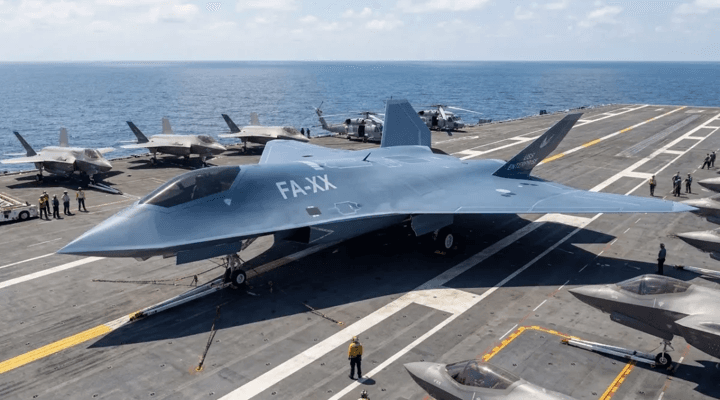
A rendering image of the U.S. Navy F/A-XX fighter program
The F/A-XX and the AIM-260 Reclaim the Perimeter
Last updated 06:29 AM EDT • Read time: 7m
Beginning in the 1960s, the U.S. Navy faced a growing threat from Soviet naval aviation and its developing antiship missile capabilities. Over the following decades, the Soviet Union expanded its ability to launch coordinated attacks against aircraft carriers using long-range bombers and antiship missiles. Aircraft such as the Tu-16 Badger and, later, the Tu-22M Backfire could launch missiles designed to threaten carrier groups.
The Soviet plan was to have bombers approach the fleet, launch their missiles from a distance, and withdraw before U.S. fighters could intercept them. This presented a serious challenge for the U.S. Navy, which needed to defend its carriers against attacks launched from beyond the reach of its existing fighter defenses.
Soviet missiles such as the AS-4 Kitchen were powerful antiship weapons capable of causing substantial damage. The U.S. Navy needed a way to intercept the bombers before they could launch their weapons. The solution matured into what became known as the Outer Air Battle doctrine, which relied heavily on the Grumman F-14 Tomcat. Powered by two engines and equipped with an advanced radar system, the Tomcat could track multiple targets and engage threats at long distances.
The Tomcat's signature long-range weapon was the AIM-54 Phoenix, a missile designed to engage hostile aircraft at distances exceeding 100 miles. Its purpose was to give the Navy an opportunity to intercept threatening bombers before they could launch their own missiles. The Tomcat became a central component of the Navy's fleet-defense strategy, providing an opportunity to disrupt incoming attacks.
The Post-Cold War Shrinking Perimeter
The end of the Cold War brought major changes to the military landscape. With the Soviet Union's collapse, the immediate threat of large-scale Soviet bomber attacks against U.S. carrier groups diminished. The Navy adapted its priorities accordingly. This transition was evident when the F-14 was retired in 2006 and the AIM-54 Phoenix was withdrawn from service with it.
Defending a large area far from the carrier became less central to routine planning, although long-range fleet air defense remained an important mission. The Navy increasingly relied on the Boeing F/A-18E/F Super Hornet, a multirole aircraft capable of performing air-to-air combat, ground attack, and other missions. The Super Hornet offered flexibility and strong precision-strike capabilities.
Over the past two decades, potential adversaries have expanded their ability to prevent U.S. forces from operating freely in contested regions. In the Indo-Pacific, China has developed a layered network of aircraft, missiles, sensors, and maritime surveillance systems designed to threaten U.S. naval forces. Its bombers can carry long-range cruise missiles, while land-based systems continue to pose the threat of long-range attacks against ships.
These systems can threaten carrier groups at considerable distances, but their effectiveness depends on more than missile range alone. Finding, identifying, tracking, and targeting a moving ship requires a functioning surveillance and targeting network. The challenge for the U.S. Navy is therefore not simply to outrange individual weapons, but to operate effectively against an integrated system designed to detect and engage its forces.
Engineering the Next-Generation Solution
The Navy's Next Generation Air Dominance (NGAD) effort centers on the sixth-generation F/A-XX platform, which is intended to address this reach deficit. The program is expected to replace the F/A-18E/F Super Hornet and EA-18G Growler over time. Public descriptions emphasize greater unrefueled combat radius, advanced low-observable capabilities, and network integration, although the aircraft's design and performance remain classified.
On September 29, 2026, the Department of War announced that Boeing had been selected for the F/A-XX full-scale development contract, valued at more than $20 billion.
If the F/A-XX delivers on its intended goals, it could offer a substantial advantage over the Super Hornet in long-distance operations. Greater unrefueled combat radius would allow the aircraft to operate farther from its carrier without relying as heavily on aerial refueling.
The effectiveness of the F/A-XX depends partly on its ability to engage airborne threats at long distances with missiles. That is where the new Lockheed Martin AIM-260 Joint Advanced Tactical Missile comes in. The AIM-260 could be an important part of the F/A-XX's future combat capability. Its specifications are classified, but public reporting indicates that it is intended to exceed the range of the AIM-120 AMRAAM. Estimates of its potential range vary, with some reports suggesting a threshold of 100-120 miles and others speculating about greater distances. These figures remain unverified, and the missile's actual operational range has not been publicly established.
Public reporting also suggests that the AIM-260 may have dimensions broadly comparable to the AIM-120 AMRAAM, although its exact dimensions have not been confirmed. A photograph of a missile identified as the AIM-260 on a Super Hornet is consistent with this assessment. Internal carriage could allow the F/A-XX to combine long-range engagement capability with a low-observable configuration. If the F/A-XX and AIM-260 deliver their intended capabilities, the combination could provide a balance of survivability and long-range air-to-air firepower.
Uncrewed Teaming and Networked Fleet Defense
The F/A-XX is expected to benefit from a more distributed sensor architecture. The manned fighter could act as an airborne command node alongside stealthy uncrewed Collaborative Combat Aircraft (CCAs).
In concept, these autonomous or semi-autonomous aircraft could operate ahead of the manned platform in contested airspace, using sensors such as passive infrared search and track (IRST) systems or low-probability-of-intercept radars to help detect and track targets. Passive infrared systems can detect thermal signatures without actively transmitting radar signals, while low-probability-of-intercept radar techniques seek to reduce the likelihood that an adversary will detect emissions.
In areas with substantial enemy activity, uncrewed aircraft might also carry additional weapons or contribute sensor data to the wider force. This approach could help the Navy balance the need to find and engage targets against the need to limit the exposure of its manned aircraft.
High-Value Node Interdiction
Beyond countering threatening bombers, the F/A-XX and AIM-260 combination could contribute to efforts to disrupt the airborne surveillance and targeting systems that support modern antiship warfare. These include airborne early warning and control (AEW&C) platforms and intelligence, surveillance, and reconnaissance (ISR) aircraft.
For example, China's KJ-500 airborne early warning and control aircraft can detect and track airborne targets and help coordinate China's wider surveillance and air-defense network. Disrupting such aircraft could complicate an adversary's ability to coordinate long-range attacks. Attacking airborne surveillance and targeting platforms could therefore help degrade the effectiveness of an adversary's overall kill chain, even if it could not eliminate the threat entirely.
Reclaiming Fleet Air Dominance
Operationally, the F/A-XX matters for its intended combination of reach, survivability, adaptable mission systems, and integration with future uncrewed combat aircraft, not simply for replacing an older fighter.
The F/A-XX aims to bridge two distinct legacies by retaining the multirole versatility associated with the Super Hornet while reviving aspects of the F-14 Tomcat's long-range fleet-defense mission. By expanding unrefueled combat radius and incorporating low-observable design features, the platform is expected to support strike, tactical air support, and air-to-air combat missions while extending the distance at which the carrier strike group can engage threats.
Armed with AIM-260 JATMs, the F/A-XX is intended to contribute to networked air-defense operations by engaging hostile aircraft, including standoff bombers, at extended ranges. If these capabilities reach their intended goals, they could extend the distance at which the carrier strike group can detect, engage, and disrupt threats. They would not eliminate the risk of attack, but they could improve the Navy's ability to operate against sophisticated adversaries.
Bruce Allen Lubbering held several management positions with aerospace manufacturing companies in a career that lasted over 30 years.
The Unfinished Reform
By Mark W. Castillon • RealClearDefense
Winning the Data Advantage
By Turin Pollard • RealClearDefense
The Pentagon’s Quantum Race Needs a Warfighter’s Scorecard
By Burak Oktenli • RealClearDefense
The F/A-XX and the AIM-260 Reclaim the Perimeter
By Bruce Allen Lubbering • RealClearDefense
Iranian Cyber Operations
By Michael Groen • RealClearDefense
Winning the Data Advantage
By Turin Pollard • RealClearDefenseThe F/A-XX and the AIM-260 Reclaim the Perimeter
By Bruce Allen Lubbering • RealClearDefenseWinning the Data Advantage
By Turin Pollard, RealClearDefenseThe F/A-XX and the AIM-260 Reclaim the Perimeter
By Bruce Allen Lubbering, RCD
F-22 Pilot Directs CCA in Flight as ‘Airborne QB’
By Stephen Losey, Air & Space Forces