
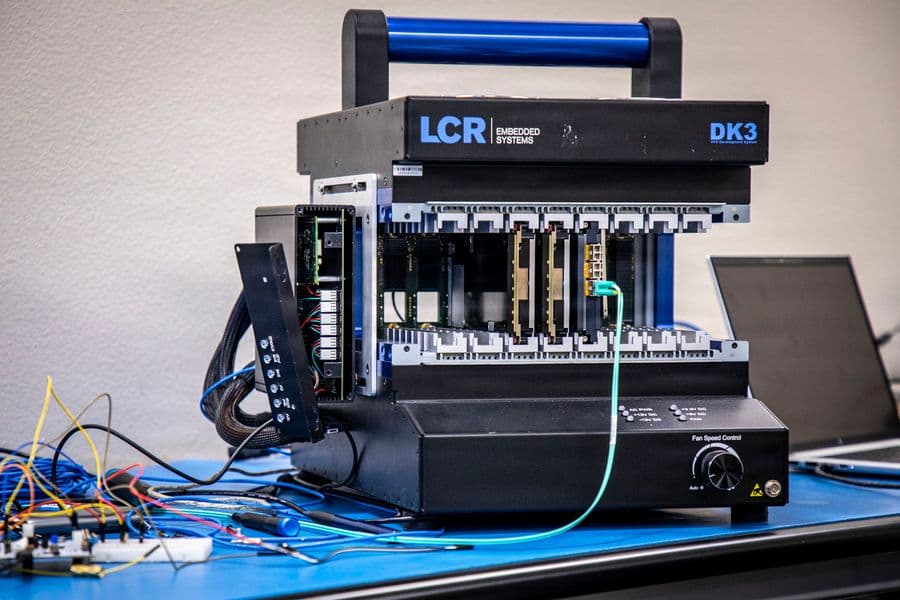
POINT LOMA, Calif. (July 14, 2026) Sensor Open Systems Architecture (SOSA)-compatible hardware is displayed during a dry run at the Joint Tactical Networking Center (JTNC) on Naval Base Point Loma, July 14, 2026. The event brought together government and industry partners to support system integration and interoperability efforts. JTNC serves as the Department of War's technical advisor for intelligent and adaptive radio technologies, conducting technical analysis, mitigating integration risks and resolving interoperability challenges to accelerate capability delivery to the joint warfighter. (U.S. Navy photo by Keypher Strombeck, contractor)
Winning the Data Advantage
The Next Phase of Digital Modernization Must Focus on Warfighting
Last updated 06:29 AM EDT • Read time: 8m
Join the Conversation
0The Department of the Navy has invested billions over the past decade modernizing information technology. Cloud migrations, enterprise contracts, cybersecurity improvements, data integration efforts, and digital transformation initiatives have become hallmarks of modernization. Those investments have laid important groundwork for a more connected, more resilient digital enterprise.
Yet despite that progress, commanders still struggle to obtain timely, authoritative information needed to maintain ships, accelerate shipbuilding, improve logistics, modernize acquisition, and make better operational decisions.
The problem is not a lack of investment.
The problem is that we continue modernizing legacy systems instead of fundamentally modernizing the way the Navy manages data.
That distinction matters.
To be clear, the Department has made meaningful progress. Leaders across the Navy and Marine Corps increasingly recognize that data is a strategic asset, and today's investments have created capabilities that simply did not exist a decade ago. The work being done by government and industry teams across the enterprise deserves recognition.
But those accomplishments should be viewed as the foundation—not the finish line.
The next challenge is no longer simply modernizing technology. It is modernizing the architecture that allows information to move seamlessly across the enterprise. Solving that challenge will determine whether the Navy fully realizes the operational value of the investments already made.
Today's enterprise remains built around dozens of independent systems developed over decades to support individual organizations and paper-based business processes. Rather than eliminating those silos, we have spent years building increasingly complex connections between them. Every interface, translation layer, middleware solution, and custom integration adds cost, increases technical debt, and delays access to the information leaders need to make decisions.
The Navy has made progress modernizing technology, notably through Operation Cattle Drive (which identifies and retires redundant and obsolete IT systems and reinvests savings in what works) and World Class Alignment Metrics, or WAMs, which evaluate IT investment and performance by connecting data to mission outcomes. Yet far too much of our investment – the large majority, in fact – still goes towards preserving yesterday’s architecture instead of empowering tomorrow’s force. That may have been acceptable when information moved at the speed of paperwork.
It is unacceptable in an era defined by artificial intelligence, autonomous systems, and strategic competition with China.
The Navy's competitive advantage will not come simply from buying better AI tools. AI is only as effective as the quality, accessibility, and timeliness of the data behind it. A predictive maintenance model cannot accurately forecast equipment failures if engineering records, maintenance histories, and supply chain information exist in separate environments. A logistics optimization tool cannot recommend the fastest course of action if inventory, transportation, and operational data must first be manually reconciled before analysis can even begin.
This is no longer an information technology problem.
It is a warfighting problem.
Consider three of the Navy's highest priorities: reducing maintenance delays, accelerating shipbuilding, and strengthening the maritime industrial base. Every one of those priorities depends on leaders being able to combine information from engineering, logistics, contracting, financial management, maintenance, and sustainment systems to make informed decisions. When that information resides in disconnected systems, people—not technology—become the integration layer. Analysts reconcile spreadsheets. Program offices build one off interfaces. Highly trained engineers spend their time cleaning data instead of solving operational problems. Decisions that should take hours often take weeks.
The consequences are measurable across the fleet.
When maintenance planners cannot quickly connect engineering data with parts availability, workforce scheduling, and shipyard capacity, repair availabilities become harder to optimize. Small delays quickly compound into larger schedule slips, reducing operational availability and extending maintenance backlogs.
Shipbuilding presents the same challenge. Program managers, shipbuilders, suppliers, contracting officers, and Navy leadership all rely on information generated across multiple organizations. Without a common data architecture, identifying supply chain bottlenecks, production delays, cost drivers, or emerging risks becomes slower and more labor intensive.
Logistics offers another example. Fleet commanders increasingly expect near real time visibility into inventory, transportation, maintenance demand, and operational requirements. Yet if that information must first be reconciled across multiple systems before producing actionable insight, commanders lose one of the very advantages digital modernization is intended to provide: speed.
America is asking the Navy to grow the fleet, restore shipbuilding, reduce maintenance delays, field autonomous systems, and integrate artificial intelligence—all while competing with China and operating under significant fiscal constraints. None of those priorities can be achieved at the required speed if the Department's data remains fragmented.
Future maritime superiority will depend as much on decision advantage as technological advantage. The Navy that turns data into operational decisions faster will create a meaningful edge before the first shot is fired. Data architecture is no longer an enterprise concern. It is combat capability.
The financial costs are equally significant.
Maintaining translation layers between legacy systems costs tens of millions of dollars annually. Cloud hosting, cybersecurity requirements, sustainment contracts, and custom integrations add tens of millions more. Those costs continue because every new capability must be connected to increasingly complex legacy architecture rather than a fundamentally modern enterprise.
The opportunity cost may be even greater.
Highly skilled data engineers are among the Navy's most valuable technical resources. They possess skills that can improve predictive maintenance, optimize logistics, accelerate acquisition, and develop AI enabled decision support for commanders. Instead, too many spend their time maintaining legacy interfaces, correcting inconsistent data, and sustaining outdated systems.
It is the equivalent of assigning some of the Navy's most valuable technical talent to sustain yesterday's systems instead of building tomorrow's capabilities.
We can do better.
Instead of asking how to connect every legacy system, the Department should begin with a more fundamental question:
What information does the Navy actually need to accomplish its mission?
Once that question is answered, authoritative data should be captured once at its point of origin, governed consistently, and made immediately available to every authorized user and application that requires it. Applications should consume trusted enterprise data rather than create, own, and maintain separate versions of the same information.
Achieving this transformation requires the Navy to move its focus to the left of today’s enterprise data lakes; toward the authoritative source and the business process where data is originally created. The objective should not simply be to extract selected data from legacy systems and consolidate it in a large downstream repository while leaving the underlying legacy systems, duplicative data, and fragmented business processes intact.
Instead, the Navy should capture and govern data at its source, establish it as authoritative enterprise information, and make it reusable across systems and organizational boundaries. Business processes and applications can then operate around trusted, shared data rather than forcing information through disconnected organizational and system stovepipes.
This is not simply better information technology.
It is better enterprise design.
It is also a practical approach.
Rather than waiting another decade for an all-encompassing enterprise replacement effort, the Navy can establish a common data model in a focused mission area, demonstrate measurable operational improvements, and rapidly expand that architecture across the enterprise. This approach reduces risk, delivers capability faster, and steadily retires costly legacy systems instead of perpetuating them. Approached correctly, with the right team and tools, this approach delivers results in months, not years.
The payoff extends well beyond the Chief Information Officer's office.
A modern data architecture means a maintenance manager can immediately understand whether the parts, workforce, and funding exist to complete an availability on schedule. It means acquisition leaders can identify supply chain disruptions before they become production delays. It means logistics planners can see enterprise wide inventory and transportation constraints in time to act. It means financial leaders can make investment decisions using authoritative data instead of manually compiled reports. And it means commanders can trust that the information supporting operational decisions is complete, current, and authoritative.
Those improvements enable faster shipbuilding decisions, more efficient maintenance planning, improved logistics, better financial stewardship, and a stronger foundation for artificial intelligence across the Department of the Navy. They also allow scarce technical talent to focus on innovation instead of maintaining legacy systems.
Industry has an equally important role to play.
Government and industry share responsibility for what comes next. Success should no longer be measured by another integration, interface, or sustainment contract. It should be measured by how quickly legacy complexity is reduced, decision making improves, and operational outcomes advance. Industry's greatest contribution will not be preserving old architecture, but helping the Department move beyond it.
None of this diminishes the work already underway across the Department; indeed, it would affirmatively advance the initiatives like Operation Cattle Drive and WAMs that are working. Today's modernization efforts have built an important foundation. The challenge now is ensuring every future investment contributes to a common enterprise architecture instead of adding new layers of complexity. Success should be measured by faster decisions, better readiness, and greater combat effectiveness—not simply by the number of systems modernized.
The Navy has always maintained its advantage by adapting faster than its competitors. In the information age, that means turning data into operational decisions faster than any adversary.
The next era of maritime superiority will belong not only to the Navy with the best ships and weapons, but to the Navy with the greatest data advantage.
That is the next phase of modernization.
It is time to build it.
Turin Pollard is Senior Vice President for the U.S. Navy at Pantheon Data.
The Unfinished Reform
By Mark W. Castillon • RealClearDefense
Winning the Data Advantage
By Turin Pollard • RealClearDefense
The Pentagon’s Quantum Race Needs a Warfighter’s Scorecard
By Burak Oktenli • RealClearDefense
The F/A-XX and the AIM-260 Reclaim the Perimeter
By Bruce Allen Lubbering • RealClearDefense
Iranian Cyber Operations
By Michael Groen • RealClearDefense
Winning the Data Advantage
By Turin Pollard • RealClearDefenseThe F/A-XX and the AIM-260 Reclaim the Perimeter
By Bruce Allen Lubbering • RealClearDefenseWinning the Data Advantage
By Turin Pollard, RealClearDefenseThe F/A-XX and the AIM-260 Reclaim the Perimeter
By Bruce Allen Lubbering, RCD
F-22 Pilot Directs CCA in Flight as ‘Airborne QB’
By Stephen Losey, Air & Space Forces