
The Kent State Shootings and Vietnam Fifty Years Later
Last updated 04:49 PM EDT • Read time: 9m
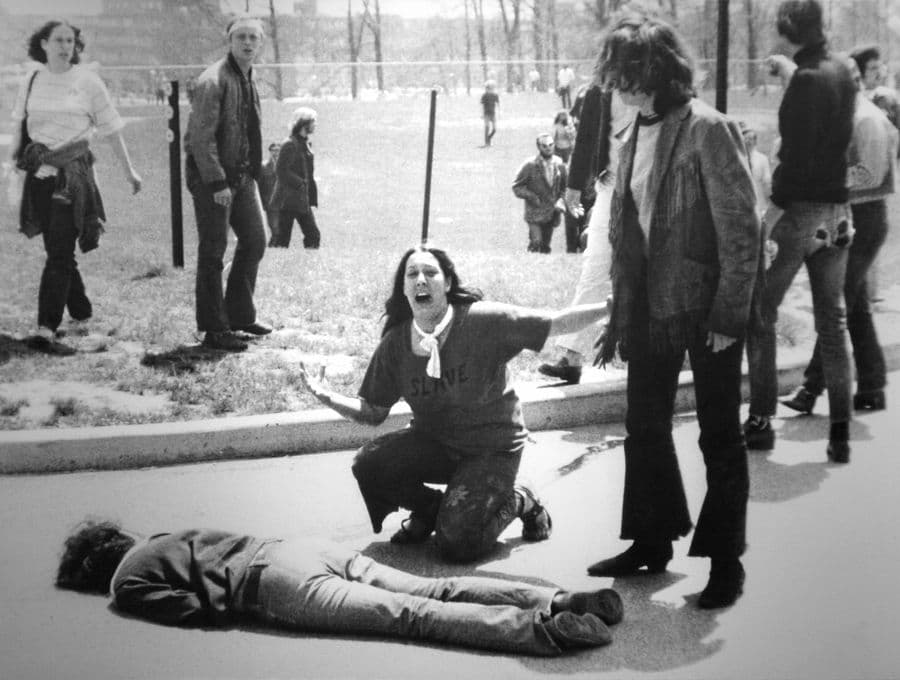
Fifty years ago today, also a Monday in 1970, four students on the campus of Kent State University in Kent, Ohio, were killed while protesting the Vietnam War’s latest escalation, an incursion into Cambodia that President Nixon had announced in a nationwide television address the evening of April 30th. At approximately 12:24 PM that day, some 70 gunshots rang out from Ohio National Guardsmen sent to the campus over the weekend to quell anticipated noontime rioting, killing four and wounding nine more, including one permanently crippled due to a spinal cord rupture.
The killings inflamed public passions that spring, leading to massive rioting in Washington that same week that sent President Nixon to Camp David for two days for his own safety; protests at some 883 colleges and universities in the month of May that included “student strikes” called against the war and involved more than one million students; and two more students killed via police gunfire ten days later at similar anti-war protests at Jackson State University in Jackson, MS. Additionally, President Nixon bizarrely visited the protesters around the Lincoln Memorial at 4 AM on Saturday, May 9th, holding court there in an impromptu give-and-take until dawn with students from Syracuse University, in the main.
What Vice President Agnew himself later that week referred to as the “murder” of these students was the final nail in the coffin of the American war effort in Vietnam, in so far as public support for the war went. A look back at the Kent shootings fifty years on evinces a needless tragedy amidst the wider disaster that was Vietnam, and sadly, offers relevant lessons for 21st century America and our current moment.
Context of the Shootings
In the spring of 1945 and with the end of the war against the Japanese Empire in sight, the Office of Strategic Services [the “OSS”], the forerunner to the Central Intelligence Agency [CIA], sent a team into French Indochina to assess the prospects for the region following the end of the Japanese occupation there. Included in this review were meetings with Ho Chi Minh, the leader of the Viet Minh independence movement, and eventual father of the Democratic Republic of Vietnam. Although nominally a communist intellectual trained in Russia, Ho was also a great admirer of the United States, having been there as a young man seeing the world on the crew of a tramp steamer. So much so, in fact, Ho borrowed from Thomas Jefferson and his Declaration of Independence in publishing a similar pronouncement for Vietnam before the world on September 2, 1945. In those 1945 discussions with the American OSS, Ho promised peace, commerce, and friendship with the United States, asking only for an end to French colonialism and true independence for Vietnam.
Sadly, in what time would prove to be a monstrous strategic error, Washington sided with a return of French colonial ambitions in Indochina, ostensibly as a counterweight to Soviet designs in East Asia. The U.S. taxpayer paid for much of the French war effort against the Viet Minh that ended in the disaster at Dien Bien Phu in 1954, after which the Americans set up a de facto client puppet state in Saigon, alienating Ho Chi Minh for good by the mid-1950s.
Even as President Eisenhower was warning against the growing power of a corrupt Beltway-based Military-Industrial-Congressional Complex in his Farewell Address of January 17, 1961, and soon after General MacArthur famously advised President Kennedy that the United States must never again fight a ground war in Asia, Mr. Kennedy was nonetheless sending thousands of "military advisors" to Vietnam by 1962. After his death, President Johnson escalated the push of American combat power toward Indochina, and the United States was drawn into the war after the Gulf of Tonkin Incident in August 1964.
By the time President Nixon was elected in 1968 with an express promise to end the Vietnam War, some 37,000 Americans had died in Vietnam [and another 21,000 more would, in the following four years]. Galvanizing public opinion against the conflict, Martin Luther King, Jr. had turned radically against the war and spoke in stark terms about the war’s immorality as well as its strategic incoherence. The Tet Offensive in the spring of 1968 had disillusioned many Americans who had been inclined to support the effort in its early years, and then in November of 1969, Seymour Hersh broke the story of the My Lai Massacre, in which U.S. Army soldiers, reconnoitering in Quang Ngai province in south-central Vietnam in a search-and-destroy effort against Viet Cong cadres, murdered some 500 Vietnamese villagers, including women and children as well as elderly. Also, in the draft lottery held on December 1, 1969, the first held since World War II, deferment rules were made more stringent in seeking new manpower born between 1944 and 1951, indicating a desired increase in American combat power: it was the exact opposite signal Nixon had been sending since the 1968 campaign.
Heading into 1970, then, the anti-war protest movement was growing and ever stronger, including on the campus at Kent State. On Thursday night, April 30, 1970, President Nixon publicly confirmed the U.S. incursion into Cambodia in a still-controversial and possibly illegal move done to counter North Vietnamese sanctuaries and supply lines along the Ho Chi Minh Trail. This was the precipitating move for the violence at Kent State over the next several days.
A large protest was held on the campus at Kent State on Friday, May 1, at noontime; breaking up an hour later, an agreement was made among the leaders to meet again at noon on Monday, May 4th, in the same "commons area" central to the campus. Later that night, however, protest marches continued in downtown Kent, adjacent to campus, with some storefronts vandalized and student rowdiness precipitating police intervention. The unrest continued to percolate on Saturday, May 2, and at 5 PM that afternoon, the decision to call in the National Guard was made. Two companies of the Ohio National Guard arrived in town that evening until around 10 PM, by which time a large demonstration was underway on campus, and the Reserve Officers' Training Corps (ROTC) building was burning. Student hooliganism continued in town on May 3, with a curfew being called, and the situation was tense as the mid-day rally commenced on May 4th, involving a student protester crowd of some 2,000 people.
The Shootings
The National Guardsmen, forming a skirmish line, were lined up alongside the campus commons area at the start of the protests, which was surrounded by a dormitory and classroom buildings and then opened into athletic fields. The student protesters grew loud and moved toward the Guardsmen, who fired tear gas canisters and shouted for the protesters to disperse. At 12:24 PM, some of the Guardsmen, many of them quite young themselves, panicked, and shots rang out. In a matter of a few seconds, four students, all either 19 or 20 years of age and later judged to being between 265 and 390 feet away from the Guardsmen, were struck and killed. Nine more students were injured, one being crippled for life. All 13 students were in good standing with the university; one of the four killed was in ROTC, and two of the four were merely walking to class and not even classified as "onlookers."
In the ensuing years there was litigation both at the state and federal level; no Guardsmen or Ohio officials were ever convicted, and a wrongful death lawsuit resulted in being overturned on appeal and remanded to the lower court, whereupon a $675,000 settlement for the victims’ families plus an apology by the defendants [Ohio’s Governor Rhodes and the Ohio National Guard plus Kent State University] was proffered.
While a Gallup Poll in the immediate aftermath of the shootings showed that 58% of the American public supported "law and order" and blamed the students, the war effort itself was further crippled by the palpable and growing contempt for the prosecution of the directionless conflict and its seeming never-ending nature. What the Tet Offensive started, Kent State finished, in terms of an end to any public affirmation of the U.S. Government's strategy in Vietnam.
The Lessons for Today
Sadly, the situation fifty years on is eerily similar in some ways, with only the names of the theatres of conflict on the other side of the world being changed today. America is still involved in unwinnable wars in Asia and is fighting conflicts either directly or by proxy on multiple fronts, with the strategic rationales for the war-fighting long-forgotten, if ever once articulated. The United States is today less safe, less free, and financially worse off and poorer, for fighting these wars in Asia.
In this month of Memorial Day remembrance, we salute our war-fighters in all our armed services, and we continue to seek an invincible national defense. But defense is the operative word here. The sage advice and warnings of Generals Eisenhower and MacArthur, so long ago now uttered to President Kennedy while mindful of decisions he was soon to make regarding an emerging conflict in Vietnam, have never been actuated in American foreign policy, sadly. It’s never too late to do the right thing, however, as we remember the deaths fifty years ago today of Allison B. Krause, Jeffrey Glenn Miller, Sandra Lee Scheuer, and William Knox Schroeder. And, we salute as well Dean R. Kahler, shot in the back, with the wound fracturing his vertebrae and leaving him permanently paralyzed from the chest down.
May a renewed reflection of fundamental American values lead us to a return to the historic foreign policy enunciated by George Washington and John Quincy Adams, among others: Friend of Liberty everywhere, Guarantor only of our Own. Once this truly “small-r” republican foreign policy is taken up again, there will be no more Vietnams, no more Iraqs, no more Afghanistans, no more Syrias, no more Libyas, no more Koreas, and no more Kent States.
Mr. Chapman is an economist and investor in Washington.
The Unfinished Reform
By Mark W. Castillon • RealClearDefense
Winning the Data Advantage
By Turin Pollard • RealClearDefense
The Pentagon’s Quantum Race Needs a Warfighter’s Scorecard
By Burak Oktenli • RealClearDefense
The F/A-XX and the AIM-260 Reclaim the Perimeter
By Bruce Allen Lubbering • RealClearDefense
Iranian Cyber Operations
By Michael Groen • RealClearDefense
Winning the Data Advantage
By Turin Pollard • RealClearDefenseThe F/A-XX and the AIM-260 Reclaim the Perimeter
By Bruce Allen Lubbering • RealClearDefenseWinning the Data Advantage
By Turin Pollard, RealClearDefenseThe F/A-XX and the AIM-260 Reclaim the Perimeter
By Bruce Allen Lubbering, RCD
F-22 Pilot Directs CCA in Flight as ‘Airborne QB’
By Stephen Losey, Air & Space Forces