
The Most Essential Part of the A-10's Story
Last updated 11:41 AM EST • Read time: 12m
By Hal Sundt
Lyons Press, 260 pp, $29.95, 2023
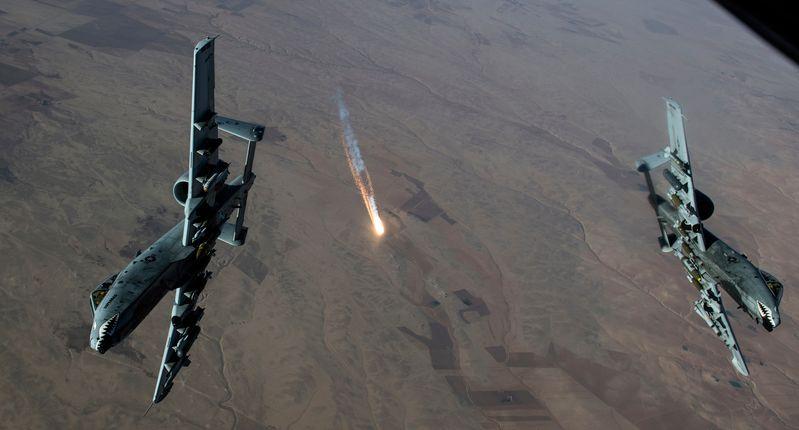
“Warplane: How the Military Reformers Birthed the A-10 Warthog” might disappoint aviation hobbyists looking for an updated technical description of this unique aircraft. The book lacks the endless pages of hardware photos, schematic drawings, and renderings of camouflage and unit paint schemes typical of many books about a single combat aircraft. Instead, the author focuses on the people at the start, middle and end of the “Warthog’s” operational career. In so doing, Hal Sundt reveals what distinguishes an effective and affordable arsenal from the high cost and delicate dilettante-weapons the Air Force hungers after today.
Before discussing the book, a personal disclosure is necessary. I helped the author, whom I came to appreciate as a friend and colleague, by rummaging through my files for some tricky to find documents on the history of the A-10, talked with him several times about my and others’ roles and appear on a few pages of his book. I, however, am a bit of a player in the history he recounts of who made the A-10 what it became.
Most prominent among Sundt’s characters is Pierre Sprey – also a friend and colleague, in my case for about four decades. As “Warplane” makes clear, Pierre was a life force: an individual of immense mental horsepower, brutally unforgiving analysis – always explained with gentility but rigor – and a rare ability to set forth his thinking – and assess others’ – with simplicity and clarity, and sometimes great humor. To know and work with him was as much an honor as it was a pleasure.
Pierre is embedded throughout the existence of the A-10, but his role and analytical power were best on display at the A-10’s creation. A basic concept for Pierre was that the Air Force had failed to keep its promise – made at its own creation in 1947 – to devote significant resources to the close support mission: protecting ground forces actively engaged in combat. The penultimate example of the close air support (CAS) mission is how Lt. Gen. “Pete” Quesada’s P-47 Thunderbolts decimated Wehrmacht forces in World War II on and behind the battleground in Europe within minutes of being requested by the troops themselves. After World War II, the leadership of the Air Force (interested solely to pursue “strategic” bombing -- actually city-bashing -- with atomic weapons) mostly dismantled Quesada’s Tactical Air Command.
When reality imposed itself in 1951 in the Korean War and proved the prognosticators wrong about the nature of the next war, US Army soldiers were provided only intermittent, tardy, and fleeting close support as the Air Force had no aircraft with the characteristics needed to perform the mission effectively, or properly trained pilots. This cost American lives and potential battlefield successes. With a different aircraft, but also some other problems, the Marines fared significantly better. In Vietnam, history repeated itself. The war the experts predicted did not occur, and again the available aircraft were too fast, too fragile, and too transitory, and crew were not given the training they needed. The only aircraft that proved able to meet the physical criteria were obsolete A-1 Skyraiders, originally designed in 1944 as Navy dive/torpedo bombers. Disgusted with the Air Force’s performance and the American lives lost yet again, Pierre set upon intensive empirical research based on World War II, Korean War and Vietnam experience to conceive a new aircraft. He did not ask the so-called experts what seemingly impressive new technical capabilities might be available; he did ask the combat operators what characteristics made the difference between success and failure, especially probing the hard learned lessons of the troops on the ground. Pricey and dogmatic theoretical studies and contractor-driven proposals had no role; they literally were the antagonist.
Presenting a non-linear synthesis of Pierre’s work process, Sundt’s “Warplane” brings the reader an understanding of a reformist weapon acquisition approach that is the antithesis of contemporary Air Force design, engineering, and production corporatism. To divide the two approaches into “low tech” and “high tech” is to fundamentally -- and purposefully -- misconstrue the difference.
Among the book’s many impressive characters are two other individuals. Col. Avery Kay was a B-17 navigator over Europe in World War II who personally witnessed the failure of the strategic bombing theorists to achieve the war’s end solely, or even primarily, through the selection of critical precision targets. He fundamentally appreciated that more battlefield failures and higher US casualties were the cost of the Air Force’s continuing disregard of its promise to sustain the close support mission. Sacrificing his own career, he maneuvered in the bureaucracy to convince the Chief of Staff of the Air Force to start a program to design an effective close support aircraft. Not long thereafter, he met Pierre through a memo Sprey had written advocating far more lethal fighter aircraft than those the Air Force had misappropriated at great cost and, naturally, the creation of a lethal ground attack aircraft to decimate Soviet ground forces. The two worked together, with others, to identify from the lessons of war the characteristics that effective close support aircraft must have. These features went beyond just the physical properties of individual aircraft but included the simplicity of design to make it reliable and always available on the battlefield and cheap enough to be bought in substantial numbers. Those requirements underlay the technical specifications that contractors had to respond to in order to win a mandated prototype fly-off competition, rigorously scrutinized by the protagonists to make sure the Pentagon did not wander into a favored contractor rather than the most effective design.
In a commendable example of his insight and research, Sundt devotes a chapter to the career of Robert “Muck” Brown, who had a seemingly modest demeanor upon meeting but also undiluted skill and determination as an A-10 pilot and instructor -- and driver of highly relevant 21st century technical improvements for the aircraft. Muck’s too short life story epitomizes the A-10 community and its admirable values, skill levels and professional dedication. It is precisely these people who the Air Force is all too eager to unburden itself of. It is not just the retirement of the aircraft it wants but also the disbandment of the human community, up to and including the virtual end of dedicated close support training.
Indeed, the book exposes the distaste for the A-10 at the top of the Air Force: Its supposedly “low tech” nature, being only a Cold War -- or alternatively a low intensity combat – weapon, and, most importantly, it can’t survive above 21st century battlefields. The Air Force has infused Congress with these shibboleths, and now with Members eager to lock in Air Force offers to base other aircraft in their districts as soon as the A-10 can be retired, the House and Senate are on the verge of legally mandating the end of the A-10.
That the aircraft is simple, especially compared to what the Air Force calls the F-35 “joint strike fighter,” leads advocates of complexity in design to reframe the debate as “low” versus “high” technology, implying their version of “high” (meaning complexity) is infinitely batter. Never mind that the A-10’s design is well conformed to its purpose and that various characteristics built into the F-35 make it ineffective, unavailable, and less survivable in the close support role.
Not suited for modern warfare? In warfare fought by the United States in this century, the A-10 has probably been more relevant than any other aircraft. Today, the prognosticators presume for the future a much different conflict where the enemy operates a fully equipped modern army and has an air force and sophisticated air defense systems to wipe, they claim, the A-10 from the skies. That form of warfare is now occurring in Ukraine. That the A-10 could perform a major role by destroying armor and other enemy assets is manifest. The big question is would it survive?
In a sense, the Air Force has answered the question: it recently deployed the A-10 to Jordan fully equipped in case Israel’s carnage in Gaza explodes the region into a wider war – one that involves the sophisticated air defenses and fighters Russia has deployed in Syria and other modern air defenses Iran has available in the region. Therein the Air Force has made explicit its selection of the A-10 as relevant to the kind of warfare it simultaneously says rules out A-10 employment. Further, the Project On Government Oversight has released a DOD report that -- despite heavy redactions – seems to imply that in the face of the air defense threats used in the tests, the A-10 was more survivable than the Air Force would have you believe – and that it was measurably more effective than the F-35 in various ground attack roles. What sparse language the Pentagon allowed to be released also suggests that in the face of the most sophisticated air defenses (“high threat” systems not present in the tests), the A-10 would benefit from the suppression of those enemy air defenses by the F-35 – one of the F-35’s intended roles and one it may be able to perform on those sparse occasions when it can get itself into the air for combat.
Finally, what is the survivability record of the A-10 in actual warfare, especially in the presence of high-end air defenses such as those over Iraq and Serbia in the 1990’s? There the Air Force prognostications were that the A-10 would not survive. We’ve been to this dance before.
The original Air Force plan to throw Saddam Hussain out of Kuwait in 1991 did not include the A-10: strategic bombing would do it all and, besides, the A-10 could not survive the then-modern French and Soviet air defenses in Iraq and Kuwait. The overall commander, Army General Norman Schwarzkopf, canned that plan and insisted that A-10s be deployed; 144 were.
The A-10s proved so effective, not just against armor but also against a whole range of targets that Air Force General Charles Horner, among those who opposed the A-10s’ being deployed, stated after seeing the results, "I take back all the bad things I've ever said about the A-10s. I love them. They're saving our asses."
The A-10 story in that war would benefit from some data. After the war, its detractors pointed out that 6 were shot down and 14 Damaged. Meanwhile none of the “high tech” stealth F-117 bombers were either shot down or damaged. Case closed?
During that war, the “stealthy” F-117 was the much praised “silver bullet,” the star of the war according to the Air Force and the media. The data shows the F-117 flew 1,788 individual attacks on targets (“strikes”). The data for A-10 strikes was not available. Those data were corrupted according to the Air Force’s commissioned study on the war, “The Gulf War Air Power Survey” (GWAPS). Only sorties, which might contain multiple attacks (strikes) on multiple targets, were counted. In its analysis of the war GAO suspected that the A-10 strike count was far larger than the 8,640 sorties in the GWAPS data base, but GAO did not have the resources to untangle the mess to produce the actual number. Thus, GAO compared the F-117 survival rate of no kills or damaged aircraft in 1,788 strikes to 20 A-10 casualties in 8,640 sorties. The F-117’s 0.0 hit rate compared to 0.0023 A-10s hit or killed per sortie.
GAO further calculated the overall survival rate of all US aircraft in the war. The probability of any aircraft being hit in the grand total 37,243 strikes/sorties flown by all aircraft was 0.0017. GAO further calculated that were any other aircraft (all non-stealthy) to perform the F-117’s relatively low number of 1,788 strikes, the most likely outcome was 0 hits. The survival rates of the F-117 and other aircraft were statistically indistinguishable, GAO said.
There is a caveat. An analysis of the A-10’s most likely Desert Storm strike count has become available. Rather than untangling the corrupted Air Force data, a probable range of strikes performed was calculated by an authoritative source by using the available data on the type and number of munitions (bombs, missiles, and gun rounds) the A-10 fleet expended in Desert Storm. Based on knowledge of A-10 tactics and using the probable number of munitions expended on an individual strike against a target, a range of Desert Storm A-10 strikes can be calculated. Based on this analysis between 13,467 and 20,835 A-10 target attacks (strikes) occur, making its actual survival rate from 0.00148 to 0.00096. Lower than most US aircraft flown in Desert Storm.
Subsequent data from the Kosovo Air War in 1999 sheds additional light. There, in the presence of Soviet era air defenses operated by Serbs, one A-10 was damaged, and none were shot down. One F-117 was shot down and another was significantly damaged both by radar directed SAMs. While sortie or strike counts for the Kosovo Air War do not appear to be available and comparative survival rates cannot be calculated, the raw numbers are interesting.
Unless some event or people intervene, the Air Force plan to retire the A-10 will be complete in 2028. However, the Air Force will not rid itself of the kind of rigorous analysis and ethical reporting from the likes of Pierre Sprey, Avery Kay, and Muck Brown. Retired Marine Dan Grazier has been researching and writing for the Project On Government Oversight for a decade. Others have also done the same. Grazier routinely produces the kind of work that Pierre praised when he was alive and would now also. The F-35, the A-10, China threat mongering and various failed and overpriced DOD programs are regular targets in his thorough data-based analyses. Because of the continued presence of people like Grazier no one should consider the legacy of the A-10 and its human community to remain on the Air Force’s intended deathbed. The story will not be over.
Winslow T. Wheeler worked on national security issues for over 30 years for Republican and Democratic US Senators and the Government Accountability Office. Subsequently, he directed military reform projects at the Center for Defense Information in Washington DC. He is now retired – mostly.
Don’t Be Swayed by Tactical Nukes
By Benjamin Giltner • RealClearDefense
How Seoul’s Break With Kyiv Serves Trump’s Russia Turn
By Sang Won Pyo • RealClearDefense
When the Grid Goes Down, the Mission Must Go On. Solar and Storage Can Help.
By John Szoka • RealClearDefense
Data and Communications Technology are the Hidden Keys to Success for Golden Dome
By Eric Velte • RealClearDefense
The Dual Threat: Why Beijing’s Collapse Is Just As Dangerous as Its Rise
By Efraín Vázquez-Vera • RealClearDefense
USS Stout Loses Power During Port Visit Due to ‘Engineering Casualty’
By USNI News
Air Force Lessons Learned From Operation Epic Fury
By Tabitha Reeves, National Defense
Marines Need Nine More Amphibious Warships To Carry Out Its Missions
By TWZ
AFRL, ACC Fly XQ-67A Drone To Test Autonomous Teaming
By Airforce Technology
F-35B Releases Meteor BVRAAM for the First Time
By Parth Satam, The Aviationist