
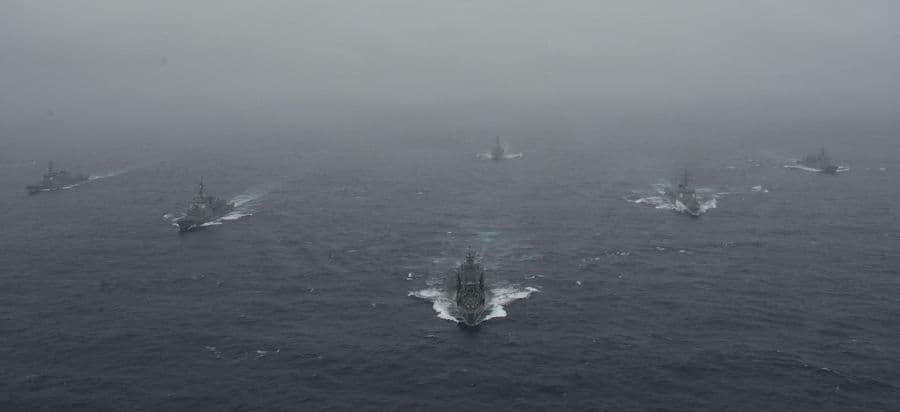
Republic of Korea Navy (ROKN), Japan Maritime Self Defense Force (JMSDF), U.S. Navy sail in formation during a maritime maneuvering exercise in the Western Pacific Ocean, Sept. 10, 2026, in support of Freedom Edge 26. Trilateral exercises and operations like Freedom Edge demonstrate our continued partnership and the growth of our trilateral cooperation to ensure peace and stability across the Indo-Pacific. (Courtesy Photo by Petty Officer 2nd Class Goto Tamon, Japan Maritime Self Defense Force)
The Dual Threat: Why Beijing’s Collapse Is Just As Dangerous as Its Rise
Last updated 06:22 AM EST • Read time: 5m
For years, Washington’s strategic debate on China has swung between two contrasting fears: an unstoppable colossus destined to rewrite the global order, and the hope that its economic headwinds will simply stall its momentum. But as analysts begin to introduce the possibility of a sudden and severe structural fracture within Beijing, this binary view misses a far more dangerous reality. Western policymakers are not facing a single trajectory. Instead, they must prepare for a dual threat, the danger of a sudden, desperate collapse on one end, and the consolidation of an illiberal hegemony on the other.
When looking at the world, Western democracies tend to project the stability and equilibrium of their own liberal systems onto others, assuming that foreign powers operate under similar rules. We often forget that China is an autocracy, and autocracies are unstable by definition and prone to sudden surprises. Western leaders know this history very well, yet they repeatedly choose to forget it. China’s system is not a model for anyone.
The myth of China's organic economic miracle crumbles when looking at the recent timeline. Back in the 1990s, China was not an economic superpower. Its dramatic rise only took off after its entry into the World Trade Organization (WTO) in 2001. That milestone proves that China’s explosive growth was not born from purely organic domestic conditions, but rather from external opportunities gifted when liberal democracies allowed its integration into global trade. Consequently, China's economic might is relatively recent, and it is now severely threatened by the crushing costs of its multipolar ambitions. It is deeply regrettable that instead of using this new wealth to lift up its own people, Beijing chose to scatter money globally driven purely by geopolitical vanity. Today, that economic pressure is real and measurable. According to World Bank and IMF data, China’s growth has slowed structurally, crushed by a lingering property crisis, staggering local government debt, and a youth unemployment rate where nearly one in five young workers cannot find stable jobs.
In grand strategy, autocracies present a unique danger. Unlike mature democracies with institutional safety valves and peaceful political transitions, single-party states operate like high-pressure boilers. They maintain power through a simple bargain: citizen compliance traded for economic growth. But sustaining global ambitions, from underwriting the Belt and Road Initiative to deploying checkbook diplomacy and stadium diplomacy, carries a massive fiscal price tag.
Historically, superpowers do not fall solely due to military pressure or direct competition. The Soviet Union collapsed because it could no longer sustain the staggering financial burden of its global ambitions while its domestic economy hollowed out.
For Beijing, entering this phase of economic strain introduces a dangerous variable: the cornered autocrat. A regime facing internal decay and declining legitimacy does not gently reform. Pressed to the wall, it risks becoming erratic and desperate. Any potential military adventure or escalation, such as a sudden crisis in the Taiwan Strait, would not be triggered by an external military threat against China, but rather by Beijing’s own overreach: its desperate attempt to play a global multipolar game while lacking the sustainable economic and internal capacity to do so. In short, manufactured crises and external escalations become the tools of choice for a struggling dictatorship seeking to spark nationalist fervor and mask its own decline.
Yet the reverse scenario is equally concerning. Even if Beijing somehow manages to survive its deep financial hurdles and successfully completes its logistical encirclement, securing critical supply chains from the Western Pacific through the Global South while simultaneously forging a formidable military apparatus, the result is an entrenched revisionist hegemony.
This dual threat means that democracies can neither rely on passive containment nor assume an inevitable, peaceful implosion. Waiting out a superpower is neither a strategic nor a wise policy. Crucially, in today's multipolar context, the United States must finally leave behind its traditional bipolar and unipolar mindset. Washington must understand that to face the Chinese challenge, it cannot act alone. Moreover, whenever policymakers and the public hear the phrase “Chinese threat,” they immediately picture a conventional military invasion or a direct strike. While that remains a theoretical risk, it is not the primary danger. The most probable and disruptive threat is a sudden, destabilizing collapse from within.
To hedge against both extremes, democracies must stop treating security as a static exercise confined to the Western Pacific. True deterrence requires building systemic resilience across vulnerable regions, like Latin America. This is why empowering agile, values-based partners like Japan is so critical. Through its Free and Open Indo-Pacific (FOIP) vision, a diplomatic and economic framework that champions the rule of law, sustainable infrastructure, and maritime security without trapping developing nations in debt, Tokyo offers a genuine, high-quality alternative to financial dependency. Whether Beijing stumbles into internal fracture or succeeds in projecting its model outward, a tightly networked coalition of resilient democracies is the best insurance policy for the twenty-first century.
Efraín Vázquez-Vera, Ph.D. is full professor of International Relations and former Chancellor at the University of Puerto Rico.
The Dual Threat: Why Beijing’s Collapse Is Just As Dangerous as Its Rise
By Efraín Vázquez-Vera • RealClearDefense
Optimizing Trump’s Strategy to ‘Rot Iran’s Economy’
By Brian G. Chow • RealClearDefense
The AI Scare Is the New Y2K: A Veteran’s Perspective on Hype, Risk, and the Discipline Needed to Modernize Safely
By Kenneth Smith • RealClearDefense
The Pentagon’s AI Rush Needs Adult Supervision
By Michael Aaron Cody • RealClearDefense
ICE Is Not a Four-Letter Word
By Meda Parameswara Reddy • RealClearDefense

Marine Died of Injuries Suffered During Fast-Rope Training on Okinawa
By Brian McElhiney, Stars and Stripes
Drones Built To Look Like Birds Evaded Detection at Air Force Tech Exercise
By T&P
Navy Unfairly Evaluated Saildrone Musv Proposal, Court Finds
By D. Stancy, BrDefense
HII and Thales Demonstrate UUV with End-to-End Autonomous MCM
By Naval News
General Atomics Joins Army-Navy Hypersonic Glide Body Production
By Defence Blog