
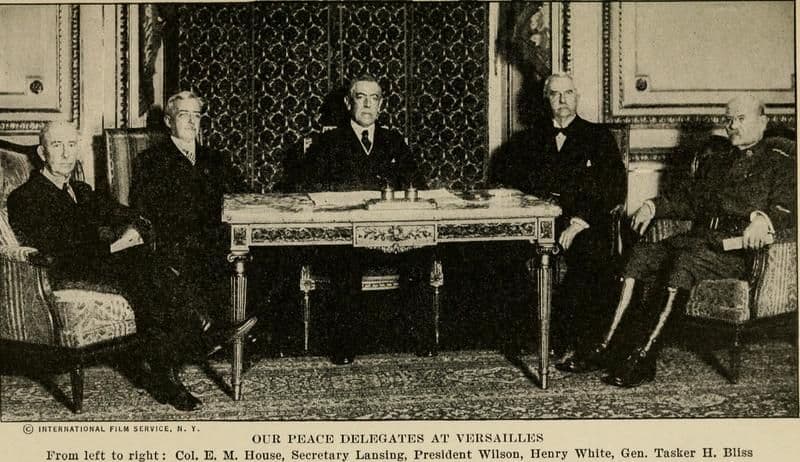
The Right Lessons from Versailles 100 Years Later
Last updated 05:00 PM EDT • Read time: 10m
One hundred years today, in the early afternoon of Saturday, June 28, 1919, the Great War, as it was then called – later known as the First World War – came to a ceremonious end in the historic Hall of Mirrors at Versailles Palace, outside of Paris. Precisely five years to the day beyond the assassination of the Austrian archduke in Sarajevo that had lit the match to the global disaster, and before more than 1000 onlookers, two seniors officials in the German Foreign Ministry, Johannes Bell and Hermann Müller, signed first, followed by the victorious Americans, British, French, Italians, and Japanese, in that order.
Herren Müller and Bell, described later by Sir Harold Nicolson, a member of the British delegation to the Versailles conference, as looking like death, left immediately afterward for Germany. But to the victors went the spoils: wild demonstrations commenced in Paris and London as soon as the Treaty was signed.
It was a victor’s peace, too: the vaunted German army (Deutsches Heer) was defenestrated and limited, most of the surface fleet of the Imperial German Navy (Kaiserliche Marine) lay at the bottom of Scapa Flow, having been scuttled the week before Versailles, and its U-Boat fleet surrendered to the Allies. Territorial losses, reparations, and eventually occupation of the Ruhr by the hated French and Belgians lay ahead, along with economic depression and radicalization of German politics.
The peace treaty following the “war to end all wars” was initially thought to be ushering in a never-ending era of peace and international brotherhood, but not all observers thought so: the German Crown Prince Wilhelm, who had fought against Marshal Petain at Verdun and was now exiled in Holland, blasted the victors’ exclusion of the surrendered governments during the Paris discussions begun that January: the very morning of the signing, he flatly predicted in an interview that a new European war was a certainty ten years hence. Meanwhile, John Maynard Keynes, the great British economist who attended the conference as a representative of the British Treasury, was disgusted with the harsh terms meted out by the western allies and resigned his post in late May. Returning to Britain, he wrote The Economic Consequences of the Peace that summer, flatly predicting another war with Germany in twenty years.
A review of why the Versailles Treaty fell apart offers insight into what followed across the 20th century, and valuable lessons for U.S. foreign policy today, not least while juxtaposed with a current real threat of war in the Persian Gulf.
America in World War I and Wilson’s Fourteen Points
The root causes of World War I and the proper apportioning of culpability of the respective great powers in their various alliances are hot topics of debate more than a century later. Space precludes our review of that important body of research until another occasion, but the critical point to evince here is that the United States, with excellent commercial and diplomatic relations on all sides of the conflict, had no need of ever entering World War I. Nor was there any public clamoring for it, although some writers have suggested that given the plurality of German-Americans, that there was initially more of an affinity for the Central Powers than for the western allies and Russia, whom many regarded as imperialists and little different from the Germans and Habsburgs.
In any case, President Wilson properly adopted a stance of neutrality at the outset of hostilities. While there were some occasional problems with Americans in war zones and intergovernmental dealings with combatants, most prominently the sinking of the armed merchant cruiser Lusitania on May 7, 1915, killing 128 American passengers, the American elections of November 1916 passed with Wilson's re-election bolstered by his slogan "He Kept Us Out of War" and his commitment to maintaining strict neutrality.
But as events transpired, Wilson had, certainly by the sinking of the Lusitania, been slipping away from his non-interventionist Secretary of State, William Jennings Bryan, who feared disaster for the Americans if they entered the war. Hence Bryan was eventually to resign in disagreement with Wilson over the American march toward entry based on a tilt toward the Western allies. Wilson obtained a declaration of war on April 2, 1917, though a lengthy mobilization meant most of the American fighting would take place later into 1918.
Ultimately, Bryan was proven correct: the United States had no reason to join in the war, and strict neutrality could have been maintained. Two reasons motivated Wilson in the end, that in hindsight one must regard as corrupt: [1] New York banks such as, prominently, J.P. Morgan and Goldman Sachs, as well as commercial interests such as DuPont de Nemours prevailed in pushing Wilson to support the Western allies, who were far more indebted to American industrial and financial creditors and suppliers than was Germany (by an astonishing factor of 83X in bank loans alone). The Americans wanted their money back, which might not be collected if the Central Powers were to win the war.
[2] Secondly, Woodrow Wilson had the usual enormous presidential ego, and saw an opportunity to enter history as one of the greatest men to ever live, if he was seen to be the architect of a permanent post-war peace in the form of his Fourteen Points, first enunciated in formal detail on January 8, 1918, partly in response to Lenin’s speech in Petrograd in late December. Wilson believed the Americans had to enter the war to have a place at the post-war peace conference, wherein he could presumably dominate the proceedings in implementing his program.
Why Versailles Fell Apart
The Fourteen Points were an idealistic compilation of progressive, liberal precepts applied to international diplomacy, including planks promising free trade, open agreements, democracy, and self-determination. By early October 1918, as the German war effort and economy deteriorated, feelers were placed with Britain and France about an armistice based on Wilson's program, which entailed magnanimous treatment of the vanquished powers.
The Germans agreed to surrender on November 9th, effective at 11 AM Central European Time on the 11th, with the assurance that Wilson’s paradigm would govern the post-war negotiations.
But when the Big Four powers (the United States, Britain, France, and Italy) gathered in Paris two months hence to design the terms of the surrender and aftermath, Germany and Austria-Hungary were uninvited.
Keynes was to write in his book later that year that this was a gross injustice, and a stain on the honor of the victors: in short, the Germans expected to be a full party to negotiations surrounding the Fourteen Points, and neither in fact, happened. In the end, the Germans were dictated to. Keynes' most damning criticism of the Treaty was that it ignored the question of economic stability in Europe:
The Treaty includes no provisions for the economic rehabilitation of Europe,– nothing to make the defeated Central Powers into good neighbors, nothing to stabilize the new states of Europe, nothing to reclaim Russia; nor does it promote in any way a compact of solidarity amongst the Allies themselves; no arrangement was reached at Paris for restoring the disordered finances of France and Italy, or to adjust the systems of the Old World and the New.
Further, he especially blasted the French premier Clemenceau for his evident lustful desire to crush the economic life of Germany, while he charged the egos of British Prime Minister Lloyd George and President Wilson with preventing common sense from reigning to the demands on Germany. Keynes presciently predicted both ruinous inflation in Germany and economic stagnation in postwar Europe, as well as another war 20 years later.
In the end, Germany lost its empire, army, navy, and suffered the disintegration of a cultured civil society that had long anchored central Europe. The Germans were required to pay $33 billion in reparations ($489 billion in today’s terms), an astronomical sum that, as Keynes predicted, bred suffering, economic depression, and resentment, paving the way for radical politics. War debts were canceled in 1933, but by then it was too late to stop events in Germany from taking their awful course.
The Lessons of World War I and Versailles
World War I was a colossal disaster that killed more than 17 million people (including 116,000 Americans) and engendered 37 million civilian and combatant casualties, as well as ruined a wide swath of Europe for decades. There are two primordial lessons for the American people today, charged as they are withholding the Beltway ruling class and its foreign policy accountable.
First and most importantly, the ego and self-aggrandizing behavior of Woodrow Wilson dragged the United States into World War I for corrupt reasons, including for the benefit of American commercial and financial interests that President Eisenhower was later to label a Military-Industrial-Congressional Complex of duplicitous special interests.
Had Wilson listened to William Jennings Bryan and stayed out of the war, including even in so far as financial lending to belligerents, a whole series of malign events might not have ensued, and the world may well have been materially different across the 20th century.
Historian Jim Powell of the Cato Institute argues convincingly that had Wilson not intervened in World War I, he would not, therefore, have engineered some $325 million in aid credits (more than $6.5 billion in today’s terms) to Alexander Kerensky’s Provisional Government in Russia in the spring of 1917. This financial aid combined with help from other western powers was offered with one proviso: Russia must stay in the war against Germany. Wilson did not want the Germans to make peace on their eastern front, and then transfer up to five million troops to face the newly-arriving Americans in Italy, France, and Belgium.
But had the Germans been able to conclude an early peace with Kerensky following the abdication of Czar Nicholas II from the Russian throne on March 15, 1917, they’d have seen no need to allow Vladimir Lenin to travel through German lines to return to Petrograd from Switzerland one month later; indeed the arrival of Lenin would have, from their viewpoint, been counterproductive once peace with Kerensky was assured. Absent Lenin, had Kerensky offered the Russian people immediate cessation of warfare along with his intended liberalizing reforms, the Bolshevik Revolution might not have ensued. No Lenin and the failure of Bolshevism imply no Stalin.
In turn, stronger German forces in the west in 1918, absent American combat power, would have forced British, French and Italian capitulation more on German terms. This implies no onerous Versailles Treaty. No Versailles implies no collapse of German civil society and hyperinflation in 1923. No destruction of German liberalism in the 1920s, mutatis mutandis, implies no Hitler, no depression in Europe in the 1920s-30s, and hence no spread of Communist movements. And without Hitler and Stalin, a German-Russian conflict may never have happened at all, or at least would not have drawn in other powers after 1939 and been far less burdensome to the world.
The second lesson from Versailles harkens back to Keynes' prescient warnings: magnanimity, goodwill, and respect can ensure a sustainable peace after a war, whereas dominance and humiliation sow the seeds of economic strife and future conflict.
All Americans salute our warfighters, and all agree we should have an invincible national defense. But as applied in the current moment, let us heed the lessons of Versailles, and World War I. Iran is a poor but proud country, whose people are proto-Western and anxious for economic revival. They have attacked no foreign entity since invading India in 1738 to subdue the Mughal Empire, and represent no threat to us now or in the future. We can have peace, commerce, and friendship with Iran, immediately, and end any chance of hostilities.
As President Eisenhower would recommend, let us, therefore, reject the call of warmongers and special interests. One hundred years beyond Versailles, its tattered remains at least offer the promise of redemption, but only in the foreign policy of a great commercial republic: a friend of liberty everywhere; champion only of our own.
Mr. Chapman is an economist and investor at Hill & Cutler Co. in Washington.
The Unfinished Reform
By Mark W. Castillon • RealClearDefense
Winning the Data Advantage
By Turin Pollard • RealClearDefense
The Pentagon’s Quantum Race Needs a Warfighter’s Scorecard
By Burak Oktenli • RealClearDefense
The F/A-XX and the AIM-260 Reclaim the Perimeter
By Bruce Allen Lubbering • RealClearDefense
Iranian Cyber Operations
By Michael Groen • RealClearDefense
Winning the Data Advantage
By Turin Pollard • RealClearDefenseThe F/A-XX and the AIM-260 Reclaim the Perimeter
By Bruce Allen Lubbering • RealClearDefenseWinning the Data Advantage
By Turin Pollard, RealClearDefenseThe F/A-XX and the AIM-260 Reclaim the Perimeter
By Bruce Allen Lubbering, RCD
F-22 Pilot Directs CCA in Flight as ‘Airborne QB’
By Stephen Losey, Air & Space Forces